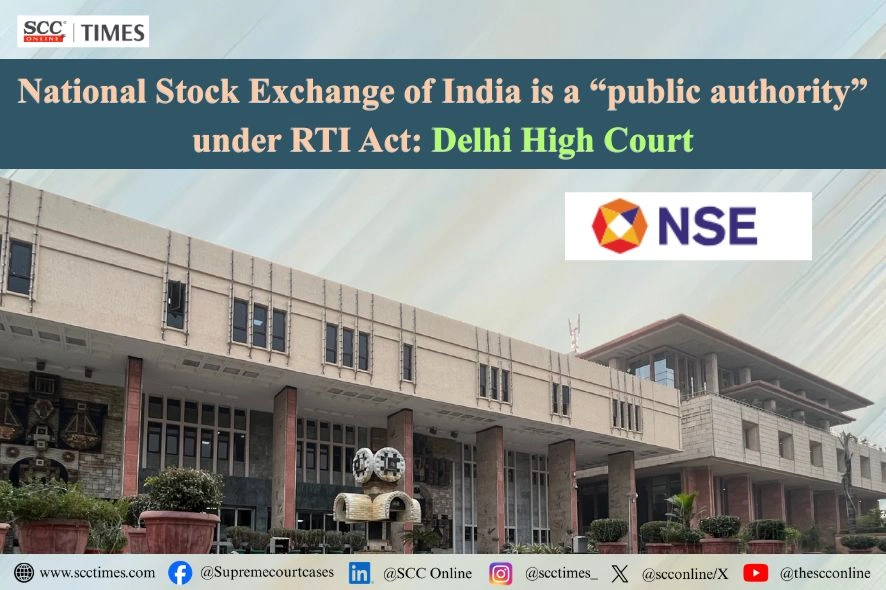
Delhi High Court: While deciding pure question of law arising an appeal, whether the National Stock Exchange of India (NSEI) is a “public authority” within the meaning of Section 2(h) of the Right to Information Act, 2005 (RTI Act), the Division bench of C. Hari Shankar* and Om Prakash Shukla, JJ., upheld the Single Judge’s judgment, holding that NSEI is amenable to the RTI Act.
Statutory Provision under Consideration
Section 2(h) of the RTI Act defines a “public authority” as an authority, body, or institution of self-government established or constituted by or under the Constitution, by a law made by Parliament or a State Legislature, or by a notification or order of the appropriate Government. The provision also includes a body that is owned, controlled, or substantially financed, directly or indirectly, by funds provided by the appropriate Government, as well as a non-governmental organisation substantially financed in that manner.
The first part concerns the manner in which an authority, body, or institution is established or constituted. The inclusive part brings within the RTI regime bodies that are owned, controlled, or substantially financed by the Government. The use of the disjunctive word “or” in the latter portion was material: ownership, control, and substantial financing were alternative routes, not cumulative requirements.
Also Read: Inside Karnataka High Court’s order holding Nirmithi Kendra a Public Authority under RTI Act
Background
In the instant matter, the appellant, NSEI, challenged the Single Judge’s judgment dated 15 April 2010, wherein it was held that NSEI qualified as a public authority under both the first and second parts of Section 2(h). The judgment adopted a purposive interpretation of the RTI Act, noting that the legislation is directed towards transparency, openness, and accountability in bodies exercising public power or benefiting from governmental involvement.
On the first part of Section 2(h), the Single Judge reasoned that NSEI was an “authority” or “institution of self-government.” NSEI’s Memorandum and Articles of Association showed that it was established to facilitate, promote, regulate, and manage dealings in securities “in public interest,” and to provide transparent, fair, and open systems for trading, clearing, and settlement. Its recognition as a stock exchange under Section 4, Securities Contracts (Regulation) Act, 1956 (SCRA) was indispensable to its functioning. The Single Judge held that recognition under Section 4(3) had the effect of constituting or establishing NSEI as an authority or institution of self-government for the purposes of Section 2(h).
The recognition order was issued by SEBI, but the Single Judge held that SEBI acted as the delegatee of the Central Government under Section 29-A, SCRA. Therefore, the order was to be treated as an order of the Central Government. NSEI consequently satisfied the first part of Section 2(h), particularly the category of bodies established or constituted by an order of the appropriate Government. The Single Judge also held that NSEI was covered by the inclusive part of Section 2(h) because it was controlled by the Central Government.
Also Read: Cochin International Airport Authority is a ‘public authority’ under RTI Act: Kerala High Court
Analysis
At the outset, the Court accepted that Thalappalam Service Cooperative Bank Ltd. v. State of Kerala, (2013) 16 SCC 82, identified 6 categories of institutions falling within Section 2(h), namely
-
“authorities, bodies or institutions of self-government established by or under the Constitution,
-
authorities, bodies or institutions of self-government established or constituted by any other law made by Parliament,
-
authorities, bodies or institutions of self-government established or constituted by any other law made by the State Legislature,
-
authorities, bodies or institutions of self-government established or constituted by notification issued or order made by the appropriate Government,
-
bodies owned, controlled or substantially financed, directly or indirectly by funds provided by the appropriate Government, and
-
NGOs substantially financed directly or indirectly by funds provided by the appropriate Government.”
The Court agreed with Single Judge’s judgment, holding that the NSEI qualifies as a “public authority” under categories (iii) and (iv) and rejected the NSEI’s contention that it fell outside those categories.
Interpretation of second part of Section 2(h)
Addressing the inclusive part of Section 2(h), the Court held that the expressions “owned,” “controlled,” and “substantially financed” are separated by “or” and must be read disjunctively. Thus, a body need not be government-funded if it is government-controlled. The Court accepted that the relevant standard of control is “deep and pervasive” control but noted that this issue had already been substantially settled in K.C. Sharma v. Delhi Stock Exchange, (2005) 4 SCC 4.
In K.C. Sharma, the Delhi High Court held that the Central Government and SEBI exercised “deep and pervasive” control over the Delhi Stock Exchange and the Supreme Court affirmed that conclusion, holding the Delhi Stock Exchange was amenable to writ jurisdiction.
The Court rejected NSEI’s attempt to distinguish K.C. Sharma merely because it arose from a service dispute. It held that the question whether governmental control is deep and pervasive over the NSEI is “agnostic of the nature of the lis before the Court.” A finding of pervasive control cannot apply only in service matters and disappear in another legal context. Since the statutory provisions examined in K.C. Sharma also applied to NSEI, the reasoning was applicable mutatis mutandis. Therefore, the Court concluded that NSEI was a public authority under clause (i) of the inclusive part of Section 2(h).
The Court also rejected the NSEI’s contention that Thalappalam prevented reliance on Article 12 jurisprudence. It examined Thalappalam and found no statement that Article 12 principles could not be applied for interpreting Section 2(h). On the contrary, para 21 of Thalappalam recognised that a body may fail to qualify as “State” under Article 12 and yet still be a public authority under the RTI Act. The Court asserted that this proposition did not exclude Article 12 analysis, rather, it showed that the RTI definition could extend even further in appropriate cases. The Court observed that Thalappalam, “in a sense, says exactly the opposite” of what NSEI contended.
Accordingly, the Court held that NSEI qualifies as a “public authority” under clause (i) of the second part of Section 2(h), RTI Act.
Interpretation of first part of Section 2(h)
The Court also agreed with the Single Judge that the NSEI qualifies as a “public authority” even under the first part of Section 2(h). The Court noted the fact that NSEI could not function as a stock exchange without recognition under Section 4(3), SCRA. This recognition was not merely a routine regulatory act, but a legal prerequisite for the entity to perform any stock-exchange function. It asserted that Section 4(3) was “not, therefore, mere ‘regulatory’ provision”.
The Court accepted the purposive interpretation of “established” and “constituted.” It held that while NSEI had originally been incorporated privately, its legal capacity to function as a stock exchange arose only upon governmental recognition. The word “constituted” was broad enough to include a body that had been set up privately but acquired its operative legal character through a statutory recognition order.
The Court further held that the Section 4(3) recognition order issued by SEBI was to be regarded as an order of the Central Government. SEBI exercised the delegated power of the Central Government under the SCRA. Thus, the essential recognition order satisfied the requirement of an order made by the appropriate Government. On this independent basis as well, NSEI satisfied the first part of Section 2(h).
The Court’s concluded that
-
Thalappalam did not prohibit reliance on principles developed under Article 12; it expressly contemplated that public-authority status under Section 2(h) could arise even where Article 12 status did not.
-
The finding in K.C. Sharma that recognised stock exchanges are subject to deep and pervasive governmental control remained applicable and was not weakened by the fact that the earlier case was a service dispute.
-
NSEI was a public authority under the inclusive part of Section 2(h) because it was controlled by the appropriate Government.
-
NSEI was also a public authority under the first part because its ability to function as a stock exchange depended upon recognition under Section 4(3) of the SCRA, and that recognition order, issued by SEBI as the Central Government’s delegate, as treated as an order of the appropriate Government.
Decision
The Court affirmed the Single Judge’s judgment, holding that NSEI is a “public authority” within the meaning of Section 2(h) of the RTI Act and is therefore subject to the obligations imposed by that Act. The Letters Patent Appeal was dismissed, with no order as to costs.
[National Stock Exchange of India Ltd. v. Central Information Commission, 2026 SCC OnLine Del 4857, decided on 1-7-2026]
*Judgment authored by Justice C. Hari Shankar
Advocates who appeared in this case:
For the Appellant: Mr. Jayant Mehta, Sr. Adv. with Mr. Pranav Sarthi, Ms. Prachi Dhingra, Mr. Ishan Agrawal, Mr. Gandharv Garg, Ms. Jasleen Oberoi, Mr. Anshit Aggarwal, Ms. Mansvini Jain, Mr. Udit Bajpai, Advs.
For the Respondent 3: Mr. Ashish Aggarwal, Mr. O.P Faizi, Mr Anand Aggarwal, Ms Darshana Aggarwal, Ms. Nishtha Verma, Ms. Lisha Arora, Ms. Tanya Jain, Mr. Himanshu Singh, Ms. Ishita, Ms Anjali, Advs.
For the Union of India: Mr. B.S. Shukla, CGSC with Mr. Dashmesh Tripathi, Adv.