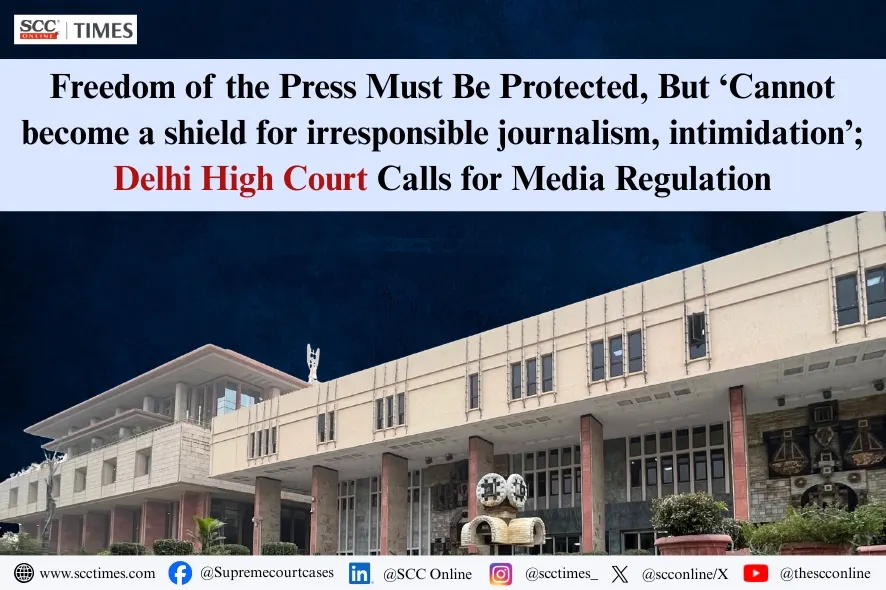
Delhi High Court: In the bail applications for regular bail, the Single Judge Bench of Girish Kathpalia, J., grants bail, holding that continued incarceration of the applicants was unwarranted in view of the doubtful identification, deficiencies in the investigation, and the fact that the trial had not yet commenced.
Recognising the growing phenomenon of unregulated digital journalism, where anyone with a mobile phone and microphone can present themselves as a reporter without professional accountability, the Court urged the legislature to consider an appropriate regulatory framework balancing press freedom with professional accountability.
Background
The applicants sought regular bail in FIR for offences under Sections 115(2), 126(2), 304(2), 317(2), 109, 74, 191(1), (2), and 190, Nyaya Sanhita (BNS). According to the prosecution, on 4 July 2025, the complainant and his colleague, who described themselves in the FIR as being “from media”, were recording videos in an unauthorised colony in Seemapuri. Their activities allegedly provoked local residents, who assaulted them. The complainant alleged that a child pulled his hair, several women and young persons assaulted them, their camera battery and mobile phone were snatched, and their motorcycle was damaged.
The prosecution further claimed that when the complainant and his colleague attempted to escape by boarding a bus, members of the mob, including the present applicants, entered the bus and continued the assault. During an earlier hearing, the investigating officer (IO) showed the Court a video footage and asserted that Applicant 1 was clearly visible entering the bus and participating in the attack.
The applicants denied these allegations. Applicant 1 argued that the video actually showed his mother pulling him away from the crowd and that he never entered the bus. Applicant 2 contended that he was not present at the scene and highlighted contradictions in the prosecution’s identification of him, noting that while the Sessions Court was told he wore a white shirt, the charge-sheet described him as wearing a brown T-shirt. The applicants also alleged that the prosecution had filed incorrect status reports, including a false assertion regarding Applicant1’s involvement in another criminal case.
The applicants had remained in judicial custody since 5 July 2025. 4 co-accused had already been granted bail. As the trial had not commenced, both applicants approached the Delhi High Court seeking regular bail.
Reasoning
The Court found significant deficiencies in the prosecution’s case. It expressed serious dissatisfaction with the conduct of the investigating agency. Despite repeated directions, neither the IO nor the SHO adequately assisted the Court during the bail proceedings. The Court observed that “such failure on the part of investigating agency to effectively assist the court even in bail matters is not acceptable”.
The Court further noted that the prosecution’s own assertions regarding the applicants’ identities were inconsistent. The earlier claim that Applicant 1 had entered the bus was not supported when the video footage was examined again. Likewise, the prosecution was uncertain regarding Applicant 2’s identity, as different descriptions were given before the Sessions Court and in the charge-sheet.
The Court also observed that if the prosecution intended to rely upon video evidence, nothing prevented the IO from collecting the complete recordings made by the complainant before he boarded the bus. Noting that the applicants remained in custody for almost 1 year while the trial had yet to commence, the Court stated that “the accused/applicants cannot be kept in jail endlessly”.
Addressing the prosecution’s argument regarding press freedom, the Court reaffirmed that “freedom of press is an indispensable pillar of every democratic society”. However, it also recognised the growing phenomenon of unregulated digital journalism, observing that today virtually anyone with a mobile phone and microphone can present themselves as a reporter without professional accountability.
The Court cautioned against sensationalism and irresponsible reporting, remarking that “the freedom of press must remain zealously protected. But, it cannot become a shield for irresponsible journalism, intimidation or the dissemination of content that jeopardizes public order”.
Nevertheless, the Court clarified that these broader observations were made only in the context of deciding bail and should not influence the trial. It specifically recorded that the involvement of the present applicants “remains a grey area” as the complainants where recording some video as regards a place of worship in the area, allegedly constructed unauthorisedly which agitated the local residents including the applicants.
Decision
Considering the uncertainty regarding identification, the contradictions in the prosecution’s case, the lengthy custody of the applicants, and the grant of bail to co-accused, the Court found no justification for continued detention and allowed bail applications. It directed the release of the applicants upon furnishing personal bonds of ₹10,000 each with one surety of the like amount to the satisfaction of the trial court.
[Abid Ali v. State (NCT of Delhi), 2026 SCC OnLine Del 5173, decided on 16-7-2026]
Advocates who appeared in this case:
For the Petitioners: Mr. Ankit Tandan and Mr. Abdul Gaffar, Advs.
For the Respondent: Mr. Sanjeev Sabharwal, APP for State with SI Anil