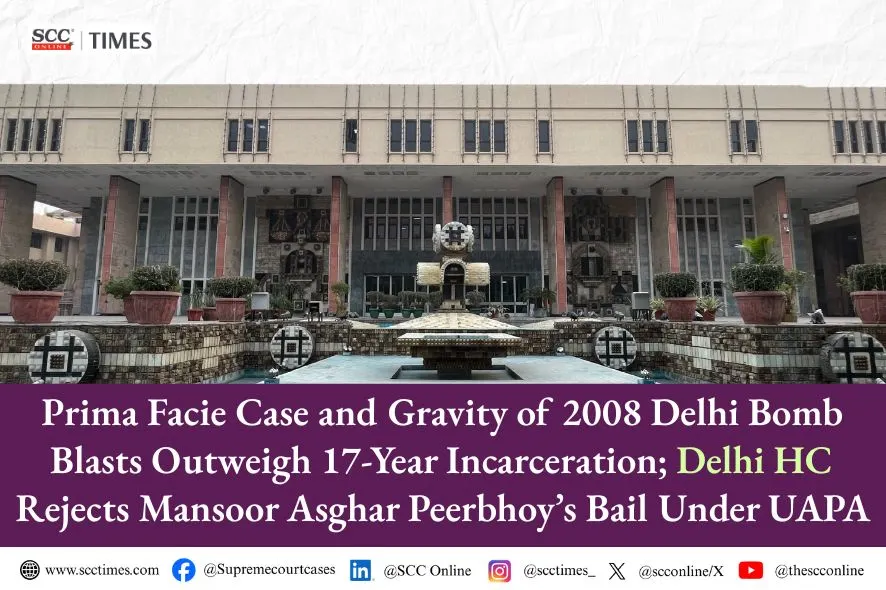
Delhi High Court: In an appeal filed under Section 21, National Investigation Agency Act, 2008 (NIA Act), challenging the rejection of 3rd bail application of appellant, alleged Indian Mujahideen operative Mansoor Asghar Peerbhoy accused in 2008 Delhi Bomb blasts case, the Division Bench of Prathiba M. Singh* and Madhu Jain, JJ., dismissed the appeal and upheld the rejection of bail, holding that 2008 Delhi Bomb blasts were synchronised terrorist attacks carried out pursuant to a larger conspiracy, the email sent shortly before the explosions was an integral part of the alleged design as it was depended upon “deliberate and skilled deployment of technology” and material concerning the laptop purchases, the attached PDF documents, the file-erasing software, the hacked Wi-Fi network and the recovery of electronic devices collectively made out a prima facie case against the appellant.
The Court held that while considering the prayer for bail, the Court had to bear in mind not merely the right to life of the appellant, but also the adverse impact that appellant’s release might have on “the right to life and safety of common citizens, having regard to the role attributed to him in the heinous crimes with which he has been charged”.
Thus, while recognising the seriousness of 17 years of pre-trial custody, the Court held that the trial’s advanced stage, the gravity of the offence, the appellant’s attributed role and the prima facie material did not justify bail.
Factual Matrix
On 13 September 2008, coordinated bomb explosions took place at Karol Bagh, M-Block Market, Greater Kailash-I and Connaught Place, while 3 live bombs were detected at Central Park, near Regal Cinema and at Children’s Park, India Gate. The incidents caused the deaths of 26 persons and injuries to 135 persons. Shortly before the blasts, at about 6.25 p.m., an email titled “MESSAGE OF DEATH” was circulated to media organisations in India and abroad in the name of Indian Mujahideen. It claimed responsibility for the attacks and carried attachments, including a document titled “EYE FOR AN EYE, THE DUST WILL NEVER SETTLE DOWN.”
The prosecution alleged that the appellant was heading the media cell of Indian Mujahideen and, with co-accused Mubin Kadar Shaikh, transmitted the threatening email after hacking into the Wi-Fi network of M/s Kamran Power Controls Pvt. Ltd., Chembur, Mumbai. The allegation was not that the appellant physically planted explosives; rather, the prosecution attributed to him a central technological and communicative role in the wider conspiracy by preparing, transmitting and attempting to erase the digital trail of the message that claimed responsibility for the attacks.
The appellant faced charges under Sections 121, 121-A, 122, 123, 302, 307, 323, 427 and 120-B, Penal Code, 1860 (IPC); Sections 3, 4 and 5, Explosive Substances Act, 1908; Sections 16, 18, 20 and 23, Unlawful Activities (Prevention) Act, 1967 (UAPA); and Section 66, Information Technology Act, 2000. The trial was being conducted jointly in relation to 5 FIRs arising from the Delhi blasts. By the time of the appeal, the prosecution had examined 303 witnesses, with only 2 witnesses remaining, one of whom had been partly examined.
The appellant had been in custody since his arrest in the connected Mumbai case on 28 September 2008 and was formally arrested in the Delhi case on 9 March 2009. Charges were framed against him on 6 May 2011. His first bail application was dismissed in 2015, and his second was rejected in 2022. The High Court had dismissed his challenge to the second rejection on 29 April 2024. Although the Supreme Court declined interference on 21 January 2025, it granted liberty to seek fresh bail if the trial was not concluded within 6 months. The present proceedings therefore concerned the third bail application filed pursuant to that liberty.
Issue for Consideration
Whether the material on record disclosed a prima facie case against the appellant and, if so, whether the prolonged incarceration of approximately 17 years nevertheless justified his release on bail?
Analysis
At the outset, the Court noted that the appellant’s case was that he had been falsely implicated in the present case, evidence relied upon by the prosecution suffers from serious infirmities and fails to establish his involvement in the alleged transmission of the email. Further, the appellant had contended that he had remained incarcerated for approximately 17 years as an undertrial prisoner, the delay in conclusion of the trial is not attributable to him, and in the light of the principles of parity, his acquittal and grant of bail in connected proceedings, and the mandate of Article 21 of the Constitution, he deserved to be enlarged on bail.
Applicability of Section 43-D(5) UAPA
The Court rejected the appellant’s argument that the amended Section 43-D(5) was inapplicable because the alleged offences pre-dated the amendment. It held that bail is a matter of procedural law rather than substantive law. Accordingly, the restriction under Section 43-D(5) applied to pending proceedings. The Court relied on its earlier decision in the appellant’s own case, Mansoor Asghar Peerbhoy v. State, 2024 SCC OnLine Del 2995 and Pragya Singh Chandrapalsingh Thakur v. State of Maharashtra, 2017 SCC OnLine Bom 493, to hold that restrictions governing bail may operate retrospectively because they regulate procedure.
The Court reiterated that under the proviso to Section 43-D(5), bail cannot be granted where the Court finds reasonable grounds for believing that the accusation is prima facie true. It adopted the approach in NIA v. Zahoor Ahmad Shah Watali, (2019) 5 SCC 1, according to which the Court is required to assess broad probabilities and is not expected to conduct an elaborate examination or dissection of the evidence. The relevant inquiry is whether the material, taken at face value, establishes the accused’s complicity in the alleged offence.
General Principles Governing Bail
The Court also referred to the settled principles governing bail in serious offences, including the nature and gravity of the accusation, the severity of punishment in the event of conviction, the possibility of absconding, the likelihood of repetition of the offence, the risk of witness tampering and the danger of justice being thwarted. It observed that, even independently of the UAPA bar, the scale of casualties and the nature of the allegations made gravity an “overwhelming factor”.
The Court emphasised that the present matter was not comparable to an ordinary criminal case as it involved coordinated attacks at several locations, an email sent minutes before the explosions, and allegations of deliberate technological planning to conceal the origin of the communication.
Prima Facie Case Against the Appellant
The Court held that the prosecution material disclosed a prima facie case. It noted that the appellant and co-accused were identified by PW 231 as purchasers of the laptops. It also relied on the recovery of electronic devices, the alleged presence of file-erasing software, the recovery of documents corresponding to the attachments sent with the email, and the evidence concerning the hacking of the Wi-Fi network of M/s Kamran Power Controls Pvt. Ltd.
The Court treated the appellant’s alleged role as “concerted, conspiratorial and active”. It observed that the role attributed to him could not be equated with that of Mohd. Hakim, whose allegation was limited to supplying ball bearings. Therefore, the Court denied parity to the accused. The Court also held that the appellant’s acquittal or bail in connected proceedings did not automatically displace the prima facie material in the present case, particularly when the specific evidence and role attributed to him differed.
The Court declined to undertake a “mini trial” or make final findings on the evidentiary objections raised by the defence, holding that the material raised serious issues requiring adjudication at trial and that it could not be said, at the bail stage, that the prosecution had established nothing against the appellant.
Prolonged incarceration and Article 21
The Court carefully considered the appellant’s 17-year incarceration through the framework of Union of India v. K.A. Najeeb, (2021) 3 SCC 713, wherein was recognised that “constitutional courts is not strictly bound by the prohibitory provisions of grant of bail under UAPA, and can exercise its constitutional jurisdiction to release an accused on bail who has been incarcerated for a long period of time”. It acknowledged the principle that the rigours of Section 43-D(5) may “melt down” where there is no realistic likelihood of trial being completed within a reasonable time and incarceration has become disproportionate.
At the same time, the Court held that Najeeb does not create an automatic entitlement to bail merely because custody has been prolonged. Relying on Gulfisha Fatima v. State (NCT of Delhi), 2026 SCC OnLine SC 10 and Syed Iftikhar Andrabi v. NIA, 2026 SCC OnLine SC 881, it held that delay must be assessed contextually. It asserted that the relevant factors include the gravity of the alleged offence, the role attributed to the accused, the strength of the prima facie case, the stage and realistic trajectory of the trial, the causes of delay, and the risk to the integrity of the proceedings upon release.
The Court found that the trial had made substantial progress, 303 witnesses had been examined, only 2 remained, and the Supreme Court had granted additional time for its conclusion. Therefore, it concluded that the prolonged custody, though significant, did not outweigh the cumulative factors against bail in this particular case. The Court treated delay as a basis for heightened judicial scrutiny, not as a “trump card” that automatically displaced the statutory restraint.
Decision
The Court dismissed the appeal and upheld the rejection of bail, holding that prima facie case against the appellant was made out. It Court clarified that the observations were confined to the bail stage and were not intended to constitute a final expression on guilt.
[Mansoor Asghar Peerbhoy v. State (NCT of Delhi), 2026 SCC OnLine Del 4984, decided on 7-7-2026]
*Judgment authored by Justice Prathiba M. Singh
Advocates who appeared in this case :
For the Appellant: Mr. Mehmood Pracha, Mr. Sanawar, Mr. Jatin Bhatt, Mr. Kshtij Singh, Mr. Sikander Raza, Advs.
For the Respondent: Mr. Ritesh Kumar Bahri, APP with Ms. Divya Yadav & Mr. Lalit Luthra, Advs.