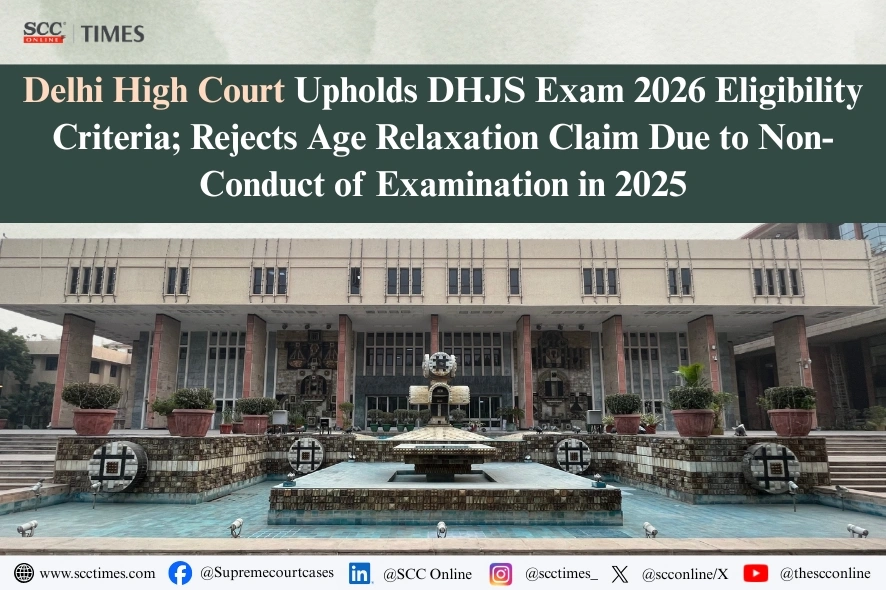
Delhi High Court: In a writ petition challenging the validity of the eligibility criteria prescribed for the Delhi Higher Judicial Service (DHJS) Examination, 2026. particularly the upper age-limit introduced after the amendment to the Delhi Higher Judicial Service Rules, 1970 (DHJS Rules), the Division Bench of V. Kameswar Rao and Manmeet Pritam Singh Arora, JJ., dismissed the writ petition holding that the recruitment Notification dated 1 July 2026 and the eligibility criteria prescribed therein were valid.
Background
The petitioner challenged the eligibility criteria prescribed in the Notification dated 1 July 2026 for the DHJS Exam 2026. The notification required candidates to have attained the age of 35 years but not 45 years as on the last date for submission of applications, i.e., 15 July 2026. The petitioner, born on 3 October 1980, had crossed the prescribed upper age-limit by the date of the notification and was therefore ineligible.
The petitioner contended that no DHJS examination had been conducted during 2025. Had such examination been held, he would have satisfied the age requirement under the unamended Rules. According to him, the amendment to Rule 9(5), DHJS Rules, made on 19 February 2026, unfairly deprived candidates like him of an opportunity to compete without providing any transitional protection. He further argued that vacancies arising after 1 December 2025 ought to have been separately identified and filled in accordance with the Rules applicable to the recruitment year 2025.
The respondents maintained that the recruitment Notification dated 27 December 2024 had already included all existing and anticipated vacancies up to 1 December 2025. Consequently, there was no necessity to conduct a separate examination in 2025. They also submitted that the Rules had to be amended pursuant to the Supreme Court’s decision in Rejanish K.V. v. K. Deepa, (2026) 4 SCC 596, after which the present notification was validly issued.
Issue for Determination
Whether the petitioner was entitled to a one-time relaxation in the upper age-limit because no DHJS examination was held during 2025?
Analysis
At the outset, the Court asserted that it was “not in agreement with the submission advanced on behalf of the petitioner”. It found that all anticipated vacancies up to 1 December 2025 had already been included in the Notification dated 27 December 2024. The petitioner had participated in that recruitment process but was unsuccessful.
The Court observed that “the objective behind conducting the DHJS Exam every year is that no vacancy that arises should remain unfilled”. Since the earlier notification had already covered anticipated vacancies for 2025, the purpose of annual recruitment stood fulfilled. Thus, the respondents’ decision not to hold another examination during 2025 “cannot be said to discriminatory or illegal in any way”.
The Court also rejected the contention regarding vacancies arising after 1 December 2025. It noted that, following the Supreme Court’s judgment in Rejanish K.V., amendment of the Rules was necessary before any further recruitment process could commence. The Rules were amended on 19 February 2026, and thereafter the Notification dated 1 July 2026 was issued. Therefore, the Court found “no infirmity with the notification for the DHJS Exam-2026”.
On the request for age relaxation, the Court held that there were “no compelling circumstances” warranting such relief. The petitioner, having crossed the prescribed upper age-limit on the relevant date, was not entitled to a one-time age relaxation. It concluded that the actions of the respondents had “not in any way affected the rights of the petitioner”.
Decision
The Court dismissed the writ petition and declined to grant any relief to the petitioner. It also dismissed the pending application.
[Ajay Kumar Sharma v. High Court of Delhi, 2026 SCC OnLine Del 5030, decided on 10-7-2026]
*Judgment Authored by Justice V. Kameswar Rao
Advocates who appeared in this case:
For the Appellant: Mr. Anupam Srivastava, Senior Adv. with Mr. Raj Kumar Ruhil, Mr. Pratap Singh, Mr. Manish K. Vaid, Mr. Hammad Ali and Mr. Sukhmandeep Singh, Advs. along with petitioner in person.
For the Respondents: Ms. Asmita Singh, Adv. for R-1. Mrs. Avnish Ahlawat SC GNCTD Services, Mr. Nitesh Kumar Singh, Ms. Aliza Alam and Mr. Mohnish Sehrawat, Advs.