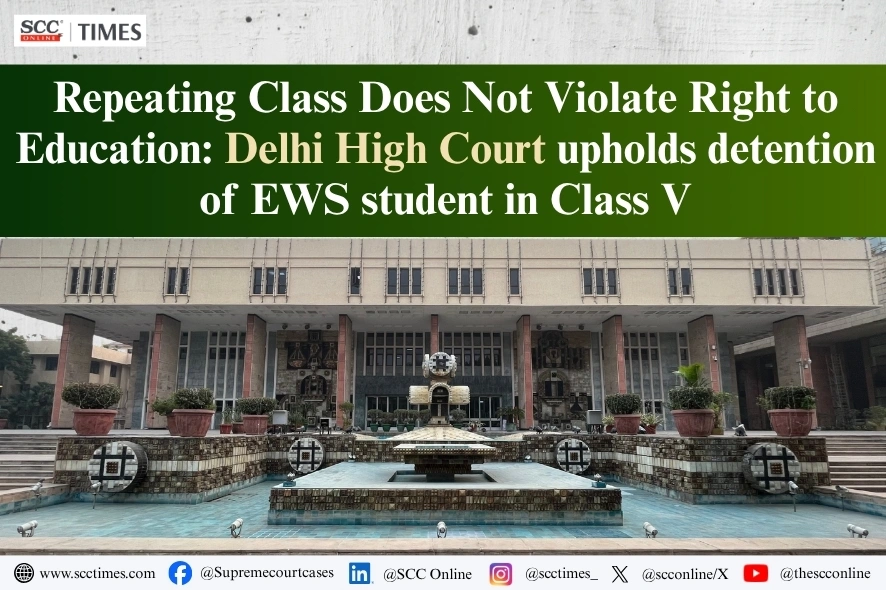
Delhi High Court: While considering a petition challenging the detention of an Economically Weaker Section (EWS) category student in Class V, a Single Judge Bench of Jasmeet Singh, J., interpreted Section 16, Right of Children to Free and Compulsory Education Act, 2009 (RTE Act), and held that the prohibition against holding back children in elementary education must be construed in light of the legislative intent of providing children, particularly those from vulnerable sections, adequate opportunities for academic progression. The Court held that where a child is unable to comprehend basic concepts despite repeated opportunities, additional classes, and re-examinations, requiring the child to repeat a class would not amount to removal from education but would facilitate better learning outcomes. Noting the petitioner’s consistently poor academic performance and inability to grasp foundational concepts, the Court directed the petitioner to repeat Class V in the respondent School while ensuring that his rights and entitlements under the EWS category were duly protected.
Background
The petitioner, a minor child, was admitted to Respondent 1-School under the EWS category. The petitioner belongs to an extremely vulnerable and impoverished background and is under the care and custody of his grandmother, who sustains the family on a monthly old age pension of ₹2500.
At the end of the Academic Session 2025—2026, the petitioner was declared unsuccessful in Class V and was detained in the same class by Respondent 1-School. Aggrieved by the said action, the petitioner approached the Court contending that his detention was contrary to the provisions of the RTE Act, particularly Section 16, which deals with the prohibition on holding back children in elementary education. The petitioner further alleged that Respondents 2 and 3 had failed to frame appropriate rules or guidelines under Section 16(3), RTE Act governing the circumstances in which a child may be detained. Accordingly, the present petition was filed challenging the action of the school.
Analysis
The Court examined the provisions of Section 16, RTE Act, and observed that the said provision must be read in a meaningful manner, keeping in view its objective of providing greater latitude to children studying in elementary classes, particularly those belonging to the EWS category, so as to afford them an opportunity to progress in their academic careers.
The Court noted that the petitioner had consistently performed poorly in academics. During the Academic Session 2022—2023, while studying in Class III, the petitioner secured 12 per cent marks and was promoted to the next class. In the Academic Session 2023—2024, while studying in Class IV, the petitioner secured 7 per cent marks and was again promoted. Thereafter, in Class V, the petitioner secured 7 per cent marks and was granted another opportunity through re-examination, wherein he secured only 8 per cent marks. The Court further noted that the petitioner was provided additional classes and fresh opportunities by the school, including examinations conducted on 25 May 2026 and 5 June 2026, but he was unable to secure adequate marks.
The Court observed that the present case was not one where the petitioner was being expelled or removed from the school, thereby disrupting his academic career. The petitioner was only being required to repeat Class V so that he could understand and comprehend the basic subjects such as Mathematics, English, EVS and Hindi. The Court also perused the answer sheets of the petitioner and observed that he was, as of that stage, unable to comprehend even the basics and fundamentals of Mathematics.
Decision
Accordingly, the Court disposed of the petition with a direction that the petitioner shall repeat Class V in Respondent 1-School and that the school shall ensure that the EWS mandate and entitlements available to the petitioner are adequately fulfilled. The Court clarified that it had not examined the prayer clause “A” of the petition as the main grievance of the petitioner stood addressed. The petition, along with pending applications, was thus disposed.
Also Read: SC: Right to Education in Mother Tongue Flows from Article 19(1)(a)| SCC Times
[Master Sorabh Rathor Through His Guardian Savitri v. North Delhi Public School, 2026 SCC OnLine Del 5279, decided on 9-7-2026]
Advocates who appeared in this case:
For the Petitioner: Khagesh B Jha, Shikha Shrama Bagga, Shivani, Advocates
For the Respondent: Dhruv Rohatgi, Panel Counsel GNCTD with Chandrika Sachdeva, Dhruv Kumar, Advocates, Punita, Principal (through VC) for School