Disclaimer: This has been reported after the availability of the order of the Court and not on media reports so as to give an accurate report to our readers.
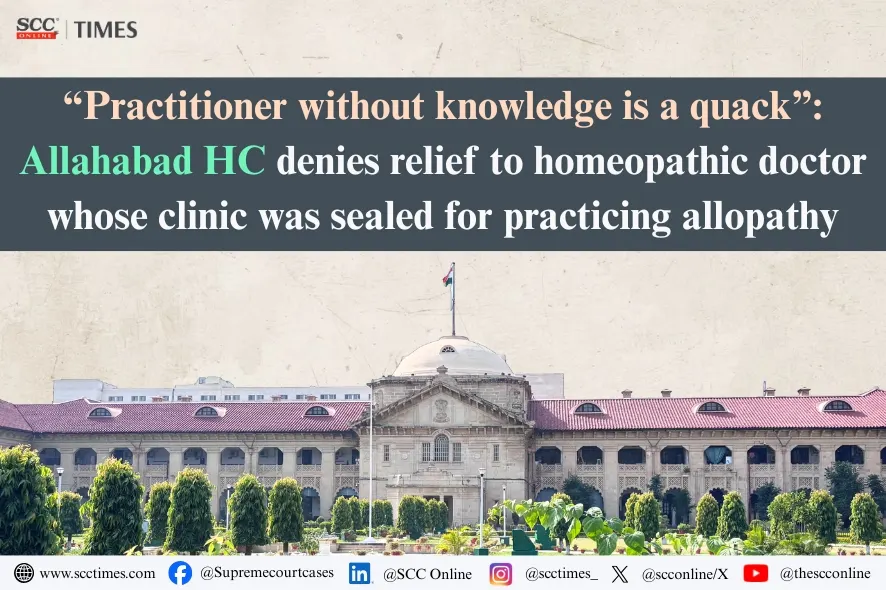
Allahabad High Court: In a writ petition filed by a homeopathic doctor against the sealing of his clinic, the Division Bench of J.J. Munir and Indrajeet Shukla*, JJ., rejected the petition, holding that the doctor was not entitled to practice modern medicine (allopathy) on the strength of his electro homeopathy certificate. Additionally, his clinic/hospital also failed to meet the standards prescribed by various government orders and the National Commission for Indian System of Medicine Act, 2020 (NCISM Act).
The Court remarked,
“A person, who does not have knowledge of a particular system of medicine but practices in that system is a quack and a mere pretender of medical knowledge or skill or to put it differently, can be maximum termed a charlatan.”
Background
The petitioner doctor contended that he obtained a Vocational Certificate in Community Health in 2005. In 2019, he was asked by the Chief Medical Officer (CMO) to submit his degrees and educational record entitling him to practice medicine. He responded to the notice and further submitted a detailed statement in 2024, annexing all his academic testimonials with a request to withdraw the notice. In 2025, he received another show-cause notice for the closure of his clinic.
Aggrieved, he filed a writ petition challenging the show-cause notice but the same was disposed of with the direction that the doctor shall be allowed to file a detailed objection against the show-cause notice before the CMO within 2 weeks, and the CMO shall decide the same within 1 month, after providing due notice, opportunity of being heard, and all materials relied upon by the authority.
After submission of a detailed response, the doctor’s objection was rejected, holding that he was practicing and treating patients with allopathic medicines, without being entitled to practice the aforesaid stream of medicine and being registered in the CMO’s office. It was also remarked that no registration/operation of a clinic can be permitted for a practitioner holding a degree in electrohomeopathy. Furthermore, the CMO stated that a holder of a certificate/diploma in electro homeopathy cannot be allowed to practice allopathic medicine, as it is prohibited by government orders.
Additionally, the order stated that the clinic concerned did not meet the standards set up by the government under the Manak Dainik Sthapan (Registrikaran aur Viniyaman) Adhiniyam, 2010, Uttar Pradesh Shashan Chikitsa Anubhag-6 Sankhya-2374/panch-5-2021, and Uttar Pradesh Shashan Ayush Anubhag-1 Sankhya-1297/71-Ayush-1-2016-davlu-283/2014. Lastly, the clinic did not have a biomedical waste management system, and even a fire NOC was not found. The clinic was not found to be observing the infection prevention and control system, which was a non-compliance with the mandatory provisions to run a clinic/hospital.
Thus, the doctor could not show any valid qualification to practice allopathic medicine or authority to operate a clinic, his registration to practice allopathic medicine was not found valid, and, consequently, the seal on his clinic was not removed. The criminal law was also set in motion, and his representation was rejected.
Aggrieved again, the doctor filed the present writ petition against the order passed by the CMO whereby his hospital was sealed in compliance with a letter issued by the Principal Secretary, U.P. Government. Further, he prayed for a direction to the State authorities to permit him to operate his clinic and practice modern medicine.
The State contended that a practitioner registered under one system of medicine cannot transgress and practice another system, particularly allopathy, without requisite qualification and registration, and that doing so amounts to negligence per se, exposing both the practitioner and the public to grave risk. Thus, the doctor’s certificate in electrohomeopathy could not be a valid degree/diploma entitling him to practice modern medicine/allopathy.
Analysis
At the outset, the Court noted that the doctor, though in possession of a certificate in electrohomeopathy, was not thereby entitled to practice modern medicine, particularly the allopathic system. Furthermore, the seal on his clinic was declined to be removed because it did not meet the standards to operate a hospital/clinic, and even unqualified doctors were found to be practicing modern medicine on the premises of the clinic in question.
“A person who does not have knowledge of a particular system of medicine but practices in that system is a quack and a mere pretender of medical knowledge or skill, or to put it differently, can be at most termed a charlatan.”
The Court stated that a person can practice in the allopathic system of medicine in a State or in the country only if he possesses a recognised medical qualification. Permitting a person who does not possess a recognised medical qualification in allopathic medicine would be in direct conflict with the Statute governing the field.
In this regard, the Court referred to Mukhtiar Chand v. State of Punjab, (1998) 7 SCC 579, wherein the Supreme Court held that there is no scope for a person enrolled on the State Register of Indian Medicine or Central Register of Indian Medicine to practise modern scientific medicine in any of its branches unless that person is also enrolled on a State Medical Register within the meaning of the Indian Medical Council Act, 1956.
The Court further noted that the doctor’s clinic was admittedly not registered with the CMO’s office, which is a sine qua non for practicing modern medicine and treating patients.
The Court also referred to Chintamanrao v. State of M.P., 1950 SCC 695, wherein it was held that the right to practice a profession under Article 19(1)(g) of the Constitution is not an absolute right and remains subject to reasonable restrictions that the State may impose in the interest of the general public under Article 19(1)(g) of the Constitution of India. In State of Gujarat v. Mirzapur Moti Kureshi Kassab Jamat, (2005) 8 SCC 534, it was held that regulatory measures ensure that only qualified and registered persons practice medicine and the clinical establishment meet prescribed standards. Such restrictions are legitimate and proportionate restrictions in the interest of public health and cannot be said to offend Article 19(1)(g) of the Constitution.
Thus, considering the factual matrix and the law, the Court held that the doctor was not entitled to practice modern medicine (allopathy) on the strength of his electrohomeopathy certificate. More so, his clinic/hospital also failed to meet the standards prescribed by various government orders as well as the NCISM Act.
Accordingly, the Court dismissed the writ petition, holding that under Article 226 of the Constitution, it could not substitute its own wisdom and findings for those of competent expert authorities.
[Santosh Kumar Sharma v. State of U.P., 2026 SCC OnLine All 21982, decided on 10-7-2026]
*Judgment authored by: Justice Indrajeet Shukla
Advocates who appeared in this case:
For the petitioner: Ashok Kumar Singh, Pratibha Singh
For the respondents: Akhilesh Kumar Tripathi
Buy Constitution of India HERE