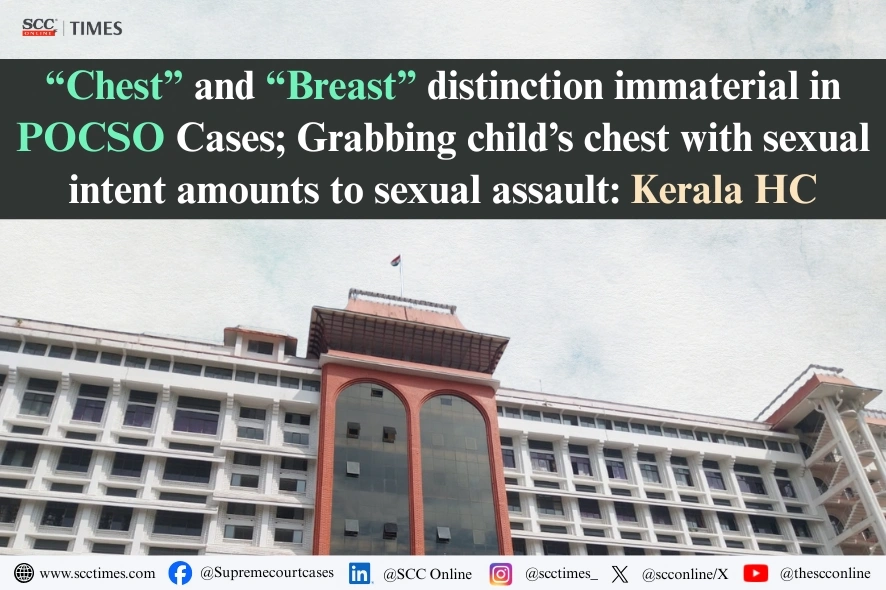
Kerala High Court: In a significant ruling under the Protection of Children from Sexual Offences Act, 2012 (POCSO Act), a Single Judge Bench of A. Badharudeen, J. held that the act of grabbing the chest of a child with sexual intent constitutes sexual assault under Section 7, POCSO Act, rejecting a narrow interpretation based on the distinction between the terms “chest” and “breast”. However, the Court observed that a conviction for aggravated sexual assault under Section 9(l) read with Section 10, POCSO Act requires proof of repeated sexual assault and cannot be sustained merely based on an unsubstantiated allegation of an earlier incident.
The Court while partly allowing the criminal appeal filed by the accused, set aside the conviction for aggravated sexual assault and modified it to an offence punishable under Section 7 read with Section 8, POCSO Act, sentencing the accused to 3 years’ rigorous imprisonment and a fine of ₹5000.
Background
The prosecution case was that on 15 May 2022 at about 4.45 p.m. (the victim’s recorded testimony stated 14 May 2022 at 6:30 p.m.), the accused committed sexual assault on a 12-year-old boy by approaching him from behind, pressing his chest, and catching hold of his abdomen. The prosecution alleged commission of offences under Section 7 read with Sections 8 and 9(l) read with Section 10, POCSO Act.
After appreciating the evidence on record, the Special Court for the trial of offences under the POCSO Act, convicted the accused under Section 9(l) read with Section 10, POCSO Act, relating to aggravated sexual assault, while acquitting him of the other charges.
Aggrieved by the conviction and sentence imposed by the Special Court, the accused approached the High Court through a criminal appeal.
Issues
-
Whether the Special Court was justified in holding that the accused had committed an offence punishable under Section 9(l) read with Section 10, POCSO Act.
-
Whether the judgment and sentence passed by the Special Court required interference by the High Court.
Analysis and Decision
The Court examined the evidence of the victim (PW 1) and the legal requirements for establishing the offence of aggravated sexual assault under the POCSO Act.
The Court noted that PW 1 had deposed that he had gone to Arimbra Junction to purchase a mosquito repellent. Since the shop owner was not present, he waited at the spot. At that time, the accused approached him from behind, caught hold of his stomach, and grabbed his chest. When PW 1 attempted to remove the accused’s hand, the accused caught hold of his hand and pulled him. The accused also offered ₹50 to accompany him to a nearby vacant house. PW 1 immediately escaped and later disclosed the incident to his parents. During his examination before the Court, PW 1 identified the accused, and his testimony remained consistent with the prosecution case.
The Court observed that the primary question was whether the acts attributed to the accused by PW 1 satisfied the ingredients of Section 9(l) read with Section 10, POCSO Act, which deals with aggravated sexual assault committed repeatedly.
The Court explained that to establish aggravated sexual assault under Section 9, the prosecution must first prove the commission of sexual assault as defined under Section 7, POCSO Act. Section 7 provides that any person who, with sexual intent, touches the breast or any other specified part of a child, or commits any act involving physical contact without penetration, commits sexual assault.
While considering the evidence, the Court noted that PW 2, the father of the victim, supported the prosecution version by stating that the child returned home frightened and immediately disclosed that the accused had grabbed his chest and stomach. The Court also considered the medical evidence, the statements recorded during investigation, and the evidence of police officials who supported the prosecution case.
The Court then examined the contention of the accused that merely grabbing the child’s “chest” would not amount to touching the “breast” as contemplated under Section 7, POCSO Act. Rejecting this argument, the Court held that although there is an anatomical distinction between the terms “chest” and “breast”, the expression used by a child victim in a sexual assault case cannot be interpreted in a narrow technical manner. The Court observed that in the context of sexual molestation, the term “chest” is commonly used to refer to the breast area.
The Court held that when a child states that the accused grabbed his chest with sexual intent, the natural inference is that the act involved touching of the breast area, thereby satisfying the requirements of Section 7, POCSO Act. Accordingly, the Court concluded that the accused had committed sexual assault punishable under Section 8, POCSO Act.
However, while examining the conviction under Section 9(l) read with Section 10, POCSO Act, the Court found that the prosecution had failed to establish the requirement of repeated sexual assault. Although PW 1 referred to an earlier incident, he did not provide sufficient details regarding the same and had not disclosed it in his statement recorded before the Magistrate under Section 164, Criminal Procedure Code, 1973 (CrPC).
Therefore, the Court held that the Special Court had erred in convicting the accused for aggravated sexual assault under Section 9(l) read with Section 10, POCSO Act. The conviction and sentence under the aggravated provision were set aside and modified to Section 7 read with Section 8, POCSO Act.
Considering the facts and circumstances of the case, the Court imposed the minimum sentence of 3 years’ rigorous imprisonment along with a fine of ₹5000. In default of payment of fine, the accused was directed to undergo 2 weeks’ imprisonment.
[Aboobacker v. State of Kerala, 2026 SCC OnLine Ker 6951, decided on 10-7-2026]
Advocates who appeared in this case:
For Appellant: T.U. Sujith Kumar, HCLSC Panel Advocate, and Winston K.V.
For Respondent: M A Shihab PP