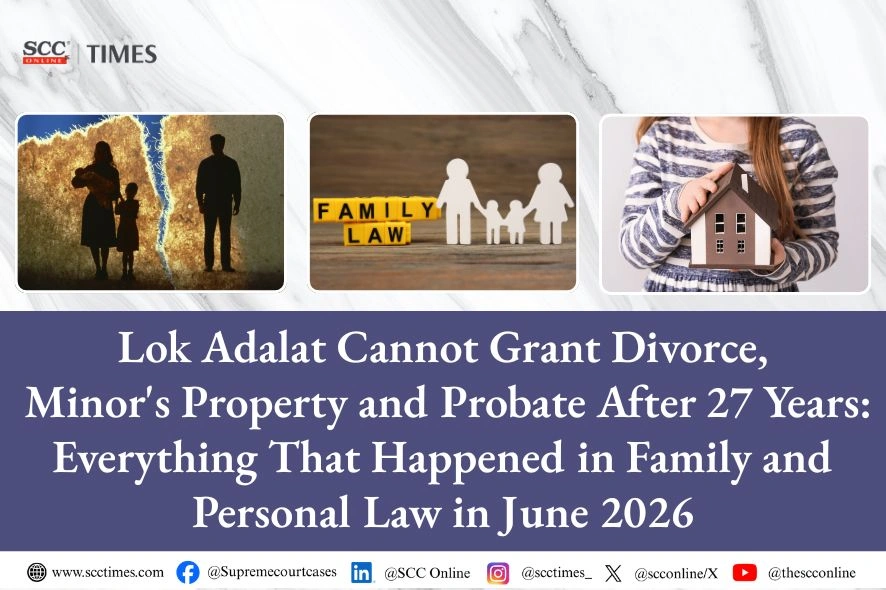
The June 2026 Roundup on Family and Personal Law gives an insight into how the family and personal law evolved in the month, through various judgments and rulings. The Courts pronounced judgments on various facets of family and personal law such as custody of children where multiple courts pronounced on the issue of custodial and visitation rights, right of maintenance of wife in the case of child marriage, law related to right to remarry and divorce decree passed by Lok Adalat and District Legal Services Authority.
HIGHLIGHT OF THE MONTH
SUPREME COURT | “Evident Advantage to Minor” is Governing Standard under Section 8, Hindu Minority and Guardianship Act; SC Allows Development of Minor’s Undivided Share in Property
In an appeal challenging the concurrent decisions of the District Judge, Darjeeling and the Calcutta High Court, which had refused permission to the appellant-mother to dispose of minor’s inherited immovable property pursuant to a development agreement under Section 8, Hindu Minority and Guardianship Act, 1956 (the Act), the Division Bench of Sanjay Karol and N. Kotiswar Singh, JJ., allowed the appeal and granted the appellant the necessary permission to give effect to and realise the development agreement, holding that where a development agreement converts an undivided and comparatively unproductive interest in land into tangible residential accommodation and secure monetary benefits that are demonstrably beneficial to the child, permission ought to be granted subject to adequate safeguards.
The court exercising jurisdiction under Section 8 of the Act must independently determine whether a proposed transaction involving a minor’s immovable property is necessary or evidently advantageous to the minor. The guardian’s consent cannot substitute judicial scrutiny.
[Shephali Chakraborty v. State of W.B., 2026 SCC OnLine SC 1064, decided on 3-6-2026]
Read more Here
Also Read: Mother can Sell Minor’s HUF Property Share for Welfare: Allahabad HC
MARRIAGE
SUPREME COURT | Marriage Dead for All Practical Purposes Must be Nullified; Parties Cannot be Compelled to Remain Married by Court Orders: SC Grants Divorce on Irretrievable Breakdown After 20 Years
In an appeal assailing orders dismissing petition for divorce, the Division Bench of Ahsanuddin Amanullah and R. Mahadevan, JJ., held that “the marriage between the parties being dead for all practical purposes has to be nullified”; granted a decree of divorce to the parties on the ground of irretrievable breakdown of marriage.
[Gopalakrishna Surapaneni v. Anuradha Surpaneni Maiden, 2026 SCC OnLine SC 1056, decided on 27-5-2026]
Read more Here
Also Read: SC on validity of US divorce decree in India under HMA |SCC Times
ALLAHABAD HIGH COURT| Husband Useda Lok Adalat Settlement to Justify a Second Marriage — Allahabad HC Holds Lok Adalats Cannot Grant Divorce; Directs Judgment to be Circulated Across UP
In a writ petition filed under Article 226 of the Constitution of India, challenging a settlement and orders passed by the District Legal Services Authority (DLSA), Unnao in a pre-litigation matrimonial dispute, a Division Bench of Shekhar B. Saraf and Abdhesh Kumar Chaudhary, JJ., held that neither the Lok Adalat nor the DLSA had the authority to grant a decree of divorce and categorically declared that no formal divorce decree existed between the parties and observed that Lok Adalats are meant to facilitate settlements and cannot assume the jurisdiction vested exclusively in Family Courts. The Bench strongly criticised the DLSA for acting in a mechanical manner, failing to scrutinise illegal terms that permitted the parties to remarry, and improperly usurping the exclusive jurisdiction of the Family Court.
[Sushma Devi v. State of U.P., 2026 SCC OnLine All 11150, decided on 30-4-2026]
Read more Here
DELHI HIGH COURT| Can the 30-Day Notice Period Underthe Special Marriage Act Be Waived? Delhi HC Answers
In a writ petition seeking relaxation of the statutory 30-day notice period prescribed under the Special Marriage Act, 1954 (SMA Act) and a direction for early solemnisation of marriage on account of the petitioner’s impending overseas employment, a Single Judge Bench of Purushaindra Kumar Kaurav, J., dismissed the petition, holding that the statutory waiting period forms an integral part of the legislative framework and cannot be waived by the Court in exercise of its writ jurisdiction.
The Court observed that neither personal hardship nor individual exigencies could justify deviation from an express statutory mandate and reiterated that where a statute prescribes a particular procedure, it must be followed in the manner contemplated by law. Consequently, the Court declined to direct the Marriage Officer to solemnise the marriage before expiry of the prescribed notice period.
[Syed Fayazuddin v. State (NCT of Delhi), 2026 SCC OnLine Del 4637, decided on 21-5-2026]
Read more Here
PROBATE UNDER SUCCESSION ACT
SUPREME COURT |Probate Revocation Plea Filed 27 Years After Grant of Probate Barred by Limitation; Notice In Mutation Proceedings Constitutes Constructive Notice: Supreme Court
In an appeal concerning the limitation applicable to proceedings for revocation of probate under Section 263, Succession Act, 1925, a Division Bench of Sanjay Karol and Vipul M. Pancholi, JJ., held that an application seeking revocation of probate is governed by Article 137, Limitation Act, 1963 and must be filed within 3 years from the date on which the right to apply accrues.
Rejecting the respondents’ plea that they acquired knowledge of the probate only in 2019, the Court held that the notice served upon them in mutation proceedings in 2013 constituted constructive notice, and their failure to inquire into the basis of the appellant’s claim amounted to wilful abstention. Observing that such conduct could not be attributed to a reasonably prudent person, the Court concluded that the application for revocation filed in 2022 was hopelessly time-barred. Accordingly, the Court set aside the judgment of the Division Bench and restored the Single Judge’s order dismissing the revocation application on the ground of limitation.
[Dhiraj Dutta v. Anirban Sen, 2026 SCC OnLine SC 996, decided on 29-5-2026]
Read more Here
CHILD CUSTODY
DELHI HIGH COURT| Custody Dispute Concerning Minor Child Amid Complex Factual Disputes Require Adjudication by “Competent Family Court”, Not Summary Writ Proceeding: Delhi HC
In a writ petition instituted by petitioner, mother of a 4-year-old minor daughter, who was born in Singapore and was diagnosed with Autism Spectrum Disorder (ASD), seeking a writ of habeas corpus directing the father to produce the child and restore her custody to the petitioner, the Division Bench of Navin Chawla and Ravinder Dudeja, JJ., declined to exercise its discretionary jurisdiction under Article 226 of the Constitution and held that the petitioner’s claim regarding custody and visitation should be adjudicated before the “competent family court” where a detailed inquiry into all disputed facts could be undertaken.
[Somya Goel v. State (NCT of Delhi), 2026 SCC OnLine Del 4629, decided on 10-6-2026]
Read more Here
DELHI HIGH COURT| Delhi HC Modifies Family Court Order Granting Overnight Custody on Finding Child had Never Stayed With Father; Says Direction Inconsistent with Findings on Child’s Comfort Level
In an appeal arising from a guardianship dispute concerning the custody and welfare of a minor child, a Division Bench of Tejas Karia and Madhu Jain, JJ., modified a Family Court order granting overnight custody of the child to the father during the summer vacation. The Court observed that the Family Court’s findings that the child had never stayed overnight with the father, that unsupervised overnight stay may not be appropriate, and that the child required further time to acclimatise before residing separately from the mother, were inconsistent with its operative direction granting overnight custody. Holding that such a direction was not warranted at the present stage, the Court substituted the overnight custody arrangement with extended daytime custody from 9:00 A.M. to 8:00 P.M. on specified dates. The Court accordingly allowed the appeal and clarified that the pick-up and drop arrangements directed by the Family Court would remain unchanged.
[X v. Y, 2026 SCC OnLine Del 4790, decided on 19-6-2026]
Read more Here
KERALA HIGH COURT| ‘Child Cannot be Treated as a Pawn’: Kerala HC Directs Family Courts to Follow Calcutta HC’S Child Custody and Access Guidelines; Restores Minor’s Custody to Mother
In a habeas corpus petition seeking custody of a minor who was taken away by the father in violation of a Family Court’s decree granting permanent custody to the mother, the Division Bench of Soumen Sen, CJ., and Syam Kumar V.M., J., held that the illegal removal of a child, despite a subsisting Family Court’s decree granting custody was unlawful and restored the child’s custody to the mother. The Court directed that the Calcutta High Court’s child custody guidelines must be followed by the Family Courts in Kerala till the committee constituted to consider the said plan had finally placed its recommendations.
[Hayarunisa Abdul Hakkim v. State of Kerala, 2026 SCC OnLine Ker 5409, decided on 1-6-2026]
Read more Here
MAINTENANCE
MADHYA PRADESH HIGH COURT| “Parents who Solemnise Child Marriages Cannot Escape Liability”: MP High Court Tells Husband to Seek Recourse From Them, Enhances Wife’s Maintenance Threefold
In a revision petition filed by an alleged child marriage victim seeking enhancement of maintenance, the Single Judge Bench of Gajendra Singh, J., partially allowed the application, holding that she could not be denied a reasonable amount of maintenance and the amount of Rs 2000 per month could not be justified. Accordingly, the maintenance amount was enhanced from Rs 2000 to Rs 6000 per month from the date of application.
The Court observed that, “Parents, who are instrumental in solemnizing such marriage cannot escape from the liability. If the husband feels hardships then he has to take help of those parents who were instrumental in performing the child marriage.”
[R v. S, 2026 SCC OnLine MP 15133, decided on 29-5-2026]
Read more Here
Also Read: Child Marriages Rising in U.P.: Allahabad HC Flags Systemic Gap, Directs DGP To Issue Guidelines
Also Read