Disclaimer: This has been reported after the availability of the order of the Court and not on media reports so as to give an accurate report to our readers.
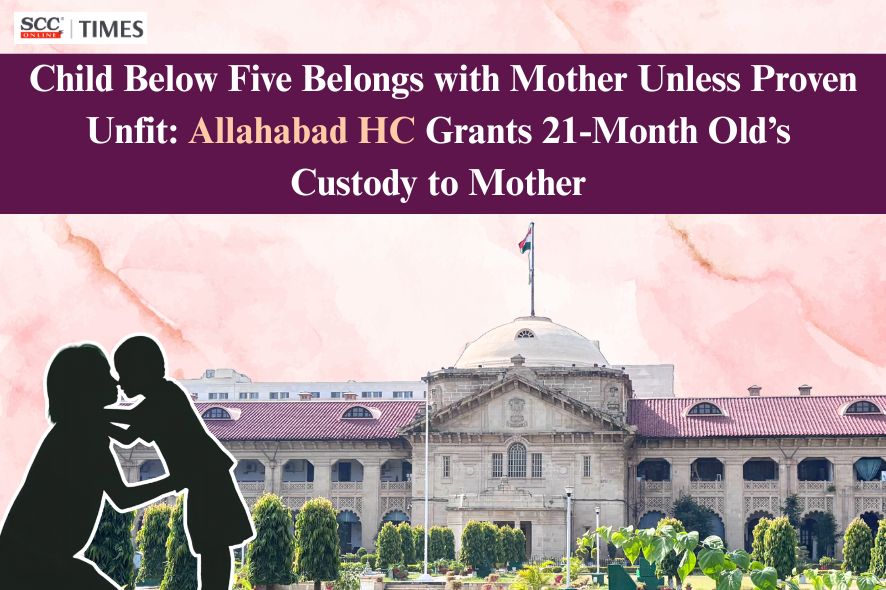
Allahabad High Court: In a habeas corpus writ petition filed by mother seeking custody of a 21-month-old minor child, the Single Judge Bench of Sandeep Jain, J., allowed the petition and directed the father to hand over the custody of the minor to the mother within 3 days, while granting the father visitation rights twice a month, holding that the welfare of the child and his tender age required that custody remains with the mother.
The Court observed that,
“It is incumbent upon the Court to identify the individual best suited to safeguard the minor’s well-being and interests.”
Background
The instant case concerns the dispute for custody of minor corpus, who was approximately 21 months old and was in custody of his father, a constable in the U.P. Police posted in District Jaunpur. It was alleged by the petitioner that after marriage, she was subjected to cruelty and dowry-related harassment by the respondent. She further alleged that on 19 October 2025, the respondent forcibly took away the minor child from her custody. Subsequently, the Child Welfare Committee, by order dated 10 September 2025, directed that custody of the child be handed over to the petitioner. However, the respondent allegedly failed to comply with the said order, leading to registration of a FIR under Section 75, Juvenile Justice (Care and Protection of Children) Act, 2015 on 7 March 2026, and his suspension from service as a police constable on 12 March 2026.
Earlier, the habeas corpus petition was dismissed on 6 November 2025 on the ground of availability of an alternative remedy under the Guardian and Wards Act, 1890. However, in Special Appeal No. 1205 of 2025, the Division Bench of the Allahabad High Court, by order dated 3 April 2026, restored the petition for adjudication on merits, holding that in matters concerning custody of a minor child, the paramount consideration is the welfare of the child and that the petition could not be dismissed merely on the ground of alternative remedy. Meanwhile, the appellate court set aside the Child Welfare Committee’s order dated 10 September 2025 on 21 April 2026, leaving the issue of custody to be determined by the High Court on the touchstone of the child’s welfare.
Analysis
The Court noted that earlier the petition was dismissed by the coordinate Bench of this Court on the grounds of availing alternative remedy under the Guardians and Wards Act, 1890, but was later allowed by the Division Bench of this Court and the matter was restored to its original number for adjudication on merits. The Court noted,
“It is incumbent upon the Court to identify the individual best suited to safeguard the minor’s well-being and interests. Guided by this principle, the Court proceeds to adjudicate the issue of custody in the instant case.”
The Court reiterated that ordinarily, custody of a minor who has not attained the age of 5 years is entrusted to the mother and that this principle is well recognised and codified by the legislature through Section 6, Hindu Minority and Guardianship Act, 1956.
“The legislative intent underlying this enactment reflects a recognition of the unique nutritional, emotional, and developmental needs of the minor, which, in the formative years, can best be met by the mother.”
The Court opined that the father does plays an essential role in the child’s upbringing, but it is the mother who is ordinarily best positioned to secure the physical and emotional welfare of the child because of biological and nurturing considerations. The Court viewing the allegations by the parties, also opined that there was no possibility of reconciliation between them.
The Court observed that although the respondent alleged that the petitioner was alcoholic, addicted, and mentally unfit to have the custody of the minor corpus, the medical prescriptions relied upon only reflected treatment for abdominal pain and advice to avoid spicy food. Since no medical opinion indicated mental instability or alcoholism, the Court held that the documents did not establish that the petitioner was unfit to look after the welfare of the minor corpus.
The Court noted that the WhatsApp chats and photographs placed on record indicated that the respondent was in the company of another woman and that the documents on record reflected that the respondent had forcibly taken away the minor child from the petitioner’s custody and had deliberately failed to comply with the Child Welfare Committee’s order dated 10 September 2025 directing him to hand over custody to the petitioner, which conduct was also noticed by the Division Bench while allowing the special appeal.
The Court further noted that the respondent, despite being a police constable belonging to a disciplined force, had shown open disregard and defiance towards the Court’s orders and was suspended from service on 12 March 2026. Considering the tender age of the corpus and that he is fully dependent upon the mother for nutritional and emotional needs, the Court observed that it would be an injustice to deprive the child of the mother’s custody.
Decision
Allowing the habeas corpus petition the Court directed the respondent-father to hand over custody of the minor child to the petitioner-mother within 3 days. However, to preserve the emotional bond between the father and the child, visitation rights were granted to the respondent twice every month, after prior intimation to the petitioner, at the nearest police station.
[Rinku Ram v. State of U.P., 2026 SCC OnLine All 4460, decided on 30-4-2026]
Advocates who appeared in this case:
For the petitioner: Ajay Singh Sengar, Kamal Dev Singh Chanchal, Kamla Kant Mishra, Varun Mishra
For the respondent: G.A., Mariya Khatoon, Ram Kesh