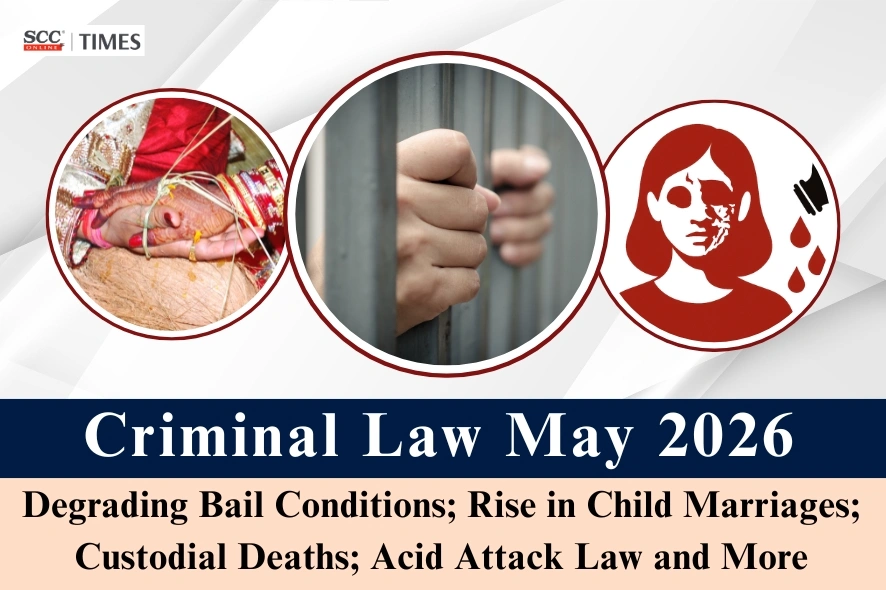
May 2026 produced some of the Supreme Court’s most significant bail jurisprudence in years, from declaring degrading bail conditions void to reinforcing the binding effect of three-Judge Bench UAPA decisions. High Courts added further dimensions, from child marriage enforcement gaps in UP to custodial death investigations that exposed institutional failure across three bodies simultaneously.
HIGHLIGHT OF THE MONTH
Supreme Court| Bhopal Dowry Death Case: SC takes note of assurance to transfer case to CBI; Urges Parties to refrain from making statements before media
In Alleged institutional bias and procedural discrepancies in the unnatural death of a young girl at her matrimonial home, In re, 2026 SCC OnLine SC 959, the Supreme Court took note of the Solicitor General’s assurances to ensure swift hand over of the investigation to the Central Bureau of Investigation (CBI) as the same has already been recommended by the Madhya Pradesh government. Read more HERE
Supreme Court| “Hopefully, the story of her life will be an eye-opener for many”: SC Upholds Conviction in Dowry Death Case
In Gour Acharjee v. State of Tripura, 2026 SCC OnLine SC 931, absence of a typical ligature mark and the presence of multiple ante-mortem injuries on the body of the deceased clearly negated the theory of suicide. Reiterating that where an offence occurs within the privacy of a house, the inmates owe a corresponding duty to explain the circumstances leading to the victim’s death, the Court held that the appellant had failed to discharge the burden cast upon him under the facts of the case. Read More HERE
BAIL
Supreme Court| “Abhorrent, Degrading, and Unknown to Law”; Imposition of Bail Conditions Such as Cleaning of Police Stations Declared as Null and Void
In Condition Being Imposed While Granting Bail by High Court of Orissa and District Courts in the State of Odisha and Ancillary Issues, In re, 2026 SCC OnLine SC 809, the Supreme Court noting the same to be “abhorrent, degrading, and unknown to law”, declared all such conditions, requiring cleaning of police stations or similar acts, as null and void. Recognising broader implications, the Court further issued omnibus directions. Read more Here
Supreme Court| A Smaller Bench Cannot Hollow Out a Larger Bench Decision Without Expressly Disagreeing: Judicial Discipline in UAPA Bail Cases
In Syed Iftikhar Andrabi v. National Investigation Agency, 2026 SCC OnLine SC 881, the Supreme Court expressed serious reservations on several aspects of the judgment rendered by a co-equal Bench in Gulfisha Fatima v. State (NCT of Delhi), 2026 SCC OnLine SC 10. The Court further clarified that three-Judge Bench decision in Union of India v. K.A. Najeeb, (2021) 3 SCC 713 is binding law entitled to the protection of stare decisis. It cannot be diluted, circumvented, or disregarded by trial courts, High Courts or even by Benches of lower strength of Supreme Court. Read more HERE
Punjab & Haryana High Court| Rejection of Anticipatory Bail plea in PM Modi video case
In Madhu Purnima Kishwar v. Union Territory, Chandigarh, 2026 SCC OnLine P&H 13145/, the Punjab & Haryana High Court dismissed the petition filed by author Madhu Kishwar (petitioner), seeking anticipatory bail in FIR registered for offences under BNS and IT Act, arising out of the alleged circulation of a misleading video concerning a constitutional authority, holding that the investigation was still at a nascent stage and the petitioner had failed to make out a case for grant of the extraordinary relief of pre-arrest bail. Read denial of anticipatory bail to author Madhu Kishwar Read more HERE
Madhya Pradesh High Court| “International gang of wildlife poachers & traffickers”: Bail denied to alleged pangolin poacher, noting prima facie involvement
In Yangchen Lachungpa v. State of M.P., 2026 SCC OnLine MP 9017, the Madhya Pradesh High Court dismissed the application, holding that the record suggested the accused’s prima facie involvement in the crime. Additionally, the apprehension that she might not be available for trial appeared well-founded. Read more HERE
Calcutta High Court| Mere Driving of Vehicle Insufficient to Establish “Constructive Possession” of Passenger’s Contraband; Bail Granted
In Saw Herald v. State of W.B., 2026 SCC OnLine Cal 4607, the Calcutta High Court held that the rigours of Section 37 were not prima facie attracted and granted bail to the petitioner subject to conditions. Read more HERE
Allahabad High Court| Bail granted to man for “I love Mohammed” post after 7 months in jail
In Nadeem v. State of U.P., 2026 SCC OnLine All 4466, the Allahabad High Court allowed the application, holding that it was appropriate to enlarge him on bail as the alleged objectionable post did not name any caste or community. Read more HERE
Orissa High Court| Sushanta Dhalasamanta released on Bail in 2004 Murder Case After a Decade of Incarceration
In Sushanta Dhalasamanta v. State of Orissa, 2026 SCC OnLine Ori 2136, while hearing a bail application filed under Section 483, Nagarik Suraksha Sanhita, 2023 (BNSS), seeking release in connection with a sessions trial involving charges under the Sections 302, 120-B and 34, Penal Code, 1860 (IPC) and Sections 25 and 27, Arms Act, 1959 (Arms Act) provisions, a Single Judge Bench of G. Satapathy, J., held that the petitioner was entitled to bail after spending more than 10 years in custody without conclusion of trial. The Court emphasised that denial of a speedy trial infringes the fundamental right guaranteed under Article 21 of the Constitution, and however grave the offence, an accused cannot be kept in jail indefinitely. Read more HERE
Allahabad High Court| “Showed genuine remorse for their actions”: Bail granted to men accused of throwing non-veg food in River Ganga
In a set of bail applications, tiled Mohd Azad Ali v. State of U.P., 2026 SCC OnLine All 6745, filed by persons accused of throwing non-veg food in River Ganga after an Iftar party, the Allahabad High Court allowed the applications, holding that the investigation about the Iftar party, the video and the alleged larger conspiracy of creating religious disharmony being part of a larger conspiracy, would not be thwarted and can continue without further detention of the accused persons. Read more HERE
Delhi High Court| Bail Granted to Accused Salim Malik in 2020 Delhi Riots Conspiracy Case, Supreme Court’s Gulfisha Fatima Principles Applied
In Salim Malik Munna v. State, 2026 SCC OnLine Del 3864, the Delhi High Court allowed the appeal and granted bail to the appellant, holding that his role was comparable to co-accused who had already been enlarged on bail by the Supreme Court in Gulfisha Fatima v. State (NCT of Delhi), 2026 SCC OnLine SC 10. Read more HERE
Allahabad High Court| Will Respect Maa Ganga For Life: Allahabad HC Grants Bail to Three More Men Accused of Throwing Non-Veg Food in River Ganga
In Danish Saifi v. State of U.P., 2026 SCC OnLine All 7607, Allahabad High Court allowed the applications, holding that a prima facie case for bail was made out. The Court stated that the accused showed genuine remorse for their actions, and the apology note appeared heartfelt. Furthermore, the Court noted that it had similarly granted bail to the co-accused persons while considering the period of detention, lack of criminal antecedents, and the apology. Read more HERE
Delhi High Court| Magistrate Cannot Impose Foreign Travel Restriction Years After Grant of Bail by “Clarifying” Original Order
In Shabir Momin v. State (NCT of Delhi), 2026 SCC OnLine Del 4287, decided on 29-5-2026, the Delhi High Court set aside the impugned order and reiterated that a Magistrate has no jurisdiction to review or modify a bail order once passed, except as permitted by law. The Court held that the introduction of a foreign travel restriction several years after grant of bail amounted to an impermissible review of the original bail order, which was barred under Section 362, Criminal Procedure Code, 1973 (CrPC). Read more HERE
Delhi High Court| Anticipatory Bail to Wife Can’t Be Denied Solely Due to Husband’s Failure to Surrender
In Priyanshi Sharma v. State, 2026 SCC OnLine Del 3821, the Delhi High Court granted anticipatory bail to the appellant, holding that wife’s anticipatory bail cannot be rejected because co-accused husband failed to surrender after rejection of his anticipatory bail application. Read more HERE
Madhya Pradesh High Court| SC/ST Act Cannot Be Used Against a Member of a Scheduled Tribe: MP HC Grants Anticipatory Bail to ‘Goud’ Community Accused
In Mulam Singh Gond v. State of M.P., 2026 SCC OnLine MP 12495, the Madhya Pradesh HC allowed the appeal and granted anticipatory bail to the appellant considering the fact that the only allegation against the appellant was that he was driving the car when the prosecutrix was being taken by the co-accused, for which he made a representation to police but they could not examine and verify the CCTV footage, and since appellant was a government employee and co-operated with the investigation, there was no apprehension of absconding or tampering with the evidence. Read more HERE
CORRUPTION
Allahabad High Court| Caught Red-Handed Taking Bribe? No Prior Sanction Required Under S. 17A PC Act; Corruption Not an Act of Official Duty
In Achche Lal v. CBI, 2026 SCC OnLine All 3353, the Allahabad High Court upheld the impugned orders, holding that no additional sanction under Section 218 BNSS [erstwhile Section 197 Criminal Procedure Code, 1973 (CrPC)] is required once sanction under Section 19, Prevention of Corruption Act, 1988 (PC Act) has been granted, as acts of corruption cannot be treated as acts done in discharge of official duty and conspiracy under Section 61(2), Nagarik Suraksha Sanhita, 2023 (BNSS) is not independent of the substantive offence. It was further held that in trap cases where the accused is caught red-handed, prior sanction under Section 17-A, PC Act is not required, and subsequently the Court dismissed the petitions. Read more HERE
QUASHMENT OF FIR
Bombay High Court| FIR quashed over ‘Ya Allah! Rasgulla! Dahi Bhalla!’ remark; No offence under S. 295-A IPC
In Shekhar Suman v. State of Maharashtra, 2026 SCC OnLine Bom 2837, the Bombay High Court examined the content of the television programme “Comedy Circus Ka Jadoo” wherein the complaint alleged that the expressions “Ya Allah! Rasgulla! Dahi Bhalla!” used during the show offended religious sentiments. The Court held that these words, spoken in rhyme and comic effect, did not disclose any deliberate or malicious intent to outrage religious feelings as they are common food items consumed across communities and carry no religious colour. Concluding that the FIR lacked the essential ingredients of the offence and that sanction under Section 196, Criminal Procedure Code, 1973 (CrPC) had not been obtained, the Court quashed the FIR and all consequential proceedings. Read more HERE
Allahabad High Court| Child Marriages Rising in U.P.: Allahabad HC Flags Systemic Gap, Directs DGP to Issue Guidelines
In Chahat Ansari v. State of U.P., 2026 SCC OnLine All 7655, the Allahabad High Court rejected the petition, holding that prima facie, ingredients of Sections 137(2) and 87, Nyaya Sanhita, 2023 (BNS), were clearly made out and a case has been made out against the accused persons. Remarking that child marriages were increasing in U.P. due to police inaction, the Court directed the Director General of Police, Uttar Pradesh, to issue necessary instructions, guidelines, circular letter, and Director General of Police (DGP) letter to all the Commissioners of Police/Senior Superintendent of Police/Superintendent of Police of Uttar Pradesh to ensure that appropriate action was taken whenever information about a child marriage comes to the knowledge of the police. Read more HERE
Delhi High Court| Subsequent Breakdown of Marriage No Ground to Revive Quashed Rape FIR
In Ashwini Pal v. State, 2026 SCC OnLine Del 4058, the Delhi High Court refused to recall the impugned quashing order, holding that the impugned order had not been procured by fraud and that the present application merely sought reopening of a concluded criminal proceeding on the basis of subsequent matrimonial discord. Read more HERE
CRIMINAL TRIAL
Supreme Court| Gravity of Offence Alone Cannot Justify Denial of Remission: MHA’s Cryptic Rejection of Premature Release, quashed
In Rohit Chaturvedi v. State of Uttarakhand, 2026 SCC OnLine SC 865, the Supreme Court quashed the impugned communication as a non-speaking and cryptic order reflecting complete non-application of mind. The Court held that any decision affecting the liberty of a person must disclose reasons and demonstrate due application of mind, as recording of reasons is an indispensable safeguard against arbitrariness and ensures transparency, fairness and accountability in executive decision-making. Read more HERE
Supreme Court| Prosecutrix Cross-Examined 4 Times Over 5 Years, Defence Files 94 More Questions 4 Years Later: SC Says Section 311 CrPC Cannot Fill Defence Lacunae
In State of Tripura v. Panna Ahmed, 2026 SCC OnLine SC 960, the Supreme Court set aside impugned order passed by the High Court and restored the trial court’s order, holding that “power under Section 311 CrPC cannot be exercised merely to fill up lacunae in the defence case”. Read more HERE
Allahabad HC| Directions to Police and State for curing pendency of cases
In Mevalal Prajapati v. State of U.P., 2026 SCC OnLine All 4981, while hearing a bail application in which the Court noted negligence in the police’s execution of the forensic process, the Single Judge Bench delved into the various reasons for the pendency of criminal cases and issued detailed directions for the police and State functionaries. Read more HERE
POCSO
Bombay High Court| “Not a single whisper of force”: POCSO Case Quashed After Accused Marries Minor Prosecutrix, Now 7 Months Pregnant
In Vijay Laxman Rotke v. State of Maharashtra, 2026 SCC OnLine Bom 2852, the Bombay High Court quashed the POCSO case citing subsequent marriage, pregnancy and lack of force allegations by the prosecutrix and held that the criminal proceedings against the accused and his parents must be ended in the interest of complete justice. Read more HERE
PRACTICE AND PROCEDURE
Allahabad High Court| “Involvement merely based on accused persons’ statements”; Withdrawal of prosecution against MLA Ram Chander in 2012 Riot Case allowed
In Ram Chander Yadav v. State of U.P., 2026 SCC OnLine All 4762, the Allahabad High Court allowed the application, holding that it could not be said that opinion for withdrawal of the prosecution was not taken and, therefore, the trial court wrongly presumed that the opinion of the Public Prosecutor was not obtained. The Court also noted that the withdrawal application filed under Section 321, Criminal Procedure Code, 1973 (CrPC), appeared to be filed by the Public Prosecutor in good faith after careful consideration of the material available on record. Read more HERE
Punjab & Haryana High Court High Court| Non-Maintenance of Form F Records Is Springboard for Foeticide: P&H HC Upholds 80-Year-Old’s Conviction under PCPNDT Act
In Pushap Lata v. State of Punjab, 2026 SCC OnLine P&H 8417, the Punjab and Haryana High Court dismissed the revision petition and upheld the conviction of the 80 years old petitioner, owner of M/s Mittal Maternity & Scan Centre, Barnala. The Court held that improper maintenance of Form F records amounted to a clear violation of PCPNDT Act and that even if the search was not conducted in strict compliance with Section 30, PCPNDT Act and Rule 12, 1996 Rules, the documents seized during such search remained admissible and could be relied upon. Read more HERE
Allahabad High Court| Failure of three institutions? CBI Intervention Directed in 2010 Custodial Death of a Disabled Man
In Assn. for Advocacy and Legal Initiatives v. State of U.P., 2026 SCC OnLine All 7636, wherein a PIL was filed in 2010 regarding the alleged custodial murder of a disabled man, the Allahabad High Court held that all 3 institutions, the Court, the State, and the National Human Rights Commission (NHRC), failed in the present case. Considering the repeated failed attempts by the Court to secure the videography evidence, as the State and the police were being evasive in their response, the Court directed the Central Bureau of Investigation (CBI) through its Anti-Corruption Bureau (ACB) office, Ghaziabad, to secure the video within 60 days from the date of this order and produce it before the Court on the next hearing. Read more HERE
ALSO READ
KEY LEGISLATIVE UPDATES