


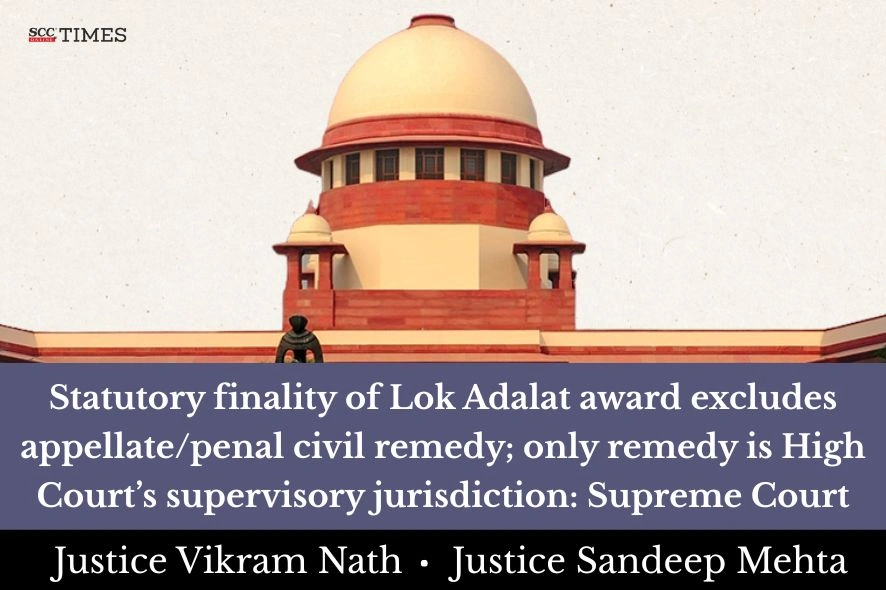
Supreme Court: The issue for consideration which arose in the present case was whether the Madhya Pradesh High Court (‘the High Court’) was justified in declining to entertain the appellant’s challenge to the Lok Adalat decree, on the ground that he had already filed objections before the Executing Court. The Division Bench of Vikram Nath and Sandeep Mehta, JJ., stated that the statutory finality attached to a Lok Adalat award, leaves no room for an appellate or plenary civil remedy against the award, which is treated as a decree. The award may be executed as a decree, but its validity cannot be reopened through an ordinary civil suit for setting it aside. The only recognised avenue of challenge is the constitutional jurisdiction of the High Court, which is supervisory and exceptional in nature.
The Court stated that the objections filed by the appellant were, in substance, a defensive step to preserve possession pending a substantive challenge to the Lok Adalat decree. Thus, the Court set aside the impugned order and remanded the matter back to the High Court to be heard and decided afresh on its own merits and in accordance with law, as expeditiously as possible from the date of receipt of a copy of this judgment.
Background
The appellant is a purchaser of certain immovable property situated at Jabalpur. The said property originally belonged to one ‘S’ and on 29-11-2008, a power of attorney was executed in Respondent 3’s favour. On 21-1-2009, an agreement to sell was executed between Respondent 3 on the one hand and Respondents 1 and 2, on the other. Based on the said power of attorney, a sale deed in favour of one ‘G’ was executed on 12-6-2009. Disputes arose between ‘S’ and ‘G’. ‘S’ instituted civil suit for a declaration that the power of attorney and the sale deed were null and void. Another suit was filed by ‘G’ seeking permanent injunction against ‘S’ in respect of the same property.
After the demise of ‘S’, her husband, asserting himself to be her sole surviving heir, executed a registered sale deed in favour of the appellant’s proprietary for a consideration of about Rupees Four Crores and Twenty Lakhs. According to the appellant, possession of the property was simultaneously delivered and has continued with him since then. Respondents 1 and 2 claim rights under the agreement to sell executed in their favour. Based on the said agreement, they instituted a suit for specific performance. The appellant and the original owner’s heirs were not impleaded as parties to that suit. In the said suit, a joint application under Order 23 Rule 3 of the Civil Procedure Code, 1908 (‘CPC’) was filed stating that the dispute had been compromised. The statements of the parties were recorded, and the compromise was verified. The matter was thereafter placed before the Lok Adalat.
On 14-5-2022, the Lok Adalat passed an award in terms of the compromise and a decree for specific performance was drawn. On the strength of the said decree, a registered sale deed was executed in favour of Respondents 1 and 2 on 22-7-2022. Respondents 1 and 2 then initiated execution proceedings before the Civil Court at Jabalpur to enforce the decree. The appellant thereupon filed an objection under Order 21 Rule 101 read with Section 151 of the CPC in Execution Case, seeking to set aside the Lok Adalat’s decree on the ground that it had been obtained by fraud.
Parallelly, on 22-9-2022, the appellant instituted writ petition before the Madhya Pradesh High Court seeking to set aside the Lok Adalat decree. The High Court held that, in view of the objections already filed by the appellant in the execution proceedings, the questions relating to right, title and interest in the property, as well as the allegations of fraud, could appropriately be adjudicated by the Executing Court and disposed of the petition. Subsequently, an appeal was filed before Division Bench of the High Court, and vide the impugned judgment, the appeal was dismissed. Hence, the present appeal was filed.
The central question in the present case was whether the High Court was justified in declining to entertain the appellant’s challenge to the Lok Adalat decree on the ground that he had already filed objections before the Executing Court.
Analysis, Law, and Decision
The Court stated that the statutory finality attached to a Lok Adalat award, leaves no room for an appellate or plenary civil remedy against the award, which is treated as a decree. The award may be executed as a decree, but its validity cannot be reopened through an ordinary civil suit for setting it aside. The only recognised avenue of challenge is the constitutional jurisdiction of the High Court, which is supervisory and exceptional in nature.
Thus, considering this, the Court stated that the High Court’s approach cannot be sustained. Once the decree sought to be executed, is one that merely embodies a Lok Adalat award under the Legal Services Authorities Act, 1987 (‘LSA Act’), the role of the Executing Court is confined to giving effect to that award in terms of execution. It has no authority to annul or set aside the award itself, or the decree drawn in its terms, nor can it sit in judgment over the validity of the compromise on which the Lok Adalat proceeded. Treating the filing of objections in such execution as an “efficacious alternative remedy” for challenging the award is inconsistent with the statutory scheme.
The Court stated that Order 21 Rules 97, 99 and 101 of CPC must also be viewed in this statutory setting. The said provisions do not authorise the Executing Court to reopen the settlement which resulted in the award, to examine the validity of the award as such, or to declare that the decree based upon it is void. The decree in such a case owes its force not merely to the CPC but to the special statute which deems the award to be a decree only for the limited purpose of execution.
The Court stated that the appellant approached the Executing Court only when warrants for delivery of possession were sought to be enforced and dispossession was imminent. The objections filed by the appellant were, in substance, a defensive step to preserve possession pending a substantive challenge to the Lok Adalat decree. In the context of a decree which merely embodies a Lok Adalat award, such objections can at best invite the Executing Court to examine whether and to what extent the decree is executable against the objector, but cannot furnish a forum for pronouncing upon the validity of the award itself or for setting aside the decree drawn in its terms.
Thus, the Court set aside the impugned order and remanded back to the High Court to be heard and decided afresh on its own merits and in accordance with law, as expeditiously as possible from the date of receipt of a copy of this judgment.
[Dilip Mehta v. Rakesh Gupta, 2025 SCC OnLine SC 2737, decided on 18-11-2025]
Advocates who appeared in this case:
For the Appellant: Siddharth Bhatnagar, Sr. Adv. ; Siddharth R Gupta, Adv. ; Sankalp Kochar, Adv. ; Siddhant Kochar, Adv. ; Mrigank Prabhakar, AOR ; Aman Agarwal, Adv. ; Uddaish Palya, Adv. ; Aditya Sidhra, Adv. ; Surbhi Saxena, Adv. ; Siddharth Sahu, Adv. ; Astha Singh, Adv ; Nr Shwetabh, Adv.
For the Respondent: Ravindra Shrivastava, Sr. Adv. ; Abhijeet Shrivastava, AOR ; Anshuman Shrivastava, Adv. ; Malik Arjun Khare, Adv. ; Shruti Verma, Adv. ; Ananya Sahu, Adv. ; Boudhik Garg, Adv. ; Shashank S Dwivedi, Adv. ; Atharva Joshi, Adv. ; Kavya Verma, Adv. ; Pallav Sishodiya, Sr. Adv. ; Kunal Verma, AOR ; Yugandhara Pawar Jha, Adv. ; Yasha Goyal, Adv. ; Swati Mishra, Adv. ; A.K. Sanghi, Sr. Adv. ; V. Sridhar Reddy, Adv. ; Abhijit Sengupta, AOR ; Hardeep, Adv. ; Deepak Bahl, Adv.
My question is If Lok adalst dismisses the criminal complaint we have to go to High court Or Supreme Court. Reply.