Disclaimer: This has been reported after the availability of the order of the Court and not on media reports so as to give an accurate report to our readers.
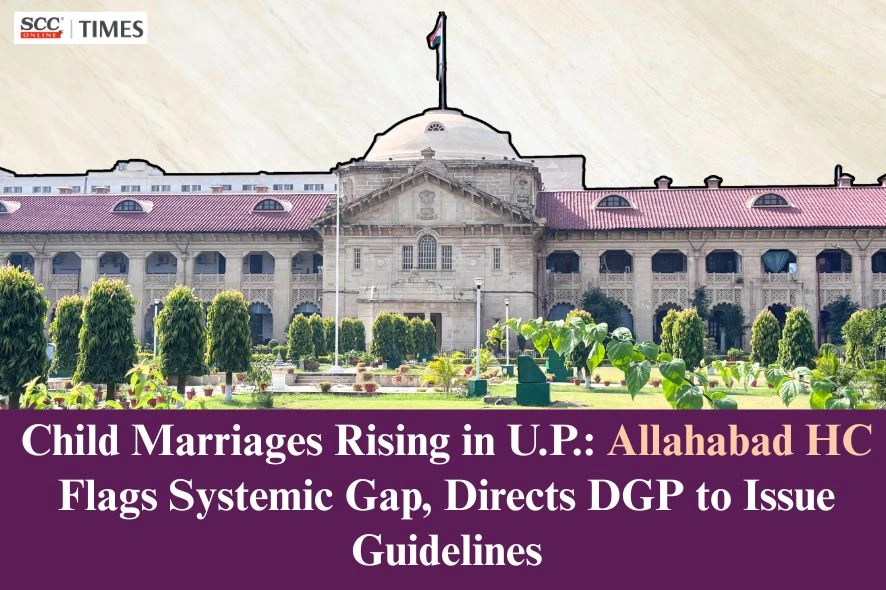
Allahabad High Court: In a writ petition filed by a 15-year-old and the accused husband seeking quashing of FIR filed against the husband by her family, the Division Bench of Rajiv Gupta and Dr Ajay Kumar-II, JJ., rejected the petition, holding that prima facie, ingredients of Sections 137(2) and 87, Nyaya Sanhita, 2023 (BNS), were clearly made out and a case has been made out against the accused persons. Remarking that child marriages were increasing in U.P. due to police inaction, the Court directed the Director General of Police, Uttar Pradesh, to issue necessary instructions, guidelines, circular letter, and Director General of Police (DGP) letter to all the Commissioners of Police/Senior Superintendent of Police/Superintendent of Police of Uttar Pradesh to ensure that appropriate action was taken whenever information about a child marriage comes to the knowledge of the police.
Background
Petitioner 1 (the daughter), i.e., the daughter of Respondent 3 (complainant), was around 15-years-old and a student of Class IX. Allegedly, in 2025 the accused, her neighbour, enticed and lured the daughter away from her home with the intention to marry her. She left home after taking gold jewellery and ₹ 20,000. The complainant contended that the accused used to visit their house with bad intentions towards her daughter, due to which they performed her Nikah (marriage) according to Muslim rites and rituals, but vidai (gauna) was pending.
The complainant also contended that the accused and his family were involved in abducting and hiding their daughter, as well as taking the jewellery and money. She claimed that she informed the police, but no action was taken by the police despite the daughter still being detained by Petitioner 2(the main accused). When no action was taken by the police, the complainant approached the Superintendent of Police, Deoria, via registered post, but yet again no action was taken. On her application under Section 173(4), Nagarik Suraksha Sanhita, 2023 (BNSS), the FIR was registered under Sections 137(2), 87, 61(2) and 316(2) BNS after the Magistrate’s order.
Aggrieved, the daughter and accused persons filed the present writ petition seeking the quashing of the FIR.
Analysis
At the outset, the Court perused the school register and certificate of the daughter and noted that her date of birth was 30 August 2011. The investigating officer (IO) had also recorded the statement of the School Principal, who affirmed the aforesaid date of birth. Therefore, the daughter was about 14 years and 9 months old.
Regarding the admission that the daughter was illegally married by the complainant to Respondent 4, the Court remarked that it was quite surprising that, without getting a divorce from the said marriage, the accused married the daughter. The Court also noted that the daughter, in her statement recorded under Section 180 BNSS, supported the prosecution’s story. Furthermore, the case diary revealed that the Child Welfare Committee, Deoria, has already handed over the custody of the daughter to her mother/the complainant.
The Court further noted that the daughter, in her statement recorded under Section 183 BNSS, stated that she was married to Respondent 4, but she ran away and started residing with the accused after marrying him. She stated that she left her matrimonial house after having a phone call with the main accused and met him in Gorakhpur. After this, they went to Deoria and stayed in a room.
Noting this, the Court stated that since she was a minor below the age of 15, her consent at this stage is immaterial. However, the main accused kept her in his home despite knowing that she was a minor girl of tender age. Additionally, her statement on leaving home after a phone call with him made it clear that there was an element of persuasion by the main accused.
Thus, the Court held that, prima facie, the ingredients of Sections 137(2) and 87 BNS were clearly made out and a case has been made out against the accused persons.
Noting that the allegations were very serious in nature, the Court held that the impugned FIR disclosed the commission of a cognizable offence against the accused persons, and sufficient evidence had already been collected implicating them, thus the impugned FIR could not be quashed at this stage.
However, before parting with the order, the Court opined that both marriages of the daughter were clearly child marriages, which were punishable under Sections 10 and 11, Prohibition of Child Marriage Act, 2006 (Child Marriage Act).
In this regard, the Court referred to Independent Thought v. Union of India, (2017) 10 SCC 800, wherein the Supreme Court clearly stated that the time had come when the Child Marriage Act needed serious reconsideration, especially considering the harsh reality that a lot of child trafficking is taking place under the guise of marriage. More stringent punishments should be imposed, and a minimum punishment should definitely be imposed, especially to those mature adults who promote, perform, conduct, direct, or abet any such marriages. Otherwise, this legislation will never act as a sufficient deterrent to prevent or even reduce child marriages.
The Supreme Court also observed that the Child Marriage Act is a secular act applicable to all. Being a Special Act dealing with children, the provisions of this Act will prevail over the provisions of both the Hindu Marriage Act, 1955 and the Muslim Marriages and Divorce Act, insofar as children are concerned. Child marriage is a reprehensible practice and an abhorrent practice that violates the human rights of a child, which cannot be seriously disputed. Child marriage will invariably lead to early childbirth, and this will adversely affect the health of the girl child. A child bride is more than twice as prone to health problems as a grown-up woman. The courts have consistently held that child marriage is an evil that should be avoided.
Noting the aforesaid, the Court remarked that child marriage is a social evil that is required to be eradicated from this country. Eradication of child marriage is not merely a statutory goal; it is a constitutional imperative. The law protects childhood so that it may blossom into informed adulthood, and the Court will not permit this protection to be diminished.
The Court stated that the provisions of the Child Marriage Act made it clear that strict action is not only required for preventing child marriage, but as soon as the fact of solemnisation/conclusion of child marriage comes to the knowledge of the police authorities, strict action is required for ensuring prosecution of all those responsible for solemnisation of such an illegal child marriage under Sections 10 and 11.
The Court also noted that normally, an FIR is lodged by the parents of a girl child regarding the kidnapping of their minor daughter, and during the course of investigation, it is found that such a minor girl has solemnised marriage with the accused. When the girl child is discovered to be a minor, provisions of the Protection of Children from Sexual Offences Act, 2012, are also invoked. However, the Court stated that it had not come across even a single case where any investigating officer invoked Sections 10 and 11, Child Marriage Act against the accused marrying a girl child and the persons responsible for solemnisation of such illegal marriage. Therefore, such instances of child marriage were increasing day by day.
“Even social and religious organisation(s), who are solemnising such illegal child marriages, normally take refuge in either the Aadhaar card of the girl child or her affidavit. Law is well-settled that the date of birth recorded in an Aadhaar card is not a valid proof of age, and despite knowing this law, they normally take illegal shelter of such Aadhaar cards and perform illegal child marriages.”
The Court opined that no such illegal child marriage can be solemnised by any religious or social organisation in the absence of clear proof of the age of the girl child. An affidavit sworn by a minor girl child that she is a major cannot make her a major. As no action was being taken under the provisions of the Child Marriage Act for prosecuting all those responsible for solemnisation of such illegal child marriages, resultantly, child marriages in Uttar Pradesh were increasing day by day.
Thus, the Court directed the Director General of Police, Uttar Pradesh, to issue necessary instructions, guidelines, circular letter, and DGP letter to all the Commissioners of Police/Senior Superintendent of Police/Superintendent of Police of Uttar Pradesh to ensure that appropriate action was taken whenever information about a child marriage comes to the knowledge of police, either on a complaint, during the course of investigation, or suo motu. Accordingly, proceedings under Sections 10 and 11, Child Marriage Act shall be initiated against all those responsible for the solemnisation of a child marriage without any delay.
The Court remarked that only when such action is promptly taken with full vigour and force against all those responsible for solemnisation of such child marriages can the social evil of child marriages be wiped out.
The Court also directed the IO of the present case to look into the matter from the perspective of the Child Marriage Act and proceed further in accordance with the law. In the course of the investigation, if it is found that a particular person had performed, conducted, directed, or abetted the marriage, then, according to Section 10, Child Marriage Act, such a person would be an accused.
Accordingly, the petition was dismissed as there was no ground to quash the FIR.
[Chahat Ansari v. State of U.P., 2026 SCC OnLine All 7655, decided on 13-5-2026]
Advocates who appeared in this case:
For the petitioner: M.J. Akhtar
For the respondent: G.A., Jagdish Singh