


Disclaimer: This has been reported after the availability of the order of the Court and not on media reports so as to give an accurate report to our readers.
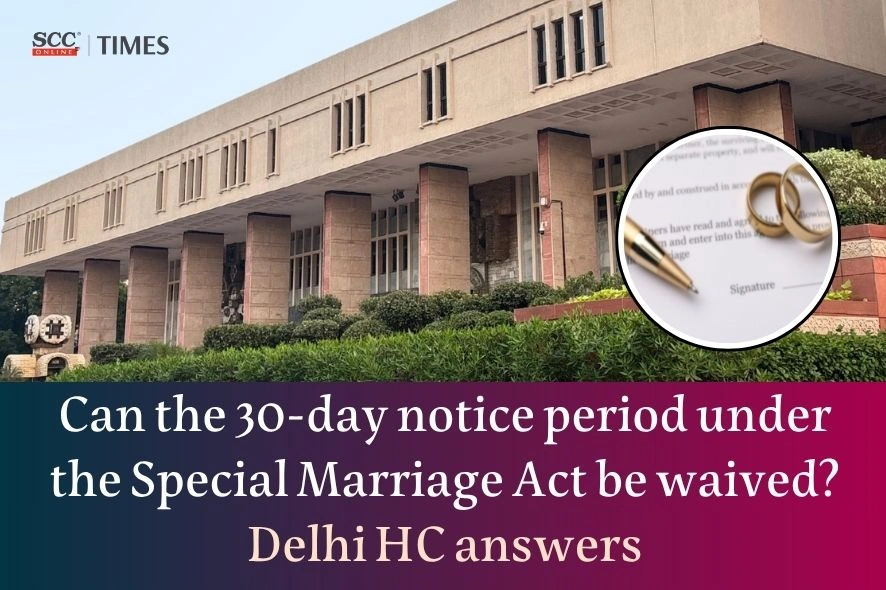
Delhi High Court: In a writ petition seeking relaxation of the statutory 30-day notice period prescribed under the Special Marriage Act, 1954 (SMA Act) and a direction for early solemnisation of marriage on account of the petitioner’s impending overseas employment, a Single Judge Bench of Purushaindra Kumar Kaurav, J., dismissed the petition, holding that the statutory waiting period forms an integral part of the legislative framework and cannot be waived by the Court in exercise of its writ jurisdiction.
The Court observed that neither personal hardship nor individual exigencies could justify deviation from an express statutory mandate and reiterated that where a statute prescribes a particular procedure, it must be followed in the manner contemplated by law. Consequently, the Court declined to direct the Marriage Officer to solemnise the marriage before expiry of the prescribed notice period.
Background
The petitioners approached the Court seeking a direction to the Marriage Officer to relax the statutory 30-day notice period prescribed under the SMA Act and to solemnise/register their marriage before 10 June 2026. The petitioners had submitted a notice of intended marriage on 11 May 2026 before the Marriage Officer, Kalkaji, in terms of Section 5, SMA Act. However, owing to the mandatory waiting period contemplated under Sections 6 and 7, the marriage was scheduled for solemnisation on 19 June 2026. The petitioners contended that Petitioner 1 had secured employment abroad and was required to join duty before 10 June 2026, necessitating an early solemnisation of the marriage. It was argued that insistence on completion of the statutory notice period would cause undue hardship to the petitioners despite there being no legal impediment to their marriage.
Analysis
The Court held that the precedents relied upon by the petitioners were inapplicable to the controversy at hand. It observed that Pranav Kumar Mishra v. State (NCT of Delhi), 2009 SCC OnLine Del 725, concerned the legality of the procedure adopted for publication and verification of notices under the Special Marriage Act, 1954, whereas Safiya Sultana v. State of U.P., 2021 SCC OnLine All 19, dealt with issues of personal liberty, privacy and the right to choose a life partner in a habeas corpus petition. Neither decision addressed the question of waiver or curtailment of the statutory 30-day notice period prescribed under the Act.
Examining the statutory scheme, the Court noted that Section 16 expressly permits solemnisation of a marriage only after the expiry of 30 days from publication of the notice under Section 6. Reiterating the settled principle that where a statute prescribes a particular manner for doing an act, it must be done in that manner alone, the Court held that writ jurisdiction under Article 226 cannot be invoked to compel statutory authorities to act contrary to an express legislative mandate.
The Court further observed that the waiting period forms an integral part of the legislative framework and is not a mere procedural formality capable of being waived on grounds of personal hardship. Relying on several Supreme Court decisions, the Court emphasised that inconvenience or hardship cannot justify dilution of mandatory statutory requirements and that courts cannot rewrite or modify statutory provisions under the guise of interpretation.
Decision
Holding that the relief sought would effectively require the authorities to violate the provisions of the Act, the Court declined to grant any exemption from the statutory waiting period and dismissed the writ petition as devoid of merit.
[Syed Fayazuddin v. State (NCT of Delhi), 2026 SCC OnLine Del 4637, decided on 21-5-2026]
Advocates who appeared in this case:
For the Respondents: Mohit Aggarwal and Prerak Khurana, Advocates


If the said couple exchanged garlands, took 7 steps, tied thali, with witness, priest photo, printed invite , all for next day and wanted to register it that afternoon, is that OK?
If so, then the law is an ass.
Fail to understand how something as private as marriage needs public notice.
Isn’t privacy a fundamental right post Puttana vs Karnataka?