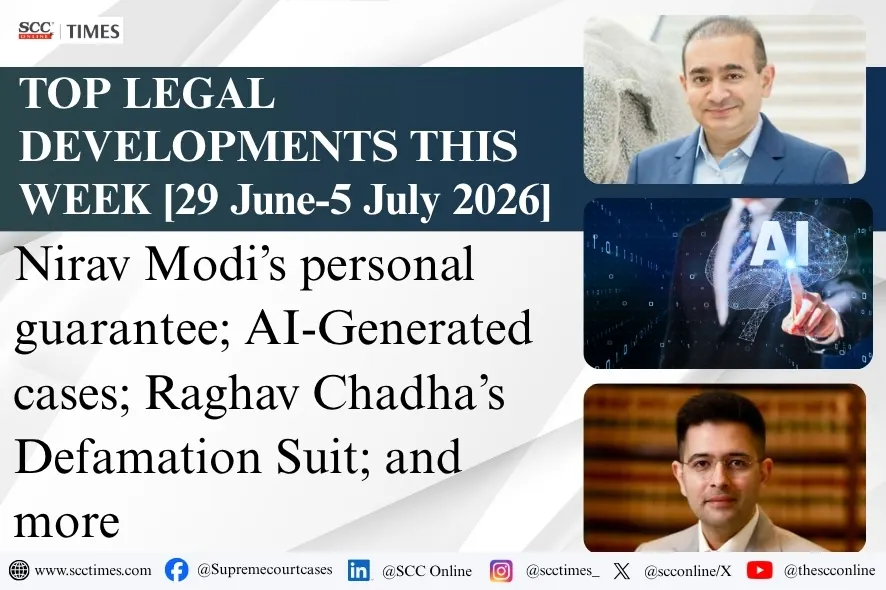
Catch up on the top legal developments this week (29th June—5th July 2026), including Hallucinated Citations, EWS reservation, ITR in motor accident claims, Udaipur Lake encroachment, selection of Indian Dressage Team, Lilavati recovery case, US Birthright Citizenship, pregnant wife murdered by husband, and more.
STORY OF THE WEEK
ARTIFICIAL INTELLIGENCE | Reliance on AI-Generated Fake Precedents Vitiates Adjudication; Zero Tolerance for Hallucinated Citations
In Pooja Ramesh Singh v. Jammu and Kashmir Bank Ltd.1, the Supreme Court set aside the orders of the NCLT and NCLAT which had admitted a Section 7 application under the Insolvency and Bankruptcy Code, 2016 (IBC). The Court held that the adjudicatory process stood vitiated as the tribunals had relied upon non-existent, fake and hallucinated precedents, allegedly generated through artificial intelligence, thereby undermining the integrity of adjudication. Reiterating a “zero-tolerance” approach towards reliance on unverified or AI-generated precedents, the Court held that a decision based on such material is no decision in the eyes of law and even an iota of such reliance vitiates the adjudication.
Read more HERE
SUPREME COURT HIGHLIGHTS
MOTOR VEHICLES CLAIM | “Just Compensation” Requires Recognition of Practical Impact of Permanent Disability on Claimant’s Occupation and Future Life: ₹10 Lakh awarded for Prosthetic Support to Injured Carpenter
In Shankar Dutt v. United India Insurance Co. Ltd., 2026 SCC OnLine SC 1193, the Supreme Court enhanced the compensation to ₹35,95,923 with 6 per cent per annum interest from the date of filing of the claim petition till actual payment, holding that the appellant’s amputation rendered him completely incapable of pursuing his vocation as a carpenter, therefore, his functional disability must be assessed as 100 per cent.
Read more HERE
RESERVATION | EWS reservation does not extend to fee concessions: Rajasthan HC Judgment on plea for fee relief in private medical colleges, upheld
In a matter titled Harshvardhan Singh v. State of Rajasthan, 2026 SCC OnLine SC 1219, concerning whether Economically Weaker Sections (EWS) candidates admitted to private medical colleges are entitled to fee concessions, in addition to reservation in admissions, to make the constitutional benefit of EWS reservation meaningful, the Supreme Court declined to interfere with a Rajasthan High Court judgment rejecting such a plea. Dismissing the Special Leave Petition (SLP), the Court observed that it found no reason to interfere with the impugned order. However, it clarified that the larger question of law, if any, has been left open for consideration in an appropriate case.
Read more HERE
LAND LAW | 1957 Registered Sale Deed Not Void for Alleged Violation of S. 154, U.P. Zamindari Abolition Act; 1982 Amendment Cannot Apply Retrospectively
In Sarafat Ali v. Director of Consolidation, 2026 SCC OnLine SC 1190, the Supreme Court set aside the concurrent judgments of the High Court and the consolidation authorities, holding that a transfer allegedly made in contravention of Section 154, Uttar Pradesh Zamindari Abolition and Land Reforms Act, 1950, was not rendered void ipso facto under the statutory regime then in force. Observing that the 1982 Amendments to Sections 166 and 167 of the Act introduced substantive changes and could not be applied retrospectively to invalidate accrued rights, the Court further held that a registered sale deed carries a statutory presumption of genuineness and due execution, which cannot be displaced by inconsequential discrepancies relating to an attesting witness in the absence of any plea or proof of fraud, forgery, coercion or impersonation.
Read more HERE
MOTOR ACCIDENT CLAIMS | How ITRs can be used to assess annual income of deceased persons in Motor Accident Claims?
While deciding this appeal titled Rashmirekha Tripathy v. Sriram General Insurance Co. Ltd., 2026 SCC OnLine SC 1256 , the Supreme Court, noting that ITRs being statutory documents are an important reference point when it comes to assessing one’s income for the purposes of compensation under the MV Act, laid down important guidelines for assessment annual income of salaried persons and self-employed individuals using ITRs in respect of determining the compensation in motor accident claims.
Read more HERE
HIGH COURT HIGHLIGHTS
MOTOR ACCIDENT CLAIM | ‘Income of No Person Can Remain Static’: Compensation Awarded to Coolie in Motor Accident Claim, enhanced
In United India Insurance Co. Ltd. v. Shivamma, 2026 SCC OnLine Kar 2987, the Karnataka High Court modified the impugned judgment and award, enhancing the compensation to ₹11,98,943 after considering the deceased’s prospects. The Court simultaneously dismissed the insurance company’s appeal, finding no merit in its challenge upon a consideration of the facts and evidence on record.
Read more HERE
LIVE IN RELATIONSHIP | Read why protection was denied to a live-in couple who ran away from home
In Lisha v. State of Punjab, 2026 SCC OnLine P&H 18120, the Punjab and Haryana High Court, dismissed the petition, holding that constitutional protection cannot be granted merely on the basis of a bald assertion of a live-in relationship when the legal prerequisites for such a relationship are not fulfilled.
Read more HERE
MUNICIPAL CORPORATIONS | “FIR to wrong Magistrate won’t save the day”: Section 471 DMC Act limitation and Municipal Magistrate jurisdiction clarified in landmark reference
In Court on its Own Motion v. State (NCT of Delhi), 2026 SCC OnLine Del 4768, wherein recurring questions concerning prosecutions under the Delhi Municipal Corporation Act, 1957 (DMC Act) were raised, particularly regarding the interpretation of Sections 466-A, 467 and 471, the Delhi High Court provided several clarifications regarding Section 471 DMC Act.
Read more HERE
ENVIRONMENT LAW | “Lakes are not mere water bodies but living heritage”: Suo motu cognizance taken of encroachments and decay threatening Udaipur’s lakes, status quo ordered
In a case titled Suo Moto v. State of Rajasthan, 2026 SCC OnLine Raj 3865, the Rajasthan High Court invoked its suo motu jurisdiction in larger public interest so as to ensure effective protection, preservation and sustainable management of lakes, water bodies, canals and associated ecological systems situated within Udaipur and the proceedings were registered as a suo motu public interest litigation (PIL) under Article 226 of the Constitution on the basis of the newspaper reports by Rajasthan Patrika.
Read more HERE
EDUCATION LAW | Rejected hours before her exam over a missing hard copy, candidate gets relief from special Sunday sitting to write UPPSC APO Mains
In a writ petition titled Shalini Pandey v. State of U.P., 2026 SCC OnLine All 19157, filed by a candidate challenging the rejection of her candidature for the Assistant Prosecution Officer (APO) 2025 Mains examination, scheduled 3 hours later on the same day, the Allahabad High Court granted interim relief by directing the Uttar Pradesh Public Service Commission (UPPSC) to provisionally permit the petitioner to appear in the Mains examination. The Court observed that the petitioner’s candidature had been rejected solely on the ground of non-submission of the hard copy of the application form, despite the fact that her submission of the online application was undisputed.
Read more HERE
PROPERTY LAW | Drainage restoration measures under Disaster Management Act not hit by Art. 300-A; No acquisition or compensation required
While deciding a batch of writ petitions titled Netaji Shekumbar Bhopale v. Commissioner, 2026 SCC OnLine Bom 4192, concerning notices issued for desilting and construction of storm water drains, the Bombay High Court held that drainage restoration backed by Disaster Management Act, 2005 (DM Act) is not hit by Article 300-A of the Constitution. The Court observed that the authorities were acting within the scope of statutory powers under the DM Act and the Maharashtra Municipal Corporation Act, 1949 (MMC Act) and that such action, being in public interest, did not require acquisition or compensation.
Read more HERE
MEDICAL AND HEALTH LAW| Cipla’s blacklisting over non-supply of Remdesivir during the COVID-19 second wave, quashed
In Cipla Ltd. v. Chhattisgarh Medical Services Corpn. Ltd., 2026 SCC OnLine Chh 11660, the Chhattisgarh High Court stated that the term “indicative quantity” did not permit the procuring agency to impose an extraordinary increase in demand and thereafter penalise the supplier for non-compliance without considering the prevailing circumstances. The Court found that Cipla, had consistently informed the respondents of the difficulties caused by the second wave of COVID-19, including shortages of raw materials, supply chain disruptions, reduced manufacturing capacity, and Central Government allocation directives. The Court held that the respondents failed to consider these relevant factors and that the 3-year blacklisting and forfeiture of the security deposit were arbitrary and disproportionate. Accordingly, the Court quashed the impugned orders.
Read more HERE
LAND LAW | Read why compensation for land acquired for Hassan-Arasikere Railway project, refused to be reduced
In appeals titled Engineer v. Chandrashekara, 2026 SCC OnLine Kar 4089, filed under Section 54(1), Land Acquisition Act, 1894 (Land Act) challenging enhancement of compensation for land acquired for the Hassan- Arasikere Railway project, the Karnataka High Court held that although the Reference Court had relied on judgments that were later set aside on appeal, the claimants had independently produced contemporaneous evidence, including sale deeds and proof the land’s locational advantages, sufficient to sustain the enhancement. Accordingly, the Court declined to interfere with the compensation awarded and dismissed the appeals.
Read more HERE
EDUCATION LAW | Challenge to a Policy Doesn’t Justify Interim Suspension of Operative Rules; AFT’s Refusal to Permit NEET PG Appearance Under Superseded Rules, affirmed
In Major Jayati Chandra v. Union of India, 2026 SCC OnLine Del 4826, challenging Armed Forces Tribunal (AFT)’s refusal to grant interim relief, to Short Service Commission (SSC) Medical Officers pending challenge to validity of the Training and Professional Progression Rules for Medical/Non-Technical Officers of Armed Forces Medical Services, 2025 (Training Rules 2025), which reduced the eligibility period for appearing in the NEET PG examination from 10 years to 7 years of physical service, the Delhi High Court affirmed the impugned order wherein it was held that a mere challenge to the validity of the Training Rules 2025 does not establish a prima facie case for interim relief that would effectively suspend the operation of the Rules while their validity of NEET PG eligibility for SSC Medical Officers remains pending before the AFT for final adjudication.
Read more HERE
CRIMINAL LAW | Husband who called police himself after killing pregnant wife gets life sentence commuted to 7 years: Held, verbal taunt amounted to grave and sudden provocation
In a criminal appeal titled Shiva v. State of M.P., 2026 SCC OnLine MP 18550, filed by a husband convicted of murdering his pregnant wife by stone pelting, the Madhya Pradesh High Court partly allowed the appeal, holding that it was not a premeditated murder because if the convict intended to murder his wife, then he would not have informed the police and other people, like the complainant. Thus, it was a case of grave and sudden provocation caused by the wife’s statement that she could keep 1000 husbands like him. Accordingly, the Court convicted him under Section 304-II, Penal Code, 1860 (IPC).
Read more HERE
SPORTS LAW | Interference with Indian Dressage Team selection for 20th Asian Games, declined; Limited scope of judicial review in sports selections reiterated
In Sudipti Hajela v. Equestrian Federation of India, 2026 SCC OnLine Del 4828, filed regarding the selection of the Indian Dressage Team for the 20th Asian Games, the Delhi High Court declined to interfere with the selection list issued by the Ad hoc Committee of the Equestrian Federation of India (EFI), holding that the Selection Committee had evaluated the competing horse-rider combinations strictly in accordance with the prescribed Selection Criteria Version 4.0. The Court reiterated that judicial review in matters of sports selection is confined to examining the decision-making process and does not permit the writ court to substitute its own assessment for that of an expert body.
Read more HERE
RIGHT TO INFORMATION | National Stock Exchange of India is a “public authority” under RTI Act
While deciding pure question of law arising an appeal, whether the National Stock Exchange of India (NSEI) is a “public authority” within the meaning of Section 2(h) of the Right to Information Act, 2005 (RTI Act) in a case titled National Stock Exchange of India Ltd. v. Central Information Commission2, the Delhi High Court upheld the Single Judge’s judgment, holding that NSEI is amenable to the RTI Act.
Read more HERE
CRIMINAL LAW | Investigating officer cannot do two jobs at once: Separate police wings for investigation and law & order, establishment of investigation labs and increase in cadre strength, directed
In a petition titled Prem Prakash Bidyasar v. State of Rajasthan3, dealing with the recommendations of the Committee report for two separate wings of police for investigation and law and order maintenance, the Rajasthan High Court issued directions to Chief Secretary and Additional Chief Secretary, Home Department, Rajasthan, to increase the cadre strength of the police and investigator staff, and establish well-equipped investigation labs in the State of Rajasthan for expeditious investigation, holding that lack of investigation labs in the State causes unnecessary delay in investigation process and that the State is under constitutional obligation to provide adequate infrastructure and trained stakeholders for fair and speedy investigation as the delay in investigation, due to lack of adequate infrastructure for investigation, violates the right of fair investigation and speedy trial.
Read more HERE
DEFAMATION | Public Figures Must Tolerate Political Satire, But Not Vulgar AI Deepfakes That Cross the Line Into Defamation; Raghav Chadha’s Defamation Suit partly allowed
An application titled Raghav Chadha v. Ashok Kumar4 was filed by Raghav Chadha, a Member of Parliament in the Rajya Sabha representing Punjab, seeking protection against the circulation of artificial intelligence (AI)-generated deepfake videos, morphed images, synthetic media and other manipulated content allegedly created to tarnish his public image. While acknowledging the serious threat posed by AI-enabled misinformation and its potential to undermine an individual’s dignity and reputation, the Delhi High Court held that “public figures assuming such positions of power must accept being at the receiving end of the satirical humour as a necessary and inevitable aspect of their profession, though unpleasant”. However, the Court clarified that AI-generated content that is profane, vulgar, malicious, or seriously impairs an individual’s dignity may justify judicial intervention.
Read more HERE
POCSO| Incoherence in a 3-Year Old’s Narrative Does Not Diminish Its Credibility; Bail Granted to POCSO Accused School Caretaker, cancelled
In State v. Lalit Kumar, 2026 SCC OnLine Del 4827, wherein the State and the victim’s mother (complainant) sought cancellation of bail granted to an accused charged with aggravated penetrative sexual assault on a 3-year-old child under the Protection of Children from Sexual Offences Act, 2012 (POCSO Act), the Delhi High Court cancelled the bail holding that where the victim is a child of tender age and the investigation in a POCSO case is at a crucial stage, the Court must assign due weight to the child’s consistent disclosure, identification of the accused, surrounding circumstances, and the object of the POCSO Act.
Read more HERE
HEALTH AND MEDICAL LAW | No absolute bar on organ donation by minors: 17-year-old permitted to donate part of liver to father on exceptional medical grounds
In a petition titled Pratik Shaw Minor v. Union of India5, wherein a mother sought seeking permission to donate a portion of her son’s liver to his father, who was suffering from advanced chronic liver disease with cirrhosis, portal hypertension, ascites, and hepatocellular carcinoma, the Delhi High Court permitted the 17-year-old minor to donate a part of his liver to his father, observing that while the law generally prohibits living organ donation by minors, such donations may be allowed in exceptional medical circumstances where the statutory requirements are fully satisfied.
Read more HERE
TRIBUNALS AND COMMISSIONS
DEBT RECOVERY TRIBUNAL | Costs of ₹1 imposed on Bank of Maharashtra’s MD for repeated non-compliance in Lilavati recovery case
In Recovery Proceeding No. 709 of 2004, a case governing Bank of Maharashtra’s repeated non-compliance in Lilavati Foundation recovery proceedings, the Tribunal imposed costs on the salary of a Bank of Maharashtra officer and a symbolic cost of ₹1 on the Managing Director of the Bank after finding repeated non-compliance with its earlier directions requiring disclosure of information relevant to pending recovery proceedings. The Tribunal observed that the affidavit filed by the Bank was “not in line with the specific directions” previously issued and could not be treated as complete compliance.
Read more HERE
NATIONAL COMPANY LAW TRIBUNAL | Share allotment diluting majority shareholder held oppressive: Rs 2.5 crore share allotment in MBG Commodities, cancelled
In Ashok Kumar Mandhani v. MBG Commodities (P) Ltd.,6 a company petition was filed under Sections 241 and 242, Companies Act, 2013 (Act) by Ashok Kumar Mandhani and 4 other family shareholders (petitioners) against MBG Commodities (P) Ltd. (Respondent 1) and 7 others, alleging oppression and mismanagement arising out of a disputed rights issue and share allotment that diluted the petitioners collective shareholding. The NCLT allowed the petition, holding that the extraordinary general meetings were void for want of valid notice and that an allotment effected through a procedurally defective process, resulting in the reduction of the petitioners from a majority to a minority constituted oppression.
Read more HERE
CESTAT| Construction services provided to Tsunami affected areas, not “Commercial or Industrial Construction Service”: Service Tax demand on Pal Promoters, quashed
In Pal Promoters (P) Ltd. v. Commissioner of GST & Central Excise, 2026 SCC OnLine CESTAT 1432, wherein an appeal was filed against order confirming the demand of service tax on construction activities rendered by the appellants-Pal Promoters Pvt. Ltd and its Managing Director (MD) fell under “Commercial or Industrial Construction Service” as per Section 65(25-b), Finance Act, 1994 (Finance Act) and “Construction of Complex service” as per Section 65(91-a), Finance Act, the Customs Excise & Service Tax Appellate Tribunal set aside the order of demand and held that construction services provided did not constitute commercial construction activity.
Read more HERE
Also read: CCI approves 100% acquisition of Royal Challengers Bengaluru’s parent company
FOREIGN COURTS
US SUPREME COURT | Birthright Citizenship Dispute: Executive Order Restricting US Citizenship at Birth, struck down
The question that arose in Trump v. Barbara7, was whether the Constitution guarantees citizenship to children born in the United States to parents who are unlawfully or temporarily present in the country. The US Supreme Court, by a 5:4 majority, held that such children are citizens at birth under the Citizenship Clause of the Fourteenth Amendment. The Executive Order was, however, struck down by a 6:3 majority. The Court ruled that children born in the United States to parents who are unlawfully or temporarily present are “subject to the jurisdiction” of the United States and therefore acquire citizenship at birth. The majority concluded that neither the constitutional text, historical understanding, nor precedent supports a domicile- or parent-status-based limitation on birthright citizenship.
Read more HERE
UK HIGH COURT | Failure to Obtain RBI Approval No Defence to Liability: Nirav Modi’s Personal Guarantee enforced
In a claim titled Bank of India v. Firestar Diamond FZE8, filed by Bank of India seeking to enforce a personal guarantee executed by Nirav Modi in respect of credit facilities advanced to Firestar Diamond FZE, the UK High Court held that Nirav Modi had been validly served with the Bank’s demand and was liable under the Personal Guarantee for the outstanding principal sum of USD 4.1 million, together with contractual interest, resulting in a liability of over USD 10.7 million.
Read more HERE
OTHER UPDATES
NEWS
LEGISLATIONS
- Government Extends Deadline for Filing Appeals Before GST Appellate Tribunal to 31 July 2026
- Passport Fees Revised from July 2026: What You Need to Know
- New RTI Framework in Maharashtra: Key Highlights of the 2026 Rules
- Temporary Restrictions on Petrol and Diesel Sales Withdrawn; Normal Distribution Resumes from 1 July
- Jan Vishwas (Amendment of Provisions) Act, 2026: Government Introduces Improvement Notice Mechanism under the Legal Metrology Act, 2009
- Employees’ Deposit-Linked Insurance Scheme, 2026: Key Changes in Assurance Benefits, Claim Settlement, and Employer Compliance
ALSO READ
- Top Weekly Legal Developments India: 22-28 June 2026 | SCC Times
- Know Thy Newly Appointed Supreme Court Judge: Justice V. Mohana
- IVYAP & TAET Host International Arbitration Careers Panel
- India’s Evolving IBC and Competition Law Landscape: Key Takeaways from Khaitan & Co.’s Media Roundtable
- A decade of the IBC, 239 insolvency professionals, and a blueprint for the next ten years: IICA national conference charts India’s restructuring future
- ‘A haven of legal peace in a world that gets more complex by the minute’: IAC Eurasia Arbitration Week 2026 opens in Astana with calls for stronger institutions and independent dispute resolution
- Gary Born on the past, present and future of International Arbitration at IAC Eurasia Arbitration Week 2026
- “AIFC Court and IAC is our shortcut to the rule of law”: Panel on arbitration, legal traditions and institutional development at IAC Eurasia Arbitration Week 2026
- Cross-border M&A disputes require dispute architecture, not just arbitration: Experts discuss at IAC Eurasia Arbitration Week 2026
- Ushering new era of Kazakhstan’s legal system: Justice Margarita Odintsova and Justice Aigul Kydyrbayeva deliver notable addresses at IAC Eurasia Arbitration Week 2026
- ‘Commercial certainty, rule of law and cultural understanding will shape arbitration’s future’: Lawrence Teh shares Singapore’s journey at IAC Eurasia Arbitration Week 2026
- ‘Asia is becoming a superpower of disputes’: Prof. Loukas Mistelis highlights global arbitration trends at IAC Eurasia Arbitration Week 2026
- “Trust, but verify”: Experts discusses AI governance, ethics and accountability at IAC Eurasia Arbitration Week 2026
- Evolving Investment Arbitration Landscape: Experts discuss BIT reforms, State practice, and emergence of Investment Mediation at IAC Eurasia Arbitration Week 2026
1. CIVIL APPEAL NO. 11950 of 2025
2. LPA 315/2010
3. Criminal Miscellaneous (Petition) No. 4784/2019
4. CS(OS) 466/2026
5. W.P.(C) 4045/2026
6. C.P. (Companies Act) No. 32/241/HDB/2025
7. 609 U.S. ___ (2026)
8. [2026] EWHC 1565 (Comm)