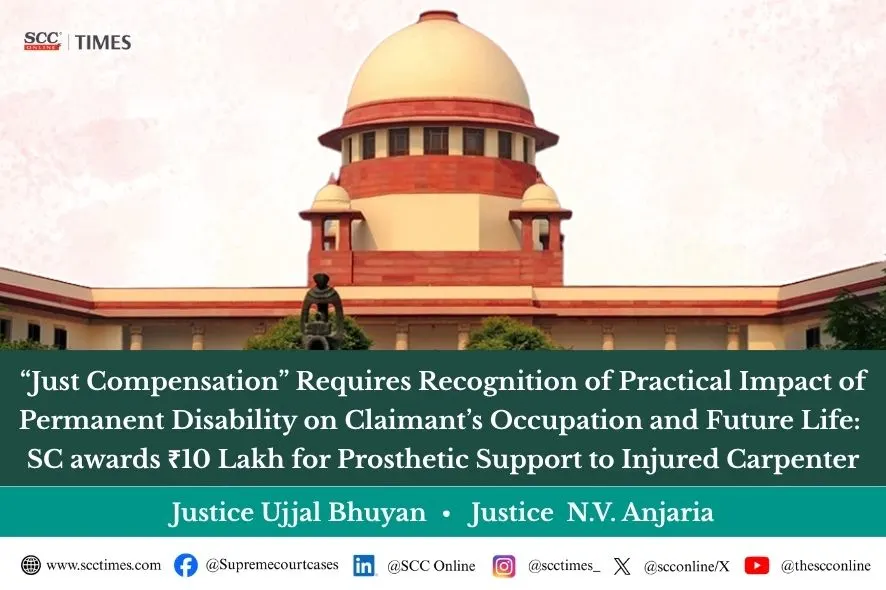
Supreme Court: In an appeal, revisiting the principles governing the assessment of compensation under the Motor Vehicles Act, 1988 (the Act) where the injured claimant suffers permanent disability resulting in loss of earning capacity, the Division Bench of Ujjal Bhuyan and N.V. Anjaria*, JJ., enhanced the compensation to ₹35,95,923 with 6 per cent per annum interest from the date of filing of the claim petition till actual payment, holding that the appellant’s amputation rendered him completely incapable of pursuing his vocation as a carpenter, therefore, his functional disability must be assessed as 100 per cent.
The Court reiterated that “the purpose of fair compensation is to restore the injured to the position he was in prior to the accident as best as possible”.
Watch Now: Supreme Court Recognises Homemakers’ Unpaid Work; Creates “Loss of Domestic Care” Compensation Head
Factual Matrix
On the night of 9 November 2004, the appellant, aged about 38 years, was travelling on his motorcycle from Kotdwar towards Motadhak. At about 8.00 p.m., a Jeep driven by its owner in a rash and negligent manner, came from the opposite direction, entered the wrong side of the road and collided head-on with the appellant’s motorcycle. The impact of the collision caused severe injuries to the appellant, particularly to his right leg.
Immediately after the accident, the appellant was admitted to the government hospital at Kotdwar. Owing to the seriousness of his injuries, he was referred the very next day to Himalayan Hospital, Jolly Grant, Dehradun, where he remained under treatment for approximately 43 days. Despite sustained medical treatment, the injuries to his right leg were so extensive that the doctors were compelled to amputate the leg above the knee to save his life.
Prior to the accident, the appellant earned his livelihood as a carpenter. According to him, carpentry was his sole occupation and the only source of income for maintaining his wife and 2 minor children. The amputation permanently deprived him of his ability to perform carpentry work, which necessarily required sitting in a squatting or cross-legged position while handling woodworking tools. Consequently, he had become incapable of carrying on his profession and had suffered complete loss of earning capacity.
The appellant instituted a claim petition before the Motor Accident Claims Tribunal (Tribunal) seeking compensation of ₹18,50,000 for the permanent disability, medical expenses, pain and suffering, and the consequent loss of income arising out of the accident.
Procedural History
The Tribunal held that the accident occurred due to the rash and negligent driving of the Jeep. and awarded compensation amounting to ₹4,77,823, together with interest at 4 per cent per annum from the date of filing of the claim petition until realisation.
Dissatisfied with the quantum of compensation, the appellant preferred an appeal before the High Court. The High Court partly allowed the appeal and enhanced the Court compensation to ₹11,51,423, carrying interest at 6 per cent per annum. While the High increased the appellant’s monthly income from ₹3000 to ₹5000 and granted compensation towards future prospects, pain and suffering, future nourishment and future medical expenses, it maintained the assessment of permanent disability at 70 per cent and reduced the multiplier from 17 to 15 in accordance with the decision in Sarla Verma v. Delhi Transport Corpn., (2009) 6 SCC 121.
Dissatisfied even after the enhancement, the appellant approached the Supreme Court holding that High Court had failed to award “just and fair compensation” because it underestimated his income, ignored several legitimate heads of compensation, and wrongly equated medical disability with functional disability.
Issues for Determination
-
Whether the appellant’s monthly income had been properly assessed?
-
Whether the High Court erred in treating his disability as only 70 per cent despite the complete loss of his earning capacity as a carpenter?
-
Whether compensation ought to have been awarded towards the purchase, replacement and maintenance of an artificial limb, attendant charges, transportation, loss of income during treatment and other consequential expenses?
-
Whether the multiplier adopted by the High Court was correct; and ultimately?
-
What would constitute fair compensation in light of the settled principles governing permanent disability and loss of future earnings?
Analysis
At the outset, the Court reiterated that the determination of compensation in cases involving permanent disability must be guided by the principle of awarding “just and fair compensation”. The award of compensation must cover among others, the following aspects:
1. pain, suffering and trauma resulting from the accident,
2. loss of income including future income,
3. the inability of the victim to lead a normal life together with its amenities,
4. medical expenses including those that the victim may be required to undertake in future, and
5. loss of expectation of life.
Relying on Laxman v. Oriental Insurance Co. Ltd., (2011) 10 SCC 756, the Court observed that a victim who suffers permanent or temporary disability in a motor accident is entitled to compensation that extends beyond reimbursement of medical expenses. Such compensation must account for the “pain, suffering and trauma caused due to accident, loss of earnings and victim’s inability to lead a normal life and enjoy amenities which he would have enjoyed but for the disability caused due to the accident”.
Carpentry is a Skilled Occupation
The Court referred to State of Orissa v. Adwait Charan Mohanty, 1995 Supp (1) SCC 470 and Neeta v. Divisional Manager, Maharashtra SRTC, Kolhapur, (2015) 3 SCC 590 and it observed that a carpenter is an artisan possessing specialised skill and manual dexterity and cannot be equated with an unskilled labourer. Quoting its earlier exposition on the meaning of “artisan”, the Court noted that an artisan is 1 who practises an industrial art and produces articles of commercial value through technical skill and craftsmanship. It also recalled the observation in Karamjit Singh v. Amandeep Singh, 2024 SCC OnLine SC 4275 that “it would be unfair to classify a carpenter as an unskilled worker”. Since carpentry is a skilled profession capable of yielding higher earnings, the claimant’s occupation had to be given due weight while assessing his income.
Fair Assessment of Notional Income
The Court found the High Court’s assessment of the appellant’s monthly income at ₹5000 by relying upon Chameli Devi v. Jivrail Mian, 2019 ACJ 3011, as inadequate. It noted that while Chameli Devi related to an accident that occurred in 2001, the present accident took place in November 2004. Moreover, the appellant’s evidence that he earned between ₹8000 and ₹10,000 per month as a carpenter had substantially remained unchallenged. Recognising that “a skilled job would always have potentiality to fetch and earn higher income”, the Court held that a monthly income of ₹9000 represented a fair and reasonable assessment for computing compensation.
Multiplier Correctly Applied
The Court rejected the appellant’s challenge to the multiplier adopted by the High Court. Applying the principles laid down in Sarla Verma, the Court held that since the claimant was 38 years of age on the date of the accident, the appropriate multiplier was 15. Accordingly, the multiplier applied by the High Court was maintained.
Loss of Earning Capacity as the Determinative Factor
The Court described loss of earning capacity as the central consideration in cases involving permanent disability. It observed that an injured person suffers not merely physical impairment but also a substantial reduction in the ability to earn a livelihood. This impairment operates both in the present and for the future, particularly where the disability is permanent. Consequently, the quantum of compensation must correspond to the extent of the loss of earning capacity.
The Court emphasised that the assessment cannot be mechanical. Besides the extent of disability, regard must be had to the claimant’s occupation, age, socio-economic circumstances and the practical impact of the injury on his earning ability. Echoing Raj Kumar v. Ajay Kumar, (2011) 1 SCC 343, the Court reiterated that the percentage of medical disability should not automatically be treated as the percentage of economic loss. The true enquiry is the effect of the disability upon the claimant’s earning capacity.
Medical Disability v. Functional Disability
Drawing a clear conceptual distinction, the Court explained that medical disability and functional disability are not synonymous. Medical disability reflects the degree of bodily impairment assessed according to medical standards, whereas functional disability concerns the actual effect of that impairment upon the claimant’s ability to carry on his occupation and perform the functions necessary for earning a livelihood.
The Court observed that “what matters is the extent by which the functions of an injured person suffers, and not what the doctor may have judged in terms of medical standards”. Therefore, functional disability must be evaluated with reference to the claimant’s profession, age, nature of work and the adverse impact of the injury on his earning capacity. An injury that is medically assessed as partial may, in practical terms, completely disable a person from continuing his chosen vocation.
Application to Present Case
Applying these principles, the Court concluded that the appellant’s functional disability was 100 per cent despite the Medical Board certifying 70 per cent permanent disability. The appellant was a carpenter whose work necessarily required sitting in a squatting or cross-legged position while handling tools and preparing wooden articles. Following the amputation of his right leg, he was unable to sit in such positions, could not stand without support, and required assistance in carrying out several ordinary activities.
The Court held that “it is essential and indispensable for a carpenter to sit to do the carpentry works”. Since the appellant could no longer perform the very functions indispensable to his trade, the injury had destroyed his earning capacity as a carpenter. Therefore, his disability had to be assessed in the context of his occupation rather than the percentage stated in the medical certificate.
Restoring Injured to same position
The Court reiterated that compensation in cases of permanent disability comprises both pecuniary and non-pecuniary damages. As per, Mohd. Sabeer v. U.P. SRTC, (2023) 20 SCC 774, pecuniary damages include medical expenses, loss of earnings and other financial losses, while non-pecuniary damages encompass pain, suffering, loss of amenities, inconvenience, frustration and mental distress.
Following Mohd. Sabeer and Anant v. Pratap, (2018) 9 SCC 450, the Court reaffirmed that the object of awarding compensation is “to restore the injured to the position he was in prior to the accident as best as possible”. The claimant is entitled not merely to reimbursement of expenses but also to compensation for the inability to lead a full life and enjoy those amenities which would have been available but for the injury.
Expenses Towards Prosthetic Leg
Recognising the lifelong consequences of amputation, the Court held that the cost of an artificial limb cannot be treated as a one-time expenditure. A prosthetic limb requires periodic replacement as well as regular maintenance and repair. Considering that the appellant was 38 years of age and had average life expectancy 75 years, the Court noted that he would require at least 6 replacements during his lifetime.
The Court observed that “while the loss of leg cannot be compensated”, the claimant was entitled to pecuniary compensation towards the purchase, replacement and maintenance of a prosthetic limb. It further emphasised that “the appellant must be compensated in a manner and to the extent that he is able to live life in the future years almost in the same way as he was leading his life prior to the accident”. On this reasoning, it awarded ₹10,00,000 towards the cost and maintenance of the artificial leg, treating it as an integral component of just and fair compensation.
Computation of Compensation
Having reassessed the appellant’s monthly income at ₹9000 and held that his functional disability was 100 per cent, the Court added 40 per cent towards future prospects in accordance with National Insurance Co. Ltd. v. Pranay Sethi, (2017) 16 SCC 680. Applying the multiplier of 15, the Court computed the compensation for loss of future earnings at ₹22,68,000.
The Court then awarded compensation under the remaining heads to ensure that the appellant received “just and fair compensation”. Recognising that the appellant would require an artificial limb throughout his lifetime, it awarded ₹10,00,000 towards future medical expenses, including the cost, replacement and maintenance of the prosthetic leg. The award of ₹1,00,000 towards pain, shock and suffering was maintained.
In addition, the Court granted ₹50,000 for loss of amenities, ₹13,500 towards loss of income during the laid-up period, ₹50,000 for attendant charges, ₹40,000 towards nutrition and other incidental expenses, ₹44,423 towards actual medical expenses, and ₹30,000 for transportation charges.
On the above computation, the Court determined the appellant’s total entitlement at ₹35,95,923, holding that this amount constituted “just and fair compensation” for the injuries and permanent disability suffered.
Decision
Accordingly, the appeal was allowed. The Court held that the appellant was entitled to the aforesaid amount together with interest at 6 per cent per annum from the date of filing of the claim petition until actual payment.
Since the High Court had already awarded ₹11,51,423, the respondent insurer was directed to deposit the balance amount of ₹24,44,500, along with interest, before the Tribunal within 6 weeks. The Tribunal was further directed to disburse the amount to the appellant after due verification by transferring it directly to his bank account.
[Shankar Dutt v. United India Insurance Co. Ltd., 2026 SCC OnLine SC 1193, decided on 24-6-2026]
*Judgment Authored by: Justice N.V. Anjaria
Advocates who appeared in this case:
For the Appellant: Mr. Vijay Kumar, AOR and Ms. Ashwani Garg, Adv.
For the Respondents: Mr. Viresh B. Saharya, AOR, Mr. Ranjan Kumar Pandey, AOR and Mr. K.K. Bhat, Adv.