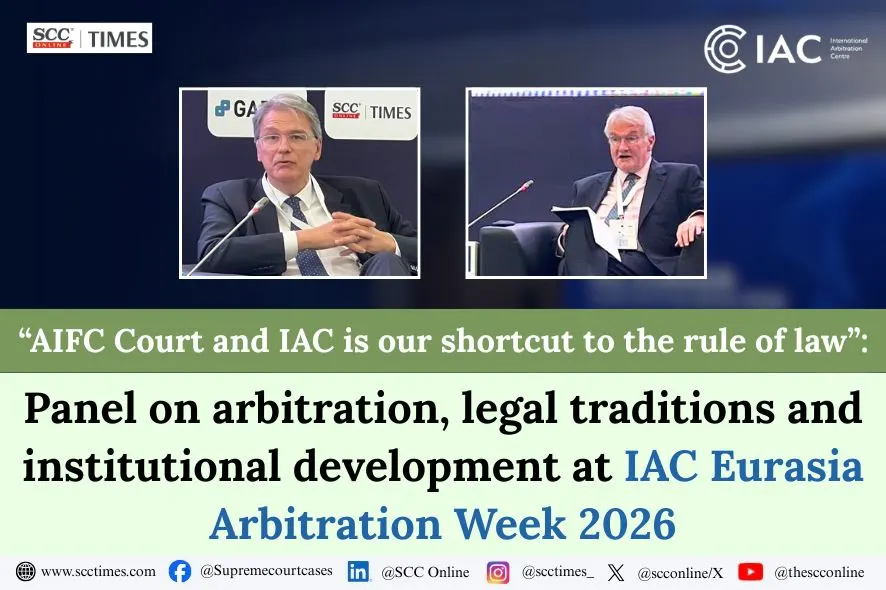
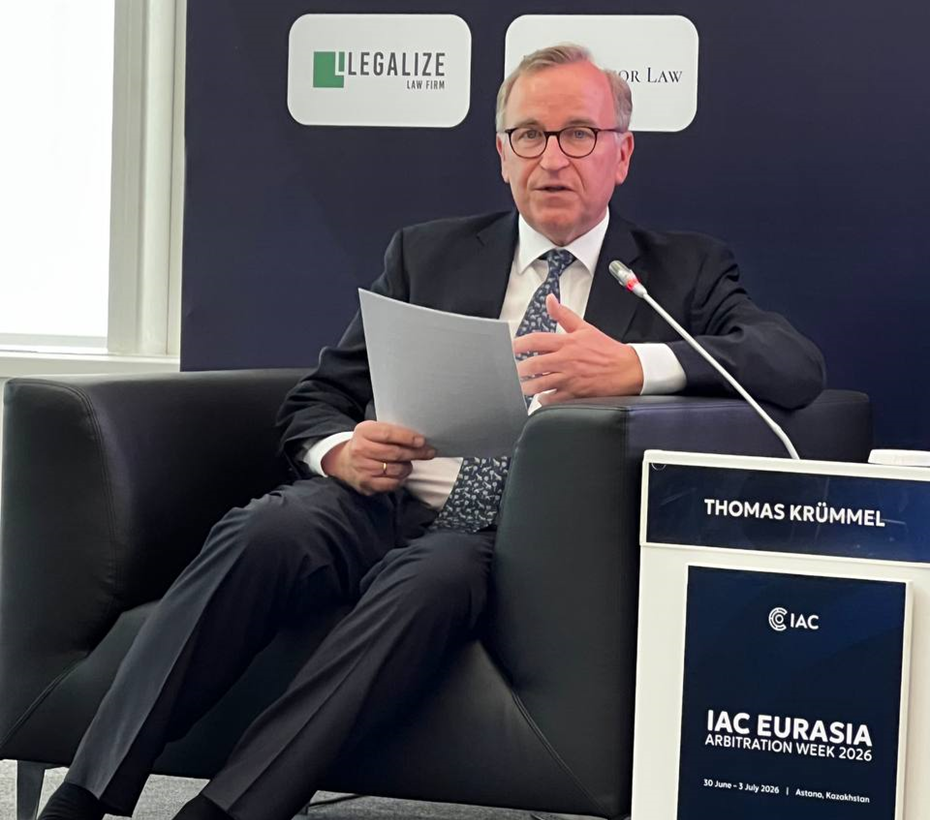
At the International Arbitration Centre (IAC) Eurasia Arbitration Week 2026 (EAW26), held in Astana, Kazakhstan, a panel titled “International Arbitration in Eurasia: Navigating Diverse Traditions, Frameworks & Cultural Expectations” was moderated by Thomas Krümmel, Chairman of the IAC, and featured:
-
The Rt. Hon. The Lord Burnett of Maldon KG, Chief Justice of the AIFC Court;
-
Prof. Maria Chiara Malaguti, President Emeritus of UNIDROIT and Professor of International Law at Università Cattolica Sacro Cuore;
-
Prof. Loukas Mistelis, Clive M. Schmitthoff Professor of Transnational Commercial Law and Arbitration at Queen Mary University of London and International Arbitration Partner at Steptoe LLP;
-
Joe Tirado, International Arbitrator, Mediator and ADR Consultant at TiradoADR Limited; and
-
Aigoul Kenjebayeva, Partner at Dentons.
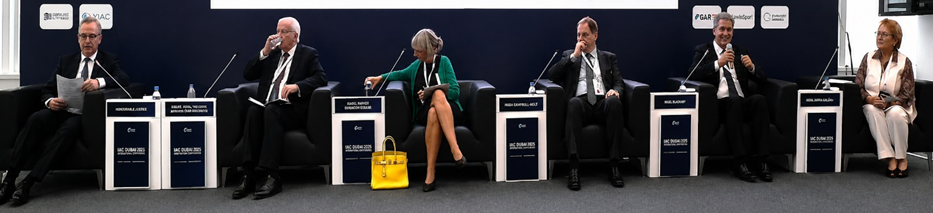
The discussion examined the role of arbitration institutions and courts, the interaction between different legal traditions, the development of legal standards, the role of settlement and mediation within arbitral proceedings, and the future direction of arbitration in Eurasia. Throughout the discussion, the panellists reflected on how institutions, legal practitioners and courts can contribute to the continued development of arbitration while responding to evolving commercial and legal needs.
The AIFC Court and Judicial Support for Arbitration
Thomas Krümmel opened the discussion by inviting Lord Burnett to reflect on the role of the AIFC Court in arbitration, particularly its approach to interim measures, supervision and enforcement while preserving the autonomy of arbitral tribunals and avoiding judicial overreach.
Lord Burnett observed that the AIFC Court and the International Arbitration Centre were established as part of the framework supporting the work of the Astana International Financial Centre (AIFC). He noted that the AIFC has its own Constitutional Statute and its own law. He further observed that AIFC Acts are based on principles of English law and the standards of leading global financial institutions.
Turning to the Court’s jurisdiction, Lord Burnett observed that the Constitutional Statute established both the AIFC Court and the International Arbitration Centre. He remarked that the AIFC Court is completely independent of the Kazakh legal system and that the Kazakh courts do not have jurisdiction over it. He further observed that the Court’s judges are all part-time common law judges, including retired judges of the Court of Appeal of England and Wales.
Explaining the Court’s procedures, Lord Burnett observed that the Court operates under its own rules, which he described as a simplified version of the Civil Procedure Rules of England and Wales, and remarked that its work is informed by common law principles.
According to Lord Burnett, the Court has exclusive jurisdiction over disputes arising within the AIFC and may also hear disputes by agreement of the parties. He noted that AIFC Court jurisdiction clauses have been incorporated into many thousands of contracts. He further observed that the Court acts as the supervising court of the International Arbitration Centre.
Referring to the Court’s supervisory role, Lord Burnett observed that it hears disputes concerning the appointment of arbitrators, applications to set aside arbitral awards and other applications with which most people would be familiar. He remarked that, in undertaking this work, the Court applies well-known international principles and noted that such applications are relatively few in number. He further observed that the Court also deals with the recognition and enforcement of IAC awards.
Turning to enforcement, Lord Burnett observed that Article 13 of the Constitutional Statute provides that decisions of the AIFC Court are enforced in Kazakhstan in the same manner as decisions of the Kazakh courts. Referring to a recent controversy relating to a foreign arbitral award, he remarked that he could not comment on the case itself but mentioned it to illustrate the Court’s function as an independent court acting in accordance with the rule of law and the applicable law.
Explaining the Court’s procedure, Lord Burnett observed that enforcement applications are first considered without notice to the debtor. However, if an order is made, the debtor may apply to set it aside. He remarked that this is the same procedure followed in London.
Lord Burnett further observed that recent cases had raised the question whether the Constitutional Statute conferred jurisdiction on the AIFC Court to enforce foreign arbitral awards against non-AIFC participants. He noted that first-instance decisions had reached conflicting conclusions and remarked that such situations can arise when independent judges make decisions independently. According to Lord Burnett, an application to set aside one such order had been heard the previous week and judgment was awaited. He further observed that the issue was likely to come before the AIFC Court of Appeal, where it would be resolved once and for all. He remarked that the process and procedure prescribed by the Court’s rules had been followed and that, as should happen whenever a new and important issue arises, the matter would be resolved after hearing arguments in accordance with the governing law.
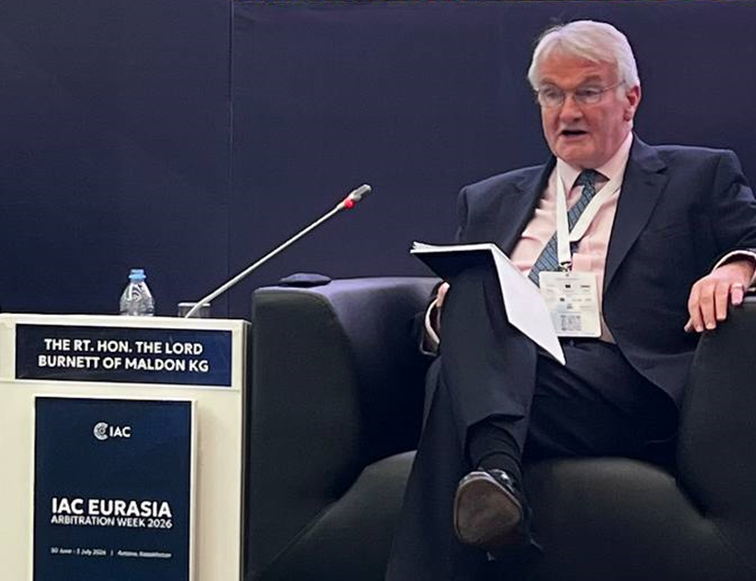
Concluding his remarks, Lord Burnett observed that the effectiveness of arbitration centres ultimately depends upon judicial independence and the enforceability of arbitral awards. In his words:
“Arbitration centres only prosper if their supervising courts are independent when applying the governing law and if awards can be enforced both domestically and internationally in accordance with the governing conventions.”
Developing legal principles and institutional frameworks
Thomas Krümmel then invited Aigoul Kenjebayeva to reflect on local confidence in arbitration and the understanding of legal principles and procedural rules in the region.
Responding, Aigoul observed that the AIFC Court and the International Arbitration Centre are approaching ten years since their establishment, while Kazakhstan has been independent for approximately 35 years. She remarked that, although this is a relatively short period, it is sufficient to begin reflecting on where the country stands and the direction in which it should be moving.
Aigoul observed that Kazakhstan became independent “literally overnight” and remarked that the country was not fully prepared, lacking both legislation and a developed understanding of the legal framework that would be required. At the same time, she noted that economic development and the arrival of foreign investors created an immediate need for legislation and a functioning legal system. According to Aigoul, Kazakhstan therefore had to adopt new laws and regulations rapidly and relied on advice from foreign experts.
Reflecting on that process, Aigoul observed that foreign experts introduced principles such as the rule of law and equality before the courts, which were subsequently incorporated into the Constitution and legislation. However, she remarked that even today these principles are not always fully understood. She further observed that concepts developed within common law systems may carry meanings different from those understood locally and remarked that Kazakhstan must determine what those principles mean within its own legal context.
Turning to the development of legal doctrine, Aigoul observed that common law jurisdictions have developed their principles over centuries through judicial precedents. By contrast, she remarked that Kazakhstan does not have the luxury of developing its legal principles over such a long period and therefore needs to develop its own legal theory. According to Aigoul, this theory should be based on doctrine, similar to continental legal systems, and she observed that developing such theories is a task for lawyers and legal scholars. She noted that she had also sought to address these issues in her own writing.
Referring specifically to arbitration, Aigoul observed that she and a number of specialists from the region had worked on a book titled Access to Justice and Arbitration in Central Asia and Azerbaijan, which was made available to conference participants. According to Aigoul, one of the conclusions reached during that work was that justice is understood differently in Western jurisdictions and in Kazakhstan. She referred to the view expressed by Professor Suleymanov that access to justice cannot be discussed in relation to arbitration because, under the Constitution, justice is administered only by courts. While acknowledging that this reflects the position under Kazakh law, Aigoul remarked that justice should also be understood in a broader sense and observed that arbitration constitutes one of the means of adjudication.
Reflecting on the implications of these differences, Aigoul observed that foreign lawyers practising in Kazakhstan should understand how Kazakh lawyers and Kazakh courts approach such concepts, particularly in matters concerning the enforcement of arbitral awards. According to Aigoul, recognising these differences requires both a theoretical approach and practical recommendations on how they should be addressed.
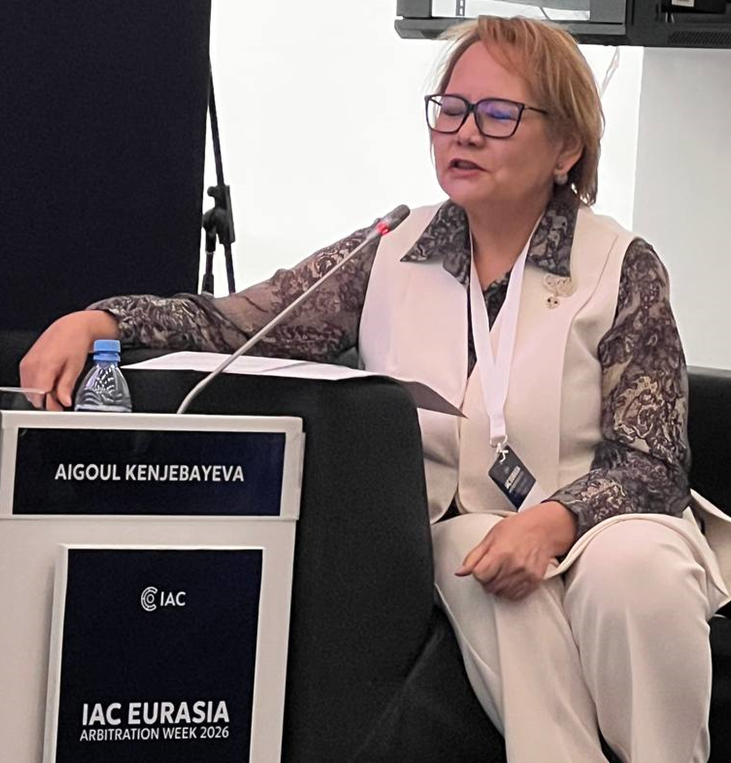
Turning to the role of the AIFC Court and the International Arbitration Centre, Aigoul recalled that at the previous year’s conference she had described the institutions as “our shortcut to the rule of law”. She remarked that, beyond making the jurisdiction attractive to investors, these institutions should also contribute to the development of Kazakhstan’s own legal system. Explaining how she viewed the role of the two institutions, Aigoul observed:
“AIFC Court and IAC is our shortcut to the rule of law.”
Developing that idea further, Aigoul observed that she had come to regard the AIFC Court and the International Arbitration Centre as a pilot project for Kazakhstan’s court system. She suggested that consideration should be given to what aspects of those institutions could be incorporated into the domestic legal system so that the same quality of justice available to investors could also benefit the people of Kazakhstan.
Concluding her remarks, Aigoul suggested that certain principles of English procedural law, particularly the simplified procedural rules applied by the AIFC Court, could be adopted within Kazakhstan’s own legal system. She invited further discussion with judges, legal practitioners and other specialists on how such ideas might be developed with the assistance of the AIFC Court and the International Arbitration Centre.
Thomas thanked Aigoul for her remarks and observed that they had provided considerable material for discussion. Referring to the issues she had raised, he remarked that an interesting question remained as to whether only foreign lawyers coming to Kazakhstan should adapt to local expectations and practical experience, or whether Kazakh lawyers should also adapt to systems that have become accepted in practice. He, however, observed that he would leave that discussion for another occasion before inviting Prof. Maria Chiara Malaguti to share her perspectives.
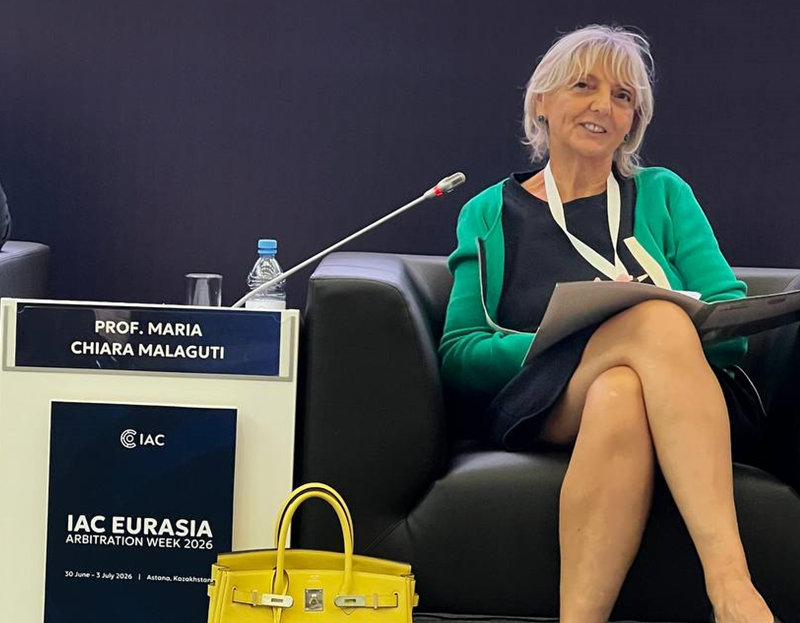
Responding, Prof. Malaguti observed that she was pleased to be back after the previous year’s conference. Speaking from the perspective of an Italian arbitrator and lawyer, she remarked that there are continuing debates on whether arbitration, particularly in Europe, should draw more from civil law or common law traditions. She also referred to the relationship between courts and arbitrators, mentioning the Achmea and Komstroy decisions, and observed that these issues continue to give rise to significant debate in Europe.
Turning to her work at UNIDROIT, Prof. Malaguti observed that it was more directly relevant to the discussion. Describing what she regarded as the guiding principle for addressing these issues, Prof. Malaguti stated:
“We should be able to overcome geography without overcoming diversity.”
According to Prof. Malaguti, while attention should be paid to the specific characteristics of each region, it is equally important to ensure common standards. She observed that it is possible to be global in standards while remaining regional in the understanding of those standards and remarked that institutions play a central role in achieving that objective.
Reflecting on arbitration, Prof. Malaguti observed that it has both strengths and challenges. She remarked that arbitration helps in finding common principles in trade while also reflecting local and regional ways of doing business. At the same time, she observed that arbitration may appear to be separate from the local judiciary. However, she remarked that this is not the case where arbitration is supported by institutions.
According to Prof. Malaguti, institutional arbitration can help ensure the rule of law and link arbitration to the strengthening of commercial law and national law. She further observed that institutions should not only resolve disputes but also help parties understand mediation, draft contracts, and resolve issues before disputes arise. In her view, such institutions become part of the legal system.
Turning to international standards, Prof. Malaguti observed that the international community seeks to develop standards that are sufficiently flexible to permit them to be regionalised or localised. She remarked that benchmarks and, in particular, soft law instruments can help resolve issues in ways that foreign parties would expect while still allowing solutions to be tailored to local realities. According to Prof. Malaguti, this is possible when such standards are implemented within an institutional framework.
Referring to business in the region, Prof. Malaguti observed that businesses from countries such as Italy and Germany expect to find a common language when operating in Eurasia, while also being prepared to discuss diversity in the sense of rules that may be tailored according to local circumstances. She remarked that the current debate is not about choosing one legal system over another but about being able to tailor solutions to particular situations. According to Prof. Malaguti, when this is achieved through institutions, it helps ensure the rule of law.
Concluding her introductory remarks, Prof. Malaguti observed that she had intentionally spoken at a high level and remarked that she would return to these issues in greater detail as the discussion progressed.
Thanking Prof. Malaguti for her remarks, Thomas observed that it would be interesting to discuss how such ideas could be implemented in practice. Referring to the development of standards by regional centres, he remarked that the process did not appear to be as straightforward as it might sound and observed that there might be an opportunity to return to the issue later. Thomas then invited Prof. Loukas Mistelis to offer his remarks.
Rule of law, Arbitration and a changing global landscape
Responding, Prof. Mistelis observed that he wished to make a brief comment on the earlier discussion. Referring to the rule of law, he remarked that it is a critical issue and observed that, while there may not be a single global understanding of the rule of law, arbitration has perhaps contributed to a better understanding of the concept within the context of arbitration. He further observed that different legal traditions may approach the rule of law differently and remarked that this is a subject worthy of further reflection.
Characterising the current state of international arbitration, Prof. Mistelis remarked:
“Arbitration has become the victim of its success.”
Explaining his observation, Prof. Mistelis remarked that arbitration has expanded significantly across the world. According to Prof. Mistelis, this development has resulted in what he described as the “democratisation of arbitration”. He observed that the latter part of the twentieth century might be characterised as a “Golden Era” of international arbitration, during which practice was confined to a limited bar of practitioners and a relatively small college of arbitrators, geographically concentrated within a narrow set of established centres. According to Prof. Mistelis, the field has since expanded far beyond those original boundaries.
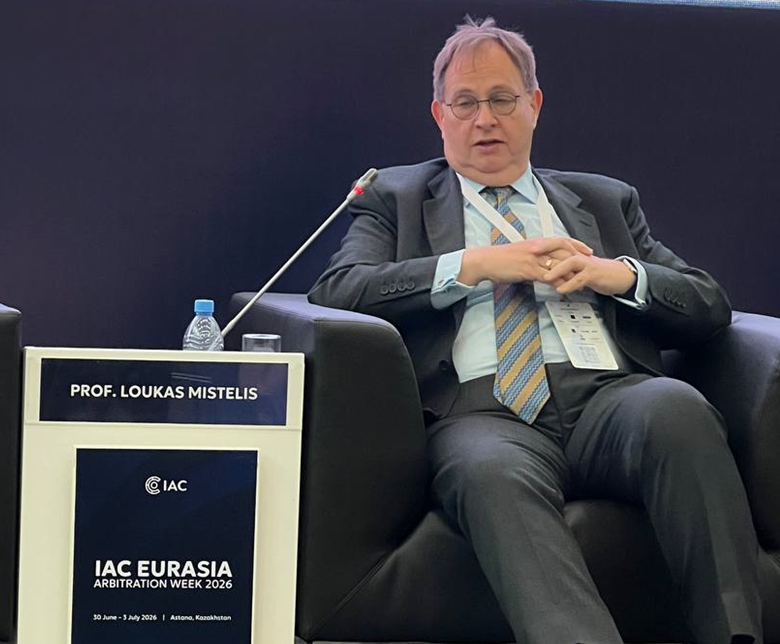
Reflecting on that growth, Prof. Mistelis observed that many participants involved in arbitration today have not previously practised arbitration and often approach international disputes from different professional backgrounds and with different procedural understandings. He remarked that arbitration must therefore continue to consider the needs of its users and the practical use of the process.
Prof. Mistelis further observed that businesses from across the world now increasingly participate in arbitration, including large and regional companies in the Caribbean, South America and Africa that have not previously had experience with arbitral proceedings. Referring to the region, he remarked that arbitration had also existed in different forms under the Soviet system.
Turning to broader developments, Prof. Mistelis observed that the world is now living in what he described as a “post-globalisation” environment. He remarked that globalisation, as it had been understood over the past several decades, has changed and observed that this has been accompanied by the rise of nationalism and populism in different parts of the world. At the same time, he noted that international institutions continue to play an important role in capacity building.
On the point of contemporary developments, Prof. Mistelis observed that the present landscape has become increasingly complex, referring to the growing number of institutions and resources and the challenges that accompany them.
Turning to geography, Prof. Mistelis observed that the centre of gravity of international commerce and investment had shifted eastward. He described the Middle East as what he termed the “new global north”, remarking that Japan, China and the Gulf region had emerged as major new investors on the global stage. According to Prof. Mistelis, these developments stand in contrast to the relative position of economies such as those of Germany and the United Kingdom, which he observed had begun to contract.
Settlement, Mediation and Cultural Expectations in Arbitration
Moving forward, Thomas Krümmel then invited Joe Tirado to share his views.
Responding, Joe Tirado referred to the role of settlement in arbitration and sought clarification as to whether this was the subject he had been asked to address. Thomas clarified that he had not intended to ask a specific question but had invited comments on cultural expectations and the manner in which they influence arbitration in different sectors.
Against that backdrop, Joe observed that one aspect of cultural expectations concerns the role, if any, of arbitrators in facilitating settlement. He remarked that a traditional arbitration purist would generally take the view that arbitrators should not assist parties in reaching a settlement and that mediation should remain separate from arbitration.
Reflecting on his own experience, Joe observed that, with the exception of a limited number of cases requiring a precedent, most disputes eventually reach a stage where settlement discussions become possible. According to Joe, parties generally do not wish to pursue disputes through formal litigation, arbitration or other time-consuming processes where a negotiated resolution remains achievable.
Turning to arbitration itself, Joe observed that however well prepared or efficiently conducted an arbitration may be, there is always an inherent element of uncertainty because parties cannot know in advance what the outcome will be. By contrast, he remarked that negotiated settlements allow parties to exercise their autonomy and reach outcomes that reflect their own agreement rather than a determination imposed by a tribunal.
According to Joe, settlements are often capable of addressing a broader range of issues than those forming the immediate dispute and may also preserve ongoing commercial relationships. He further observed that negotiated settlements generally avoid many of the practical difficulties associated with enforcing arbitral awards because the parties themselves have agreed to the outcome.
Reflecting on clients’ expectations, Joe observed that clients consistently want their disputes resolved. He remarked that, over time, many law firms had rebranded themselves as dispute resolution departments, although there can sometimes be a greater focus on winning disputes than resolving them. According to Joe, what clients ultimately want is for their problem to be resolved as quickly and cost-effectively as possible.
Turning to the role of arbitrators, Joe observed that settlement discussions are not inconsistent with pursuing an arbitration vigorously. Rather, he remarked that settlement negotiations should be viewed as a strategic tool capable of assisting parties in achieving the outcome they seek.
Joe further observed that arbitrators can support settlement by recognising opportunities for negotiations and, where appropriate, allowing parties time within the procedural timetable to explore resolution. He remarked that this could even be reflected in an early procedural order. According to Joe, if settlement proves unsuccessful, the arbitration can simply continue.
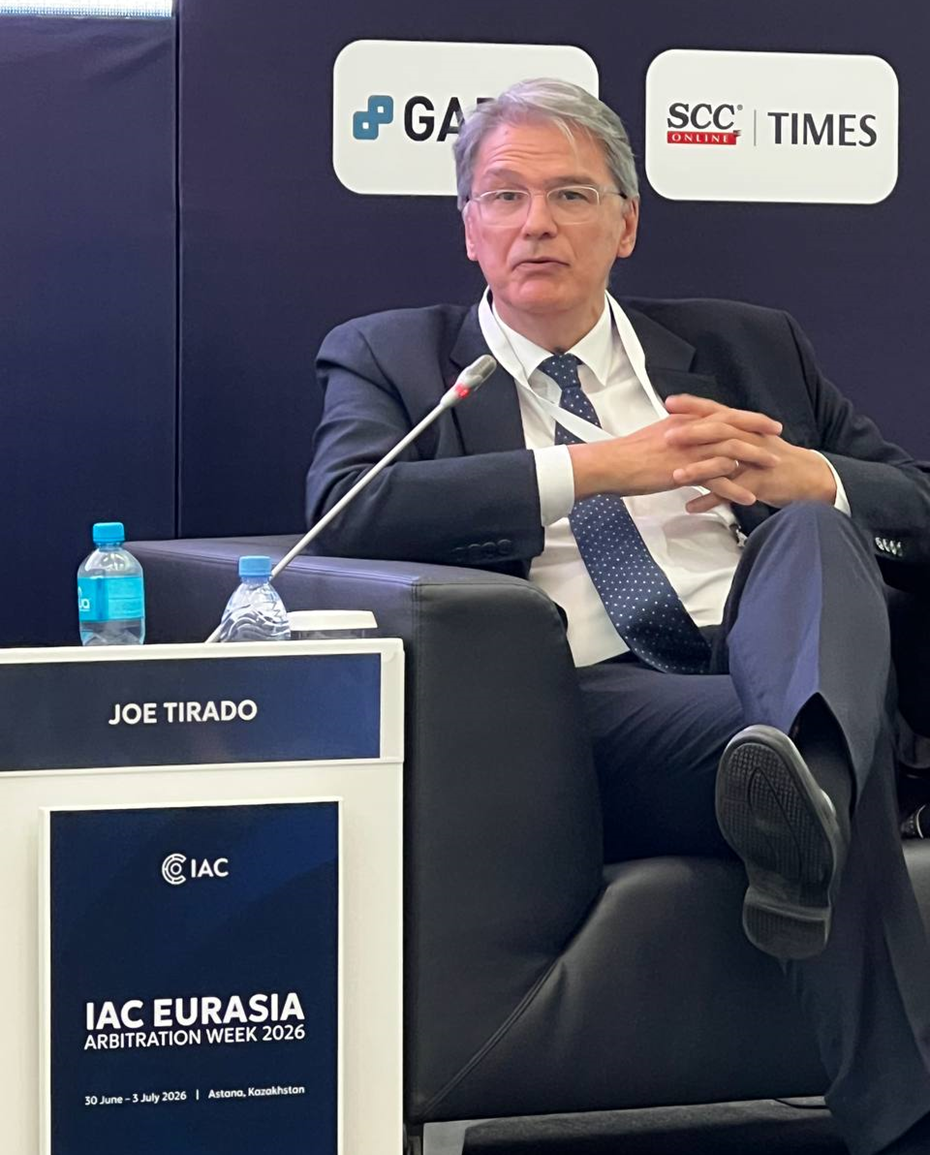
Reflecting on recent developments, Joe observed that the COVID-19 pandemic prompted many to reconsider existing approaches to dispute resolution. He remarked that one consequence had been renewed attention to mediation and observed that mediation has increasingly gained acceptance in different jurisdictions, including the United Kingdom, where mandatory mediation has begun to emerge.
According to Joe, arbitration also has a role to play in encouraging parties to explore settlement where appropriate. He observed that, although some jurisdictions may initially regard such approaches as unsuitable for their legal systems, attitudes can change over time. Referring to Italy as an example, Joe remarked that the country had once been among the most resistant to mediation in Europe, to the point that lawyers went on strike and were “literally rioting against the police” over its introduction. He remarked that Italy has since become one of the most pro-mediation jurisdictions in Europe and cited this transformation as evidence that attitudes towards mediation can change profoundly, even where initial resistance has been fierce.
Concluding his remarks, Joe observed that mediation and arbitration should not be regarded as mutually exclusive. While emphasising that unresolved disputes must ultimately be decided by arbitrators through an efficient arbitral process, he remarked that encouraging settlement where possible remains an important objective. Summing up his observations on dispute resolution, Joe remarked:
“What clients say consistently they want… is to resolve their dispute.”
The future of Arbitration in Eurasia
Turning to the future of arbitration in the region, Thomas invited each panellist to share what success for arbitration in Eurasia might look like over the next five to ten years. He observed that success could be measured in different ways, including a greater number of arbitrations seated in the region, increased appointments of regional arbitrators in international cases, stronger judicial support, improved institutional rules, greater linguistic diversity or the emergence of Eurasia as a contributor to the development of arbitral practice.
Responding first, Aigoul observed that her principal area of interest is the representation of parties before courts and arbitral tribunals. She remarked that the current standard of legal representation in arbitration and court proceedings in the region is not yet at the desired level. According to Aigoul, she would like to see a much stronger and more professional legal community working in arbitration over the next five years, observing that this would contribute to improving the overall quality of arbitration in the region.
Turning to Joe Tirado, Thomas invited his reflections on the future of arbitration in Eurasia.
Responding, Joe observed that visibility would be one of the most important factors going forward. Referring to the considerations outlined by Thomas, he remarked that they were all relevant and observed that there is no reason why the region cannot make a meaningful contribution to the development of international arbitration. According to Joe, institutions in the region play an important role in supporting that progress. He further observed that events such as the conference itself are gaining greater international visibility and remarked that becoming part of the wider arbitration community is an important objective.
Building on Joe’s remarks, Thomas referred to the earlier discussion on settlement and asked whether greater emphasis on settlement could represent one of the first practical steps for the region before participants met again in the coming years.
Responding, Joe observed that unfamiliarity with new concepts often gives rise to suspicion. According to Joe, education is therefore essential and must be regarded as a long-term process rather than something capable of producing immediate change. He remarked that, once discussions begin, people gradually come to appreciate the value of such approaches.
Turning to the development of arbitration institutions, Thomas asked whether the emphasis should now be on consolidation rather than continued expansion, particularly in light of the rapid growth experienced in recent years.
Responding, Joe observed that this was a fair assessment. He remarked that, although there is always an emphasis on growth, consolidating existing progress and strengthening knowledge and visibility are equally worthwhile objectives. According to Joe, the region is moving in the right direction and should continue building on its existing progress.
Building stronger Arbitration Institutions
Before moving to the next panellist, Thomas remarked, humorously, that he would giving himself a bell for asking an extra question. He then invited Prof. Mistelis to share his concluding thoughts.
Responding, Prof. Mistelis observed that growth should not be regarded as the objective in itself. According to Prof. Mistelis, the various systems relating to arbitration, adjudication and dispute resolution should function together in an effective manner. He further observed that these developments should not be confined to the AIFC alone but should extend beyond that context. Referring to the broader legal ecosystem, Prof. Mistelis remarked that understanding how to make use of the available resources and ecosystem to support developments across these different aspects is critical.
Turning to Prof. Malaguti, Thomas remarked, with a touch of humour, that if he were to remain Chairman of the IAC for the next five years, he would like to know how he should go about implementing some of her suggestions. Referring to her earlier remarks on setting standards, developing soft law instruments and helping parties better understand contract drafting and cross-cultural interactions, Thomas acknowledged that it was a difficult question but remarked that she had “started it”, prompting him to take the discussion a step further.
According to Prof. Malaguti, the first step is to open a broader discussion on what can be achieved collectively. Turning to the practical aspects of the question, Prof. Malaguti observed that institutions should help people understand that disputes have become increasingly complex and that they may be resolved not only through arbitration but also through mediation, settlement and other available mechanisms. According to Prof. Malaguti, institutions should provide parties with the tools necessary to understand what she described as an extremely complex ecosystem that extends beyond merely cross-border disputes.
Looking ahead, Prof. Malaguti observed that arbitration is increasingly addressing issues relating to sustainability and human rights, which she regarded as important areas for the next five to ten years. She remarked that the objective should not be growth in terms of numbers but, agreeing with Prof. Mistelis, growth in terms of quality.
Referring to contract drafting, Prof. Malaguti observed that a range of standards is already available and noted, by way of example, UNIDROIT’s investment contract project, which was then open for consultation. According to Prof. Malaguti, such projects enable jurisdictions to examine how particular issues are addressed elsewhere, identify the underlying general principles and tailor those principles to their own legal systems. She further observed that this approach had already been adopted in relation to procedural matters and could likewise be applied within the region.
-
Looking Ahead: Courts, Markets and International Confidence
Thanking Prof. Malaguti for her remarks, Thomas Krümmel invited Lord Burnett to look ahead and reflect on what courts in the region could do differently over the next five years in relation to arbitration. He asked whether there remained a need to further develop or strengthen judicial support for arbitration and the role of courts in that process.
Responding, Lord Burnett observed that arbitration requires parties to make a series of choices, including whether to arbitrate, the seat of arbitration and the applicable law. According to Lord Burnett, arbitration operates within a free market.
Referring to Prof. Malaguti’s earlier remarks, Lord Burnett observed that many institutions around the world are seeking to establish themselves as centres for international arbitration. He remarked that, ultimately, the market will determine which arbitration centres prosper and which do not.
Reflecting on the expectations of international businesses, Lord Burnett observed that commercial parties are generally comfortable with systems and institutions they already know and trust and are often reluctant to embrace substantial change. According to Lord Burnett, the AIFC institutions were established on that basis, with structures and personnel familiar to the international arbitration community.
Lord Burnett agreed that continued development is important but remarked that such development should remain sensitive to the expectations of the international market. He added that domestic markets may have different requirements because the businesses involved often operate within a narrower commercial context.
Turning to the role of the courts, Lord Burnett observed that courts should faithfully apply international standards that prevent unnecessary judicial interference in arbitral proceedings.
Concluding the session, Thomas thanked the panellists for what he described as a fascinating, insightful and interesting discussion.
Read More reports from IAC EAW 2026: