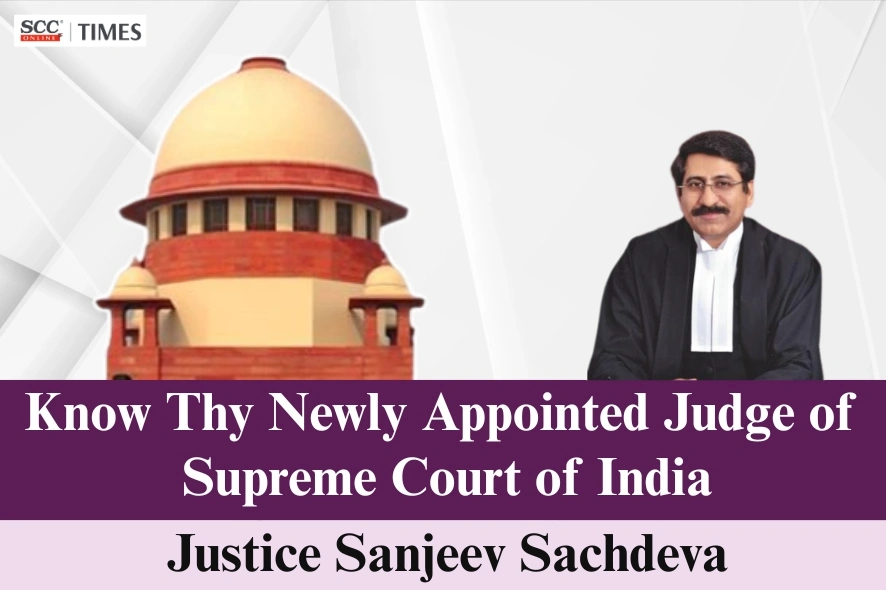
Justice Sanjeev Sachdeva is one of India’s eminent jurists whose legal career reflects academic excellence, professional distinction, and unwavering commitment to the administration of justice. His elevation to the Supreme Court of India on 2 June 2026 marked the culmination of nearly 4 decades of distinguished service at the Bar and the Bench.
Early life and Education
Justice Sachdeva was born on 26 December 1964, in Delhi. He completed his schooling in commerce stream from Delhi Public School, Mathura Road, in 1982. He pursued higher education at the Sri Ram College of Commerce (SRCC), University of Delhi, where he earned his Bachelor of Commerce (Honours) degree in 1985. Subsequently, he obtained his LL.B. degree in 1988 from Campus Law Centre, Delhi University, securing a position on the institutional merit list.1
*Did you know? Justice Sachdeva signed the DPS Honour Book for proficiency in academic subjects in the year 1985.2
Career as an Advocate
Justice Sachdeva’s journey in the legal fraternity started on 1 August 1988 with his enrolment as an advocate with the Bar Council of Delhi. His legal practice spanned before the Supreme Court of India, High Court of Delhi, and District Courts of Delhi.
Early in his career, 1992, he was awarded the British Council Scholarship as one of the 5 young lawyers selected to represent India at the Commonwealth Young Lawyers Course at University of London during which he also worked with Solicitors and Barristers in England. By June 1995, he secured second position in the Advocate-on-Record examination conducted by the Supreme Court of India.3
*Did you know? Justice Sachdeva was awarded the best student award for the course of Personal Computing with Basic and was awarded with scholarship for the Computer Software Application course by the N.I.I.T. in 1986.4
Justice Sachdeva served as a Standing Counsel for the Bar Council of India for over 20 years and was later appointed as Senior Panel Lawyer for Union of India where he worked for over 10 years. In addition to his legal practice, he served as a lead trainer in the Indo-British Advocacy Skills Project, imparting advocacy skills including examination and cross-examination of witnesses across multiple High Courts in India.5
*Did you know? Justice Sachdeva completed personal computing with basic course in 1986& Computer software Applications course in 1986-87 from the National Institute of Information Technology (N.I.I.T.).6
Justice Sachdeva’s outstanding contribution was formally recognised when on 28 July 2011, he was appointed as senior advocate in the Delhi High Court.7
Career as a Judge
Justice Sachdeva was elevated as Additional Judge of the Delhi High Court on 17 April 2013 and was confirmed as Permanent Judge on 18 March 2015.8
Justice Sachdeva was transferred to Madhya Pradesh HC on 29 May 20249 and took oath on 31 May 2024.10 He subsequently served as the Acting Chief Justice from July 2024 to September 2024, and was appointed as Acting Chief Justice again in May 2025.
A significant milestone in his judicial career came in July 2025, when Justice Sachdeva was appointed as Chief Justice of the Madhya Pradesh High Court with effect from 14 July 2025,11
*Did you know? Justice Sachdeva was awarded the National Prize for the year 1985-86 by the Directorate of Education Delhi.12
track record, the Supremecourt Collegium recommended13 his elevation to the Supreme Court alongside four others. On 2 June 2026, he took oath as a Judge of the Supreme Court of India. He is slated to serve tenure of 3 years and 6 months, with his superannuation scheduled on 25 December 2029.14
Notable Judgments by Justice Sachdeva
In an appeal preferred by the Gujarat Pollution Control Board (GPCB), assailing the National Green Tribunal (NGT) order holding the landlord not accountable for the tenant’s environmental violations, the Division Bench of Satish Chandra Sharma and Sanjeev Sachdeva, JJ., found no reason to entertain the appeal challenging the NGT order.
‘Not Even 10% Women Nominations’: MP HC halts Rewa Bar Association Elections
In a petition filed by a female advocate challenging the Rewa Bar Association’s Elections due to a lack of mandatory 30 percent reservation for women, the Division Bench of Sanjeev Sachdeva*, CJ., and Vinay Saraf, J., restrained the Rewa Bar Association from holding its elections till the next date of hearing.
In an application filed by the National Highway Authority of India (NHAI) seeking vacation of the impugned order whereby the Court restrained NHAI from undertaking any activity in the NHAI Tiger Corridor Case, the Division Bench of Sanjeev Sachdeva*, CJ., and Vinay Saraf, J., directed the National Tiger Conservation Authority (NTCA) and National Board for Wildlife (NBWL) to assist the Court and explain the integrated landscape management plan proposed for managing the said area while ensuring that the wild life passage was not disturbed in a way that impeded on the free movement of wild life.
In a writ petition filed by an advocate seeking provision of amenities for specially abled persons to access the Court premises, the Division Bench of Sanjeev Sachdeva*, CJ., and Vinay Saraf, J., directed the Registrar General of the High Court to file an audit report on various amenities and facilities available for women, persons with disability, persons suffering from chronic disease and senior citizens in the premises of the High Court, District Courts and Tehsil Court buildings within four weeks.
Inadequate Teachers in MP Govt Schools: Madhya Pradesh HC seeks data on vacancies
In a writ petition filed regarding the inadequate of teachers in MP Govt. schools, the Division Bench of Sanjeev Sachdeva*, CJ., and Vinay Saraf, J., directed the respondent authorities to file affidavits indicating the number of Government Schools in the State and the positions that had vacancies in the said Schools.
In a suo motu writ petition registered regarding the reported illegal felling of 488 trees case in Bhopal, the Division Bench of Sanjeev Sachdeva*, CJ., and Vinay Saraf, J., directed the State to file a better affidavit indicating the exact nature, age, and girth of trees proposed to be planted as compensation.
In a writ appeal filed by a distributor of Coldrif cough syrup against the order whereby his petition against the sealing of his ship and cancellation of his drug license was rejected, the Division Bench of Sanjeev Sachdeva*, CJ., and Vinay Saraf, J., dismissed the appeal holding that there was no infirmity in the view taken by the Single Judge or any merit in the appeal.
In a suo motu writ petition registered regarding the reported illegal chopping of 488 trees near Bhopal, the Division Bench of Sanjeev Sachdeva*, CJ., and Vinay Saraf, J., sought responses from different authorities regarding transplantation and directed that no tree shall be cut, pruned or transplanted in any manner in Madhya Pradesh except with the prior permission of the Committee constituted by the NGT and the Tree Officer concerned till the next date of hearing.
In a writ petition filed by the petitioner,father seeking the production of his daughter (corpus), who had left home, a Division Bench of Sanjeev Sachdeva,* CJ., and Vinay Saraf, J., recognised the her right to study and pursue civil services ambition, and facilitated a supportive environment by involving a senior IAS officer as her mentor.
In a writ petition filed by MBBS students seeking quashing of the amendment in Schedule I of Madhya Pradesh Medical Education Admission Rules, 2018 (“the Rules”) whereby 100 % institutional preference was granted to MBBS graduates from medical colleges in the State for admission in postgraduate (“PG”) seats in private medical colleges in Madhya Pradesh(“MP”), the Division Bench of Sanjeev Sachdeva*, CJ., and Vinay Saraf, J., allowed the petition, holding that since the amendment was unconstitutional since it exceeded the 50% reservation cap.
In a suo motu writ petition registered regarding the reported illegal chopping of 488 trees near Bhopal, the Division Bench of Sanjeev Sachdeva*, CJ., and Vinay Saraf, J., directed that no tree in Bhopal shall be cut, pruned, or transplanted in any manner except with the leave of the Court.
In a writ petition filed by Congress MLA Umang Singhar against BJP MLA Nirmala Sapre seeking her disqualification from the Legislative Assembly, the Division Bench of Sanjeev Sachdeva*, CJ., and Vinay Saraf, J., issued notices to the Speaker of Madhya Pradesh Legislative Assembly (“the Speaker”) and Nirmala Sapre.
In a suo motu writ petition registered regarding the reported illegal chopping of 488 trees near Bhopal, the Division Bench of Sanjeev Sachdeva*, CJ., and Vinay Saraf, J., directed the State to file photographs along with the GPS locations of each of the 253 allegedly transplanted trees.
In a suo motu writ petition registered regarding the Indore Truck Crash Case wherein a rashly driven truck entered a residential area thereby causing several accidents, injuries to 35 people and loss of three lives, the Division Bench of Sanjeev Sachdeva*, CJ., and Vinay Saraf, J., held that despite the order passed by the Court, sufficient action was not taken by the authorities to prevent recurrence of similar incidents.
Accordingly, the Court directed the Commissioner of Police (‘the Commissioner’) to appear before the Court through VC on the next date and consider the suggestions given by the Amicus Curiae and submit his response.
In a suo motu writ petition registered regarding the reported illegal chopping of 488 trees near Bhopal, the Division Bench of Sanjeev Sachdeva*, CJ., and Vinay Saraf, J., directed the Public Works Department (“PWD”) to file an affidavit indicating how many trees had been cut for the subject project and how many trees are further sought to be cut.
In a writ petition filed against the livestreaming of court proceedings, the Division Bench of Sanjeev Sachdeva*, CJ., and Vinay Saraf, J., directed the Registry to temporarily stop the livestreaming of all the Benches hearing criminal matters till the next date of hearing.
In a writ appeal filed by a former revenue inspector against the dismissal of his writ petition wherein he had sought payment of his retiral dues, the Division Bench of Sanjeev Sachdeva*, ACJ., and Pavan Kumar Dwivedi, J., rejected the appeal, holding that the Furlough Scheme clearly stipulated that the period spent on furlough shall not be counted towards eligible service for computation of pension.
In a writ petition seeking issuance of a writ of habeas corpus for production of her daughter and two minor children, who went missing from Pune, a division bench of Vinay Saraf and Sanjeev Sachdeva*, JJ., held that the writ of habeas corpus was not maintainable in the present case as there was no evidence of unlawful detention.
In a petition challenging single judge order which quashed the Excise Commissioner’s order prohibiting all beer and liquor bottling units from reusing embossed bottles, and remitted back the matter to the Commissioner for reconsideration, a division bench of Sanjeev Sachdeva* and Pranay Verma, JJ., upheld the Excise Commissioner’s order prohibiting the reuse of bottles with embossed logos but set aside the prohibition on reusing bottles after removing/scratching the logos, leaving that issue for a different forum.
In a contempt case regarding the respondent’s conduct during court proceedings before the Judicial Magistrate First Class, Sambalgarh, District Morena, a Division bench of Sanjeev Sachdeva* and Vinay Saraf, JJ., accepted the respondent’s apology and directed the respondent to plant 50 indigenous trees of at least 4 feet in height in Sambalgarh under the supervision of the Sub-Divisional Officer (Forest).
The respondent admitted limited knowledge of legal procedures and court decorum, expressed regret for his actions, and tendered an unconditional apology. He also volunteered to undertake social service.
The Court accepted the respondent’s apology and undertook to maintain court decorum in the future. The Court considered the respondent’s semi-literacy, lack of legal knowledge, and genuine remorse, and directed the respondent to plant 50 indigenous trees of at least 4 feet in height in Sambalgarh under the supervision of the Sub-Divisional Officer (Forest) and complete the tree plantation within an additional 15 days. The Court directed the respondent to report to the Judicial Magistrate First Class, Sambalgarh, within 15 days with a copy of the Court’s order.
In a Public Interest Litigation (PIL) highlighting allegedly unsanitary storage of drinking water for inmates of Central Jail in Jabalpur, thereby raising concerns about their health and safety, a division bench of Sanjeev Sachdeva*, ACJ., and Vinay Saraf, J., directed the Superintendent of Central Jail Jabalpur to have the drinking water tested for potability by an approved laboratory and submit the test results before the next hearing date.
In a Public Interest Litigation (PIL) filed against the Central Government and the Central Board of Film Certification (CBFC) challenging the impending release of the film “Emergency”, raising concerns over its portrayal of the Sikh community, a Division Bench of Sanjeev Sachdeva,* ACJ., and Vinay Saraf, J., permitted the petitioners to submit a detailed representation to the CBFC and directed the CBFC to consider the objections submitted by the petitioners regarding both the film and the trailer.
In a petition against the non-compliance with the Supreme Court’s 2012 directives regarding the treatment and rehabilitation of Bhopal gas victims, a division bench comprising of Sanjeev Sachdeva*, ACJ and Vinay Saraf, J., directed the concerned authorities to examine the Monitoring Committee’s status report and take proactive steps for implementation of the directions in respect of which there are no issues.
In a petition seeking direction to respondents for clarification that Integrated Goods and Services Tax (‘IGST’) rate applicable to petitioner for import of dialysis machines was five percent, the Division Bench of Sanjeev Sachdeva* and Ravinder Dudeja, JJ., disposed of the present petition binding respondents to their statement that insofar as the case of petitioner was concerned, subject to verification of HSN Code, the same would be eligible to tax at five percent in terms of the office memorandum dated 13 October 2023.
A petition was filed to consider whether it is permissible for any employer to process the resignation request which it had earlier declined to process. A division bench of Sanjeev Sachdeva* and Manoj Jain, JJ., held that the earlier resignation request, being turned down, albeit, for want of certain particulars, it was no longer obligatory for the petitioner to have submitted any formal application seeking withdrawal of his resignation request.
A petition was filed by a Constable/GD in the Central Reserve Police Force (CRPF), served for nearly 17 years with an exemplary record seeking to set aside of memorandum dated 9 August 2023 whereby a departmental inquiry has been initiated against him. A division bench of Sanjeev Sachdeva* and Manoj Jain, JJ., held that the petitioner’s failure to disclose the previous involvement in the criminal case was justified under the Juvenile Justice Act, 2000, thus, the Court set aside the impugned Memorandum dated 9 August 2023 that initiated the inquiry against the petitioner.
In a petition challenging the show cause notice dated 8 November 2022, order of cancellation dated 7 February 2023 and order in appeal dated 24 August 2023, the Division Bench of Sanjeev Sachdeva* and Ravinder Dudeja, JJ., opined that the registration could not be cancelled with the retrospective effect mechanically and it could be cancelled, only if the proper officer deemed it fit to do so. Further, such satisfaction could not be subjective but must be based on the objective criteria. The Court opined that, “merely, because a taxpayer has not filed the returns for some period does not mean that the taxpayer’s registration is required to be cancelled with retrospective date also covering the period when the returns were filed, and the taxpayer was compliant.” Thus, the Court set aside the show cause notice, order of cancellation and order in appeal. The Court restored the GST registration of the petitioner and directed the petitioner to file the returns for the relevant period within a period of two weeks from 8 January 2024.
In the instant matter, petitioner sought for quashment of order dated 17 October 2018 passed by respondents, whereby was dismissed from service and other impugned orders dated 4 March 2019 and 23 August 2019, whereby his punishment of “dismissal from service” had been upheld by respondents, and mercy petition against such order had been rejected, respectively. The Division Bench of Sanjeev Sachdeva* and Manoj Jain, JJ., opined that instead of showing empathy with petitioner, when he first attempted to commit suicide, the commanding officer sentenced him to 89 days rigorous imprisonment particularly when he was already undergoing psychiatric treatment. The Court thus directed that petitioner should be reinstated in service with all consequential benefits.
A petition was filed for consideration is as to whether the fundamental right guaranteed by Article 19(1) (c) of the Constitution to form an Association also includes the right to be recognized by a State Bar Council or by the Court for the purposes of availing benefits that flow from such recognition, either as a Court annexed Bar Association or as a recognized Bar Association under the Advocates Welfare Fund Act, 2001 referred to as the Advocates Welfare Fund Act. A division bench of Sanjeev Sachdeva* and Ravinder Dudeja, JJ., held that while the right to form associations is a fundamental right, recognition by legal authorities is a separate matter governed by specific laws and regulations. Associations must meet the prescribed criteria to be recognized, and recognition is not automatic or guaranteed solely by virtue of association formation. Compliance with legal requirements is essential for obtaining recognition and accessing associated benefits under the law.
In a case wherein, the appeal was filed against the order dated 22 February 2020, whereby the Family Court had directed Appellant 2 to pay the ad-valorem court fee on the amount claimed by her, the Division Bench of Sanjeev Sachdeva* and Vikas Mahajan, JJ., opined that the proceedings under Section 18 and 20, Hindu Adoptions and Maintenance Act, 1956 (‘HAMA’) were not suits and ad valorem court fee was not liable to be paid, and accordingly set aside the impugned order.
In a case wherein the wife-appellant challenged the common order and judgment dated 18 September 2018 passed by the Family Court, Dwarka, New Delhi (‘Family Court’), whereby the petition filed by the husband-respondent under Sections 13(1)(ia) and (ib), Hindu Marriage Act, 1955 (‘HMA’) seeking divorce on the ground of cruelty and desertion had been allowed, the Division Bench of Sanjeev Sachdeva* and Vikas Mahajan, JJ., opined that the power to grant divorce on the ground of irretrievable breakdown of marriage was exercised by the Supreme Court under Article 142 of the Constitution to do complete justice to both the parties and such a power was not vested in the High Courts leave alone the Family Courts. The Court held that in the present case, the Family Court had erred in travelling beyond the scope of its powers to grant divorce. Thus, the impugned judgment granting divorce on the ground of cruelty and breakdown of marriage was set aside.
A petition was filed impugning the way the Indian Coast Guard (respondents) have rejected his candidature on the ground of mismatch appearing in the online details and the documents furnished by him physically and seeks a direction for them to induct him in subsequent batch 02/2023, division bench of Sanjeev Sachdeva* and Manoj Jain, JJ., quashed the impugned order and held that the decision of the respondents in declaring the petitioner as failed in stage — II cannot be sustained.
In a case wherein, the appellant-wife filed an appeal against the judgment dated 11 April 2019 passed by the Family Court whereby the divorce petition filed by the respondent-husband under Section 13(1)(ia), Hindu Marriage Act, 1955 (‘HM Act’) was allowed, the Division Bench of Sanjeev Sachdeva* and Vikas Mahajan, JJ., disposed of the preliminary objection regarding the delay in filing an appeal and held that the limitation period for filing an appeal against the judgment or the order of the Family Court was thirty days, however, delay could be condoned under Section 5, Limitation Act, 1963, if sufficient cause was showed.
In an appeal filed by the appellant-wife challenging the judgment passed by the Family Court that allowed the petition seeking dissolution of marriage and thereby granted divorce on grounds of cruelty, a division bench of Sanjeev Sachdeva* and Manoj Jain, JJ., sets aside the impugned order as the allegations of cruelty leveled by the husband remained unproven during proceedings and this by no stretch of imagination amounts to cruelty. The Family Court held that allegations such as the husband being in an illicit relationship and that he had attempted to kill her are ‘not proved’, therefore, such unproven allegations were sufficient to cause mental cruelty.
An appeal was filed by the appellant challenging an order dated 25 July 2022 whereby her application under Section 151 CPC filed in a petition under the Hindu Marriage Act seeking dissolution of marriage on account of cruelty which has been dismissed by a Family Court Judge. A division bench of Sanjeev Sachdeva* and Manoj Jain, JJ., held that no new instance of cruelty has been cited in the subject petition and merely because the appellant had knocked the doors of the Court for redressal of her grouse and grievances, it would not imply that she had inflicted any cruelty upon her husband. Hence, the Court dismissed the petition for dissolution of marriage.
In a petition filed by the petitioner seeking quashing of the result dated 15 July 2022 to the extent that he has been declared failed in document verification examination by Respondent 2 and further seeking to set aside the cancellation of his candidature for recruitment in the Indian Coast Guard as Navik (GD), a division bench of Sanjeev Sachdeva* and Vikas Mahajan, JJ., directed the respondents to permit the petitioner to participate in Stage II of the advertisement that has been issued in August/ September 2022 as there was no deliberate intent on the part of the petitioner in uploading any incorrect document. However, the petitioner shall not be entitled to any seniority or other benefits.
In the present suit filed by the Plaintiff against Defendants and other parties who are unnamed, technically called as ‘John Doe’ who are claimed to be rogue websites involved in infringing the Plaintiff’s rights by unauthorizedly and illegally disseminating the Plaintiff’s original content in its talk-show series ‘Unstoppable’ over their platforms, Sanjeev Sachdeva, J., granted an ex parte ad-interim injunction thereby restraining the Defendants their owners, partners, proprietors, officers, servants, employees and all others in capacity of principal or agent acting for and on their behalf or anyone claiming through by or under it, from in any manner hosting, streaming, broadcasting, re-transmitting, exhibiting, making available for viewing and downloading, providing access to and communicating to the public, displaying, uploading, modifying, publishing, updating and/or sharing including to its subscribers and users on their websites, through the internet, or in any manner or platform whatsoever, the Plaintiff’s talk show series titled ‘Unstoppable’ season 1 and season 2 or any other future seasons.
In a petition filed under Section 34, Arbitration and Conciliation Act, 1996 (‘the Act’) for setting aside of the arbitral award dated 14 September 2015 allowing the claim of the respondent, Sanjeev Sachdeva, J., has held that the impugned award suffers from patent illegalities, and fraud and conflicts with the Public Policy of India.
*Judge who has penned the judgment.
1. Justice Sanjeev Sachdeva, Delhi High Court
2. Justice Sanjeev Sachdeva, Delhi high Court
3. Justice Sanjeev Sachdeva, Delhi high Court
4. Justice Sanjeev Sachdeva, Delhi high Court
5. Justice Sanjeev Sachdeva, Delhi high Court
6. Justice Sanjeev Sachdeva, Delhi high Court
7. https://delhihighcourt.nic.in/files/2024-12/list_of_senior_advocates.pdf.
8. Justice Sanjeev Sachdeva, Delhi high Court
9. https://www.doj.gov.in/static/uploads/2025/09/b647beedafca3b1fde35f6247ef55132.pdf
10. Justice Sanjeev Sachdeva, Madhya Pradesh High Court.
11. https://www.doj.gov.in/static/uploads/2025/09/9138815c9f1d5e69b0027b264927cf3d.pdf
12. Justice Sanjeev Sachdeva, Delhi high Court
13. https://cdnbbsr.s3waas.gov.in/s3ec0490f1f4972d133619a60c30f3559e/uploads/2026/05/2026052740.pdf