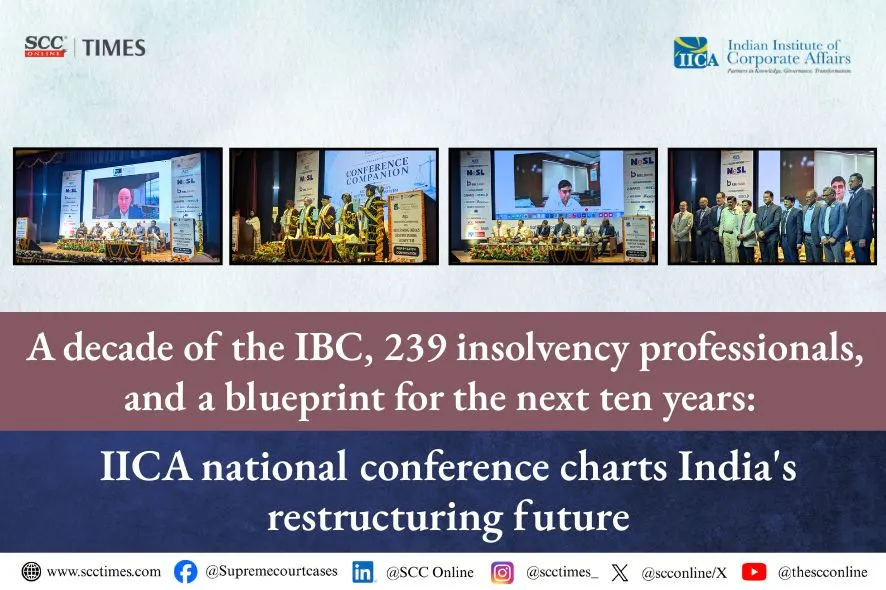
Commemorating a decade of the Insolvency and Bankruptcy Code, the Indian Institute of Corporate Affairs (IICA) convened its National Conference on “Redefining India’s Restructuring Ecosystem: A Decade of Learning — Directions for the Future” alongside the Convocation of the sixth batch of its flagship Post Graduate Insolvency Programme (PGIP) on 13 June 2026 at the Pradhanmantri Sangrahalaya Auditorium, New Delhi. Bringing together members of the judiciary, policymakers, regulators, insolvency professionals, academicians and industry leaders, the conference reaffirmed IICA’s growing role in advancing insolvency education, professional capacity building and policy discourse in India.
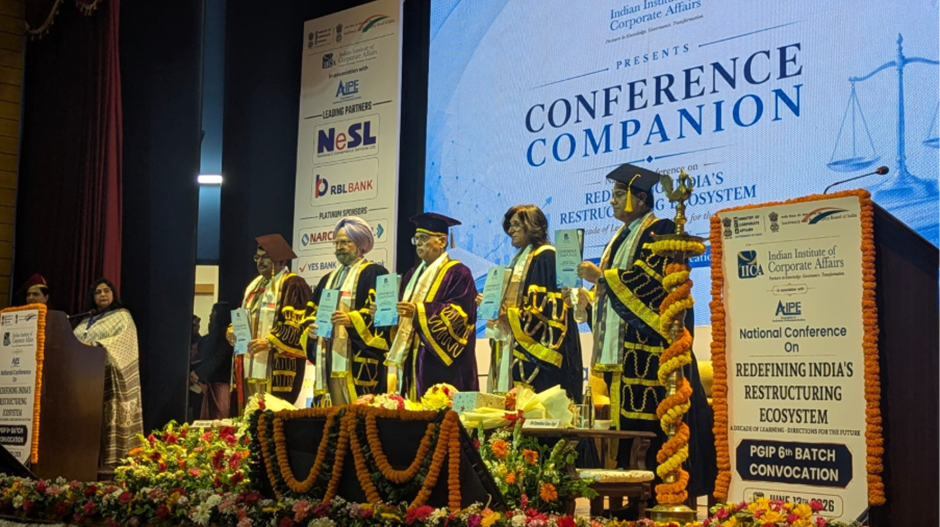
Organised by IICA, in association with the Association of Insolvency Professionals Entities (AIPE), the conference was conducted in a hybrid format and comprised the PGIP Convocation followed by four technical sessions examining cross-border insolvency, early-stage resolution, ditressed assets and the future of India’s insolvency ecosystem.
A defining feature of the event was the continued success of IICA’s Post Graduate Insolvency Programme, conceived under the leadership of Sudhaker Shukla, Former Whole-Time Member, Insolvency and Bankruptcy Board of India (IBBI), and Head, Centre for Insolvency and Bankruptcy, IICA. Approved by the IBBI, the two-year residential programme provides graduates with a unique pathway to register as Insolvency Professionals without the conventional ten-year experience requirement. Across seven batches, the programme has produced 239 insolvency professionals, many of whom are actively leading insolvency assignments across the country, underscoring IICA’s contribution to strengthening India’s insolvency ecosystem through institutional capacity building.
The Convocation Address was delivered by Justice Ashok Bhushan, Chairperson, National Company Law Appellate Tribunal (NCLAT), while Justice Anupinder Singh Grewal, President, National Company Law Tribunal (NCLT) attended as Guest of Honour. Deepti Gaur Mukerjee, IAS, Secretary, Ministry of Corporate Affairs, and Gyaneshwar Kumar Singh, Director General and CEO, IICA, addressed the gathering. The conference context was introduced by Sanjeev Pandey, CEO and Honorary General Secretary, AIPE.
The Convocation
Welcoming the distinguished guests and participants, Gyaneshwar Kumar Singh reflected on the journey of IICA’s Centre for Insolvency and Bankruptcy and the remarkable evolution of its flagship PGIP. Acknowledging the vision of Sudhaker Shukla, he noted that the programme has emerged as one of India’s most significant academic initiatives in insolvency education, combining rigorous classroom instruction with practical professional training to prepare the next generation of insolvency professionals.
Drawing upon his experience as former Joint Secretary (Insolvency), Member of the IBBI Governing Board and Member Secretary of the Insolvency Law Committee, Singh reflected on the transformative impact of the IBC over the past decade and emphasised the importance of strengthening institutional capacity, promoting professional excellence and ensuring that India’s restructuring framework continues to evolve alongside global best practices.
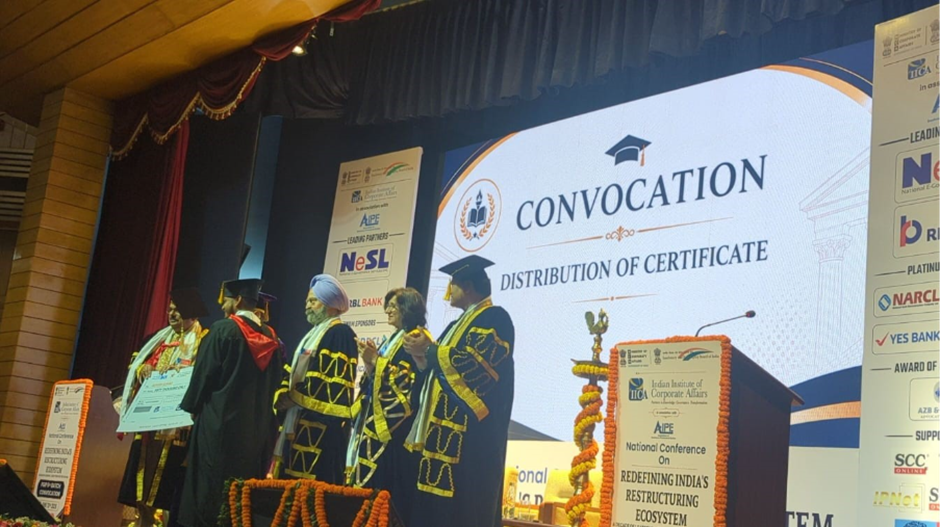
The Convocation witnessed 40 students of the sixth PGIP batch being conferred degrees and certificates. The Institute also recognised academic excellence, with Ashish Kumar securing the First Position, Arun Kumar securing the Second Position and K. Geetha Vaishnavi securing the Third Position. The merit awards, sponsored by AZB & Partners, recognised outstanding academic performance and professional commitment.
The occasion also witnessed the release of the National Conference Souvenir, documenting the evolution and jurisprudential development of the IBC over its first decade. IICA further announced the PM Vidya Lakshmi merit-cum-means scholarship for PGIP students and the extension of the One Nation One Subscription (ONOS) platform to the Institute, providing faculty, researchers and students with seamless access to leading legal databases, academic journals and research resources.
Panel I | Cross-Border Insolvency Framework under IBC: Global Standards, Domestic Readiness and Strategic Challenges
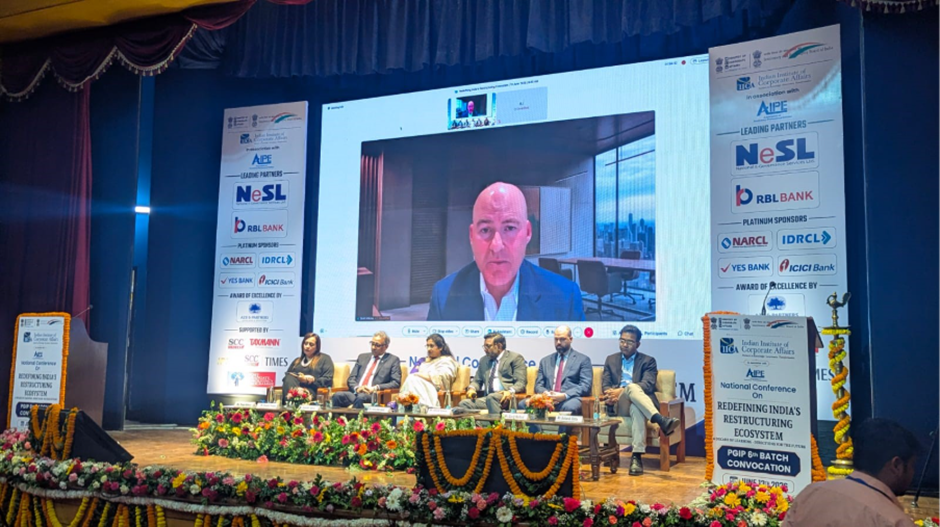
The first technical session examined India’s preparedness for cross-border insolvency under the evolving IBC framework. Moderated by Anoop Rawat, the panel featured Suharsh Sinha, David Welford, Sumant Batra, Anita Shah Akella, Scott Atkins and Pooja Bahry. The discussion focused on jurisdictional challenges, coordination of parallel proceedings, protection of cross-border assets and the implementation of the enabling provisions introduced through the IBC (Amendment) Act, 2026. Panellists also examined India’s proposed adoption of the UNCITRAL Model Law on Cross-Border Insolvency, emphasising the need for enhanced judicial preparedness, regulatory coordination and future reforms relating to group insolvency.
Panel II | Reimagining Early-Stage Resolution under the IBC
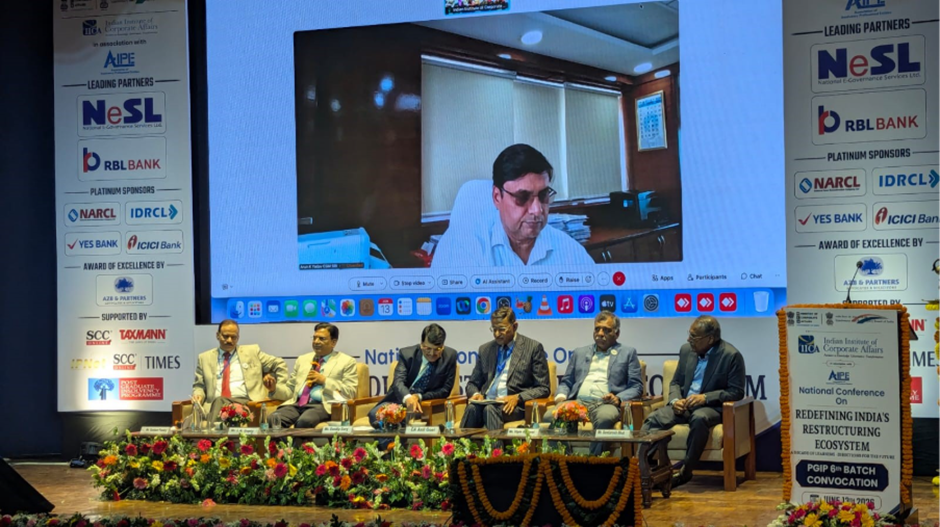
The second session explored emerging mechanisms for early-stage resolution of financial distress. Featuring Sanjeev Pandey, L.N. Gupta, Sandip Garg, CA Anil Goel, Vipin Agarwal, Sundaresh Bhat and Arun K. Yadav, the panel examined the newly introduced Creditor-Initiated Insolvency Resolution Process (CIIRP), discussing its potential to facilitate timely intervention before value erosion. Panellists also deliberated on pre-packaged insolvency processes, hybrid resolution models and the growing role of mediation, arbitration and other ADR mechanisms in preserving enterprise value while reducing litigation.
Panel III | Unlocking Value in Distressed Assets
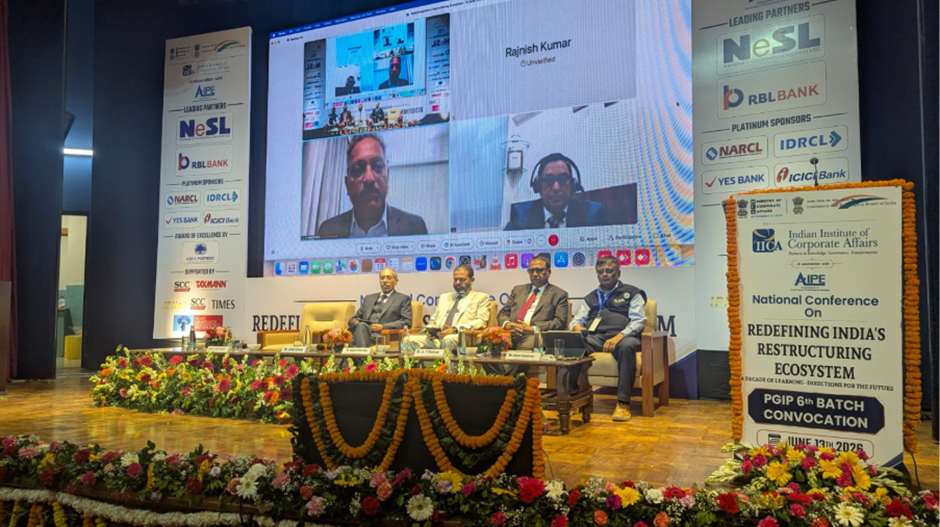
The third panel, comprising Hari Hara Mishra, P. Santosh, Jalesh Grover, Udayraj Patwardhan, G.P. Madaan and Jayesh Sanghrajka, examined the evolution of India’s distressed asset ecosystem and the expanding role of Asset Reconstruction Companies (ARCs), Alternative Investment Funds (AIFs) and institutional capital in facilitating corporate rescue and turnaround financing. The discussion also considered reforms necessary to deepen the secondary market for stressed assets, strengthen rescue financing mechanisms and encourage long-term domestic and foreign investment through greater regulatory certainty and market efficiency.
Panel IV | The Road Ahead: Building a Future-Ready Insolvency Ecosystem
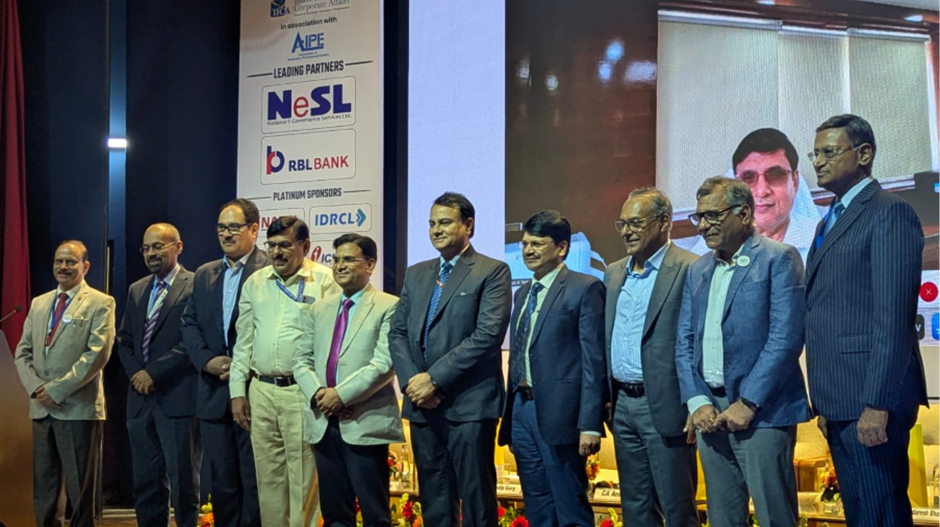
The concluding session featured Anil Kohli, Vikas Goel, M.S. Sahoo, Anju Agarwal, CA Manindra K. Tiwari, CA (Dr.) Ashoka Haldia and Debajyoti Ray Chaudhuri, who examined the future direction of India’s insolvency ecosystem. Discussions centred on early warning systems, pre-distress intervention mechanisms, resolvability or “Living Will” frameworks for systemically important enterprises, and the growing role of artificial intelligence, data analytics and integrated digital platforms in improving transparency, reducing litigation and enhancing the efficiency of insolvency resolution processes.
The decade ahead
Proposing the Vote of Thanks, Sudhaker Shukla, Former Whole-Time Member, IBBI, and Head, Centre for Insolvency and Bankruptcy, IICA, expressed gratitude to the judiciary, regulators, insolvency professionals, industry partners, academicians and participants for their contributions to the conference. He reiterated IICA’s commitment to strengthening insolvency education, advancing professional excellence and fostering policy innovation to support the continued evolution of India’s restructuring framework.
The conference concluded with a shared commitment to building a more resilient, efficient and globally aligned insolvency regime for India. More significantly, it reinforced IICA’s position as the country’s leading institution for insolvency education, research, professional capacity building and policy engagement, demonstrating how academic excellence and stakeholder collaboration can shape the next decade of India’s restructuring ecosystem.
Reported by: Sourav Ghosh, Damodaram Sanjivayya National Law University, Vishakhapatnam and Sudikshaa Pandey, Dr. B.R. Ambedkar National Law University, Sonepat