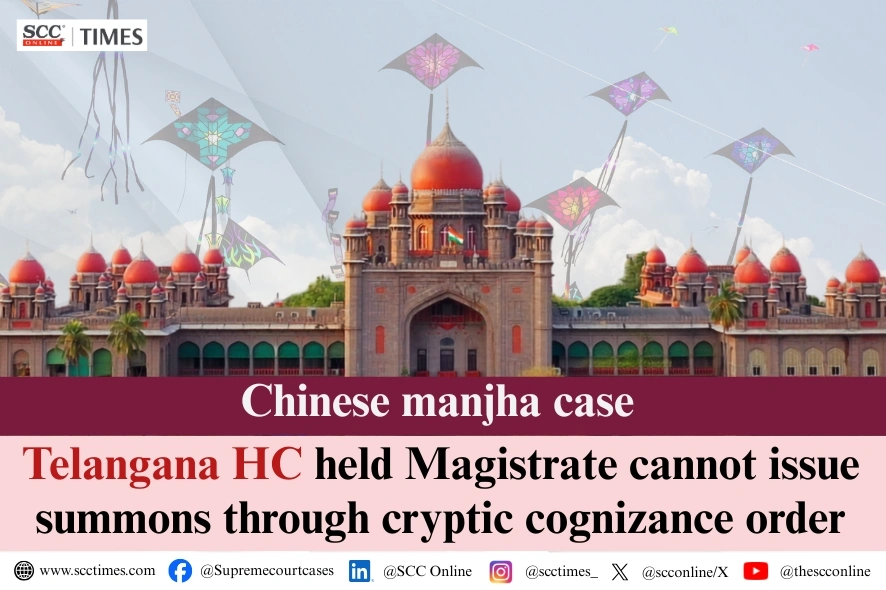
Telangana High Court: While considering a criminal petition under Section 528, Bharatiya Nagarik Suraksha Sanhita, 2023 (BNSS) seeking quashing of the proceedings in the Chinese manjha case, Justice J. Sreenivas Rao allowed the petition in part and held that the Magistrate’s order taking cognizance and issuing summons was unsustainable as it failed to disclose any application of mind or reasons for proceeding against the accused.
Facts and Background
By docket order dated 19 February 2024, the Special Judicial Magistrate took cognizance of offences under Sections 188 and 336, Penal Code, 1860 (IPC) and Section 15, Environment (Protection) Act, 1986 (EPA) against the petitioner and issued summons in the Chinese manjha case. It was not disputed that the matter before the trial court had not progressed beyond the stage of the petitioner’s appearance and had not ripened for trial.
Aggrieved by the manner in which cognizance had been taken, the petitioner invoked the inherent jurisdiction of the Court.
Analysis and Decision
The principal issue before the Court was whether a Magistrate could validly take cognizance and issue process through a cryptic docket order without recording reasons or demonstrating application of mind.
The Court observed that taking cognizance and summoning an accused to face criminal prosecution is a serious judicial function. Referring to Sunil Bharti Mittal v. CBI, (2015) 4 SCC 609, the Court reiterated that issuance of process cannot be ordered mechanically and the Magistrate must record reasons indicating satisfaction that the allegations, if proved, constitute an offence.
The Court also relied upon GHCL Employees Stock Option Trust v. India Infoline Ltd., (2013) 4 SCC 505, wherein the Supreme Court held that issuance of summons without recording satisfaction regarding the existence of a prima facie case is legally unsustainable.
Placing reliance on Chief Enforcement Officer v. Videocon International Ltd., (2008) 2 SCC 492, the Court observed that “taking cognizance” necessarily involves judicial application of mind by the Magistrate to the commission of an alleged offence and is not an empty formality.
The Court further referred to Fakhruddin Ahmad v. State of Uttaranchal, (2008) 17 SCC 157, wherein the Supreme Court clarified that cognizance is taken of the offence and not of the offender, and that before initiating criminal proceedings the Magistrate must examine the allegations and the accompanying material to satisfy himself that a prima facie offence is disclosed.
Applying these settled principles, the Court found that the impugned docket order merely recorded that cognizance had been taken and summons issued, without disclosing any reasons or indicating that the Magistrate had examined the material placed before him. Such a cryptic order failed to satisfy the legal requirements governing the exercise of judicial discretion while taking cognizance.
The Court held that orders directing issuance of summons cannot be passed mechanically and must reflect due application of mind by the Presiding Officer. Accordingly, without examining the petitioner’s remaining contentions, the Court held that the docket order dated 19 February 2024 was liable to be quashed. The Court clarified, however, that quashing of the cognizance order would not prevent the Magistrate from considering the matter afresh and passing a fresh, reasoned order in accordance with law.
Accordingly, the criminal petition was disposed of by quashing the impugned cognizance order while granting liberty to the Magistrate to proceed afresh in accordance with law.
[Kistaiahgari Sandeep v. State of Telangana, 2026 SCC OnLine TS 6390, decided on 29-6-2026]
Advocates who appeared in this case:
For the Petitioner: S. Surya Teja, Advocate.
For the Respondents: Jithender Rao Veeramalla, Additional Public Prosecutor.
Buy Penal Code, 1860 HERE