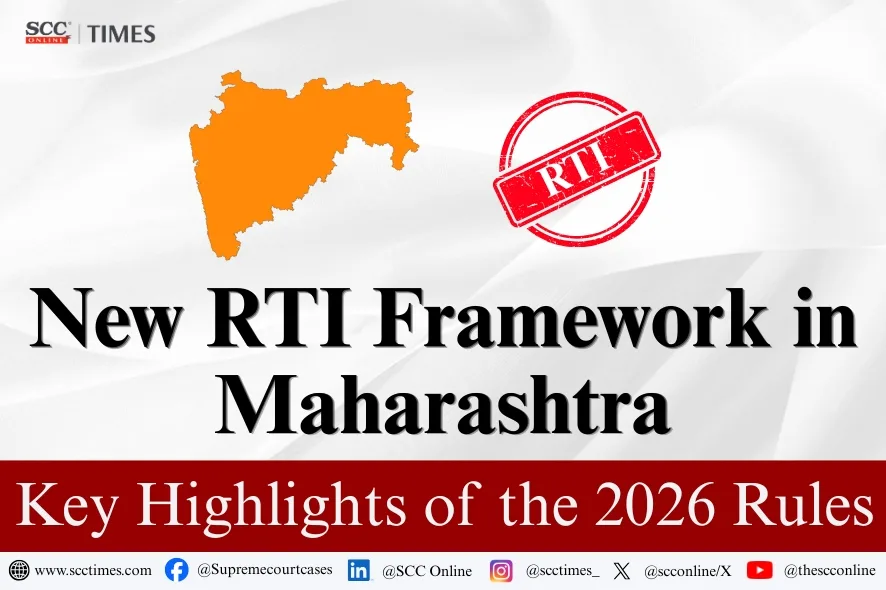
On 12 June 2026, the Maharashtra Government notified the Maharashtra Right to Information Rules, 2026, introducing a framework that prescribes the procedure for seeking information and secures the right of citizens to obtain information from public authorities across Maharashtra.
Key Highlights:
- These Rules have been framed by the Maharashtra Government under the Section 18(3), 19(10) and 27(2) of the Right to Information Act, 2005 (RTI Act).
- Rule 3 prescribes the format and conditions for RTI applications, as under:
- Applications must be submitted in the prescribed format (Annexure ‘A’)
- The format must include the applicant’s details and the particulars of the information sought.
- A ₹30 application fee is required.
- The original format contained a requirement to state the “purpose of information sought,” which was later omitted through the Maharashtra Right to Information (Amendment) Rules, 2026.
- Rule 4 prescribes the following charges:
- ₹5 per page for A4 or smaller size documents
- ₹5 per page for digital/scanned copies
- Actual cost for larger documents or samples
- Inspection: first hour free, then ₹50 per hour
- Postal charges: ₹50 or actual cost where applicable
- Fees are waived for persons below the poverty line, subject to proof; however, where the information is voluminous, the first 50 pages are provided free, and charges apply for the remaining pages.
- Fees may be paid through:
- Cash
- Court fee stamp
- Demand draft / bankers’ cheque / postal order
- Treasury deposit
- Electronic modes such as UPI and online payment systems
- Every applicant is required to attach a self-attested photo identity proof along with the application, failing which the application may be returned.
- Under Rule 13, personal information is exempt from disclosure unless justified by overriding public interest, aligning with Section 8 of the RTI Act.
- A person dissatisfied with the response can file a first appeal before the First Appellate Authority in Annexure ‘B’ with a ₹50 fee and basic supporting documents.
- If still dissatisfied, a second appeal can be filed before the State Information Commission in Annexure ‘C’ with a ₹100 fee along with all relevant documents, submitted in three copies.
- Under Rule 22, in appeals or complaints, the burden of proof lies on the party making the claim, and the applicant must show denial, delay, or incorrect information.
- The Public Information Officer or authority must justify its action in accordance with the provisions of the RTI Act.
- Under Rule 23, appeals may be withdrawn on request, but costs may be imposed if withdrawn after notice, and proceedings end if the appellant dies.
- The Commission issues written orders, and the same procedure applicable to appeals also applies to complaints.
-
The Commission also has the power to pass necessary procedural orders, correct errors, and allow authorised representatives to present cases.
Also Read: Latest Supreme Court and High Courts Judgments on Right to Information Act, 2005
[Maharashtra Right to Information Rules, 2026, dt 12-6-2026]
[Maharashtra Right to Information (Amendment) Rules, 2026, dt 19-6-2026]