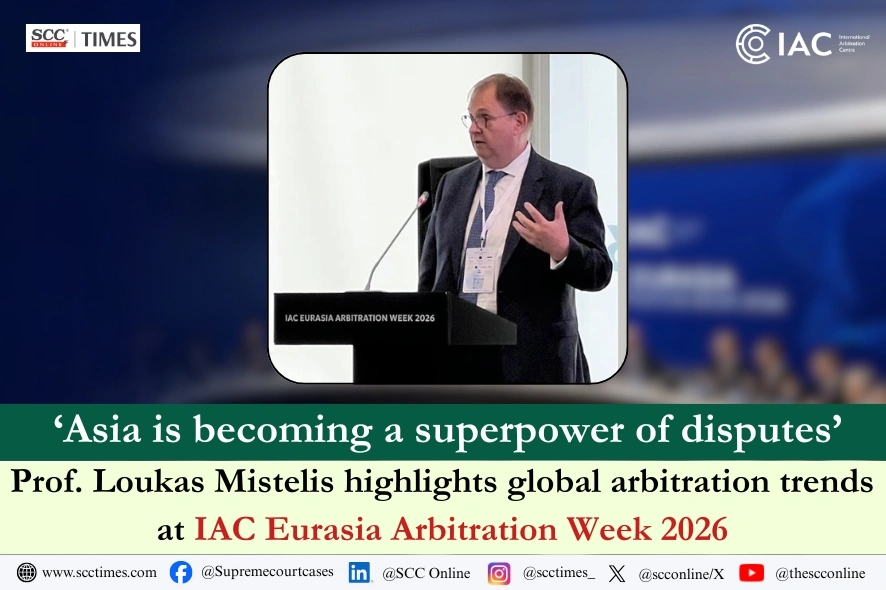
On Day 2 the International Arbitration Centre (IAC) hosted a keynote session titled “Queen Mary International Arbitration Survey: Global Trends, User Expectations & the Path Forward” during IAC Eurasia Arbitration Week 2026, featuring Prof. Loukas Mistelis, Clive M. Schmitthoff Professor of Transnational Commercial Law and Arbitration at Queen Mary University of London and International Arbitration Partner at Steptoe LLP.
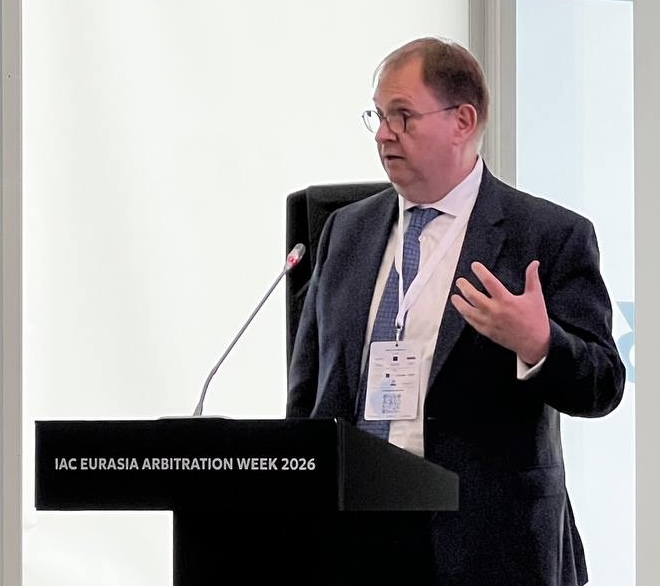
Introducing the speaker, it was noted that Professor Mistelis had played a defining role in establishing the empirical study of international arbitration through the Queen Mary surveys, long before arbitration discourse became driven by rankings and analytics. He observed that the surveys sought to understand not merely how arbitration functioned, but how its users perceived and experienced it.
The moderator further remarked that for the IAC, the survey represented more than academic research. As a relatively young arbitral institution that has recently crossed the milestone of 5,000 cases, the Centre hopes to earn recognition through user confidence rather than institutional promotion. “We hope to appear because users name us, because they have used us, trusted us and found us worthy of comparison with established international centres,” he said.
Origins of the Queen Mary International Arbitration Survey
Beginning his address, Professor Mistelis explained that the Queen Mary International Arbitration Survey originated from a simple yet significant question: how do businesses actually choose arbitration?
Recalling the survey’s inception more than two decades ago, he said that the idea emerged during a discussion with colleagues over dinner, at a time when international arbitration lacked systematic empirical research.
He observed that in the early 2000s, resources either did not exist or were in their infancy. Discussions surrounding arbitration were largely anecdotal, with little understanding of what users actually valued in arbitral proceedings.
Accordingly, the survey was designed to understand why businesses choose arbitration, what users expect from the process, and how arbitration functions as a transnational legal order.
Professor Mistelis noted that the surveys have been conducted in partnership with leading organisations, including PwC, White & Case LLP, and Pinsent Masons, while every researcher associated with the project has gone on to establish a distinguished career in arbitration, whether in academia or practice.
2025 Survey reflects Asia’s growing engagement
Turning to the latest edition of the survey, Professor Mistelis explained that the 2025 Queen Mary International Arbitration Survey combined quantitative responses with qualitative interviews.
The survey received approximately 2,400 responses and included 117 in-depth interviews across jurisdictions, industries and stakeholder groups.
One of the most striking findings, he noted, was Asia’s growing participation.
Nearly 47 per cent of respondents came from the Asia-Pacific region, followed by Europe (31 per cent) and North America (10 per cent).
Professor Mistelis attributed this not merely to demographic realities but also to the region’s increasing engagement with international arbitration and growing reliance on empirical research.
Arbitration remains the preferred method for cross-border disputes
Discussing the survey’s principal findings, Professor Mistelis noted that international arbitration continues to enjoy overwhelming user confidence.
He stated:
“Arbitration remains the preferred method for cross-border disputes.”
Approximately 87 per cent of respondents identified arbitration as their preferred standalone mechanism for resolving international commercial disputes, while many others preferred combining arbitration with other forms of alternative dispute resolution such as mediation and negotiation.
Although perceptions have evolved over the past two decades, he observed that the fundamental preference for arbitration has remained remarkably consistent.
London retains leadership while Asia emerges as a global arbitration powerhouse
Professor Mistelis observed that London has consistently remained the world’s leading arbitral seat since the first Queen Mary survey in 2006.
According to the 2025 findings, London continues to lead globally, followed by Singapore, Hong Kong, Beijing, and Paris.
Regional preferences, however, reveal significant shifts. Within the Asia-Pacific region, respondents identified Hong Kong, Singapore, Beijing, London, and Shenzhen as their preferred arbitral seats.
Similarly, the survey demonstrated the continuing prominence of the International Chamber of Commerce (ICC) as the most preferred arbitral institution globally, followed by institutions such as the Hong Kong International Arbitration Centre (HKIAC), London Court of International Arbitration (LCIA), China International Economic and Trade Arbitration Commission (CIETAC), and others.
Reflecting on broader global developments, Professor Mistelis remarked:
“Asia is becoming a superpower of disputes.”
He explained that not only are an increasing number of disputes originating from Asia, but many are also being seated within Asian arbitral centres, demonstrating the region’s growing influence over international dispute resolution.
Efficiency, cost and confidentiality remain users’ primary concerns
Professor Mistelis noted that while arbitration continues to be widely preferred, users consistently emphasise three priorities: efficiency, cost, and confidentiality.
He observed that demands for expedited procedures, early determination of unmeritorious claims, and more effective case management continue to grow.
At the same time, survey respondents frequently attributed procedural inefficiencies differently depending upon their role.
He remarked, somewhat humorously, that:
“Counsel blame arbitrators and arbitrators blame counsel.”
Cost also remains a recurring concern. Professor Mistelis stated:
“Cost matters.”
Nearly half of the survey respondents continue to regard arbitration as expensive.
Offering his own perspective, however, he described arbitration as a premium dispute resolution mechanism.
He explained:
“Arbitration is a luxury market. It’s the private health service.”
According to him, arbitration was never intended for every category of dispute, particularly low-value consumer or small commercial claims, and attempts to extend arbitration into such areas may undermine its original purpose.
Confidentiality also continues to distinguish arbitration from litigation. While some institutions have promoted greater transparency by publishing arbitral awards, Professor Mistelis observed that parties overwhelmingly continue to value confidentiality, particularly in commercial disputes.
Artificial Intelligence will improve efficiency but not replace arbitrators
Addressing one of the most closely watched themes of the survey, Professor Mistelis discussed the growing role of Artificial Intelligence (AI) in international arbitration.
Survey respondents generally believe AI will improve efficiency, particularly in document review, organisation of evidence, and factual summaries.
However, they remain reluctant to entrust substantive legal reasoning to AI.
Professor Mistelis explained that while AI may assist tribunals in administrative tasks and procedural management, the drafting of legal reasoning and final decisions must continue to remain the responsibility of human arbitrators. He also acknowledged concerns surrounding algorithmic bias and differing technological standards across jurisdictions.
Geopolitics and mediation will shape future arbitration practice
Looking ahead, Professor Mistelis identified several developments likely to influence future editions of the survey.
These include the growing interaction between mediation and arbitration, emergency relief mechanisms, sanctions, and the fragmentation of the global legal order resulting from geopolitical developments.
He observed that international arbitration is increasingly evolving within regional ecosystems while remaining fundamentally global in character.
During the interactive session, Professor Mistelis also addressed questions regarding the survey’s methodology and representativeness. He explained that the questionnaires are developed through carefully selected focus groups comprising representatives from arbitral institutions, businesses, in-house counsel and arbitrators, while qualitative interviews provide essential context beyond statistical findings.
Concluding the session, the moderator observed that the Queen Mary Survey serves as an important benchmark for arbitral institutions worldwide.
He remarked that institutions ultimately build their reputation not through self-promotion but through user confidence. Expressing the IAC’s aspirations, he stated that the Centre hopes to be recognised in future editions of the survey because users choose it voluntarily and regard it alongside the world’s leading arbitration institutions.
Read more IAC Eurasia Arbitration Week 2026 coverage: