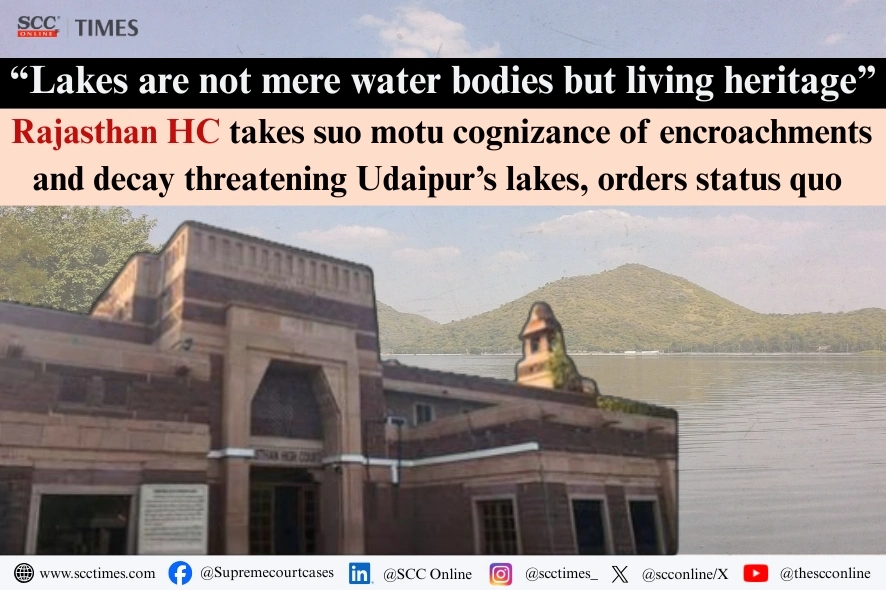
Rajasthan High Court: A Division Bench of Pushpendra Singh Bhati and Rekha Borana, JJ., invoked its suo motu jurisdiction in larger public interest so as to ensure effective protection, preservation and sustainable management of lakes, water bodies, canals and associated ecological systems situated within Udaipur and the proceedings were registered as a suo motu public interest litigation (PIL) under Article 226 of the Constitution on the basis of the newspaper reports by Rajasthan Patrika.
The Court observed that,
“Article 21 of the Constitution encompasses the right to a clean and healthy environment and Article 48-A casts a duty upon the State to protect the environment and safeguard forests, lakes, rivers and wildlife, while Article 51-A(g) recognises a corresponding duty of every citizen to protect and improve the natural environment. The Public Trust Doctrine mandates that natural resources of vital public importance are held by the State as a trust, for the benefit of the public and the future generations, and cannot be permitted to suffer degradation through inaction or unsustainable use.”
Background
A suo motu PIL was registered under Article 226 of the Constitution as the court took note of multiple newspaper reports published in Rajasthan Patrika (Udaipur Edition) dated 25, 29 and 31 May 2026 raising serious concerns about the condition of lakes, canals, wetlands and water bodies situated in Udaipur, highlighting issues of encroachments and boundary disputes upon lakes, degradation, deficiency in canal infrastructure, developmental activities in proximity to ecologically sensitive areas and overall management and preservation of urban water resources.
The newspaper reports covered Rupsagar Talab, repairs in Madar Canal walls and Fatehsagar Lake.
The court stated that the issues involved are not confined to isolated incidents concerning individual locations, rather they indicate broader concerns relating to protection of lakes and water bodies, preservation of catchment areas, maintenance of water infrastructure, prevention of encroachments, regulation of developmental activities and conservation of the ecological character of urban water bodies within the city.
The court addressed the issues as per the newspaper reports that warrant immediate judicial scrutiny and issued several interim directions to State Government and concerned authorities.
Analysis
The court stated:
The lakes of Udaipur are not mere water bodies but constitute a living natural and cultural heritage that has shaped the history, economy and collective consciousness of the region for centuries. These water bodies not only form an integral part of the city’s environmental and cultural heritage but also perform critical functions relating to groundwater recharge, water security, biodiversity conservation, flood moderation, climate resilience and maintenance of ecological balance. The preservation and protection of these life giving natural resources is hence essential not only for environmental sustainability but also for safeguarding the constitutional right of the present and the future generations, to a clean and healthy environment….
….in a region such as southern Rajasthan where water resources assume immense importance, pollution, degradation, or encroachment on such water bodies can have far-reaching ecological, hydrological and social consequences
The court observed that protection and preservation of lakes, wetlands and associated ecosystems is firmly embedded within the constitutional framework as Article 21 encompasses right to a clean and healthy environment, Article 48-A casts a duty upon State to protect environment, safeguard forests, lakes, rivers and wildlife, while Article 51-A(g) recognises such corresponding duty of every citizen. The Public Trust Doctrine mandates that natural resources of vital public importance are held by the State as a trust, for the benefit of the public and the future generations and cannot be permitted to suffer degradation through inaction or unsustainable use.
Highlighting the significance of Udaipur’s environmental landscape, the court observed that increasing urbanisation, unregulated development, encroachment, sewage discharge and inadequate maintenance of water infrastructure significantly affect water-stressed regions. Examining the newspaper reports, the court highlighted several issues arising out of the reports such as protection of lakes and water bodies, preservation of catchment areas, maintenance of water infrastructure, prevention of encroachments, regulation of developmental activities and conservation of the ecological character of urban water bodies.
Thus, the court identified several points for consideration such as—
-
identification, mapping, demarcation and protection of lakes, water bodies, canals, feeder channels and catchment areas;
-
present status, ecological condition and conservation measures pertaining to major lakes and water bodies;
-
measures undertaken and legality and environmental implications of developmental and commercial activities undertaken or proposed in proximity to ecologically sensitive lake areas;
-
condition, maintenance and structural integrity of canal infrastructure and associated water management systems;
-
impact of degradation of lakes and water bodies upon biodiversity conservation, groundwater recharge, water security, ecological balance and environmental sustainability; and
-
formulation and implementation of short-term, medium-term and long-term measures essential for protection, restoration and sustainable management.
The court opined that the aforementioned issues require immediate attention and a coordinated response from the concerned authorities, warranting immediate judicial scrutiny in larger public interest.
Interim Directions
The court directed the matter to be registered as a writ petition titled, Protection and Conservation of Lakes and Water Bodies in Udaipur v. State of Rajasthan. All the respondents were directed to file detailed affidavit/status reports indicating steps taken and proposed future course of action. Interim measures were issued to the State Government to ensure no further encroachments, no untreated sewage discharged into any lake, conducting inspection of water bodies and lakes, undertake water quality assessment, examination of existing boundaries and demarcation proceedings, etc.
The court also appointed Avin Chhangani, Shubham Ojha, Mudit Nagpal as Amicus Curiae.
Next date of hearing was set to be 13-7-2026.
[Protection and Conservation of Lakes and Water Bodies in Udaipur v. State of Rajasthan, 2026 SCC OnLine Raj 3865, decided on 5-6-2026]
Buy Constitution of India HERE