This roundup of weekly legal developments in India covers the most significant Supreme Court and High Court rulings, including POCSO Case Quashed After Accused Marries Minor Prosecutrix; Family Pension Granted to Second Wife; Wife Cannot Use RTI to Access Husband’s Income Tax Details, etc.
It also highlights major legislative developments such as the Cabinet Approval to Add 4 More Supreme Court Judges; RERA Amendment vide Jan Vishwas (Amendment of Provisions) Act, 2026, enforced; Khasi and Garo Declared Official Languages in Meghalaya, along with other updates from across India.
STORY OF THE WEEK
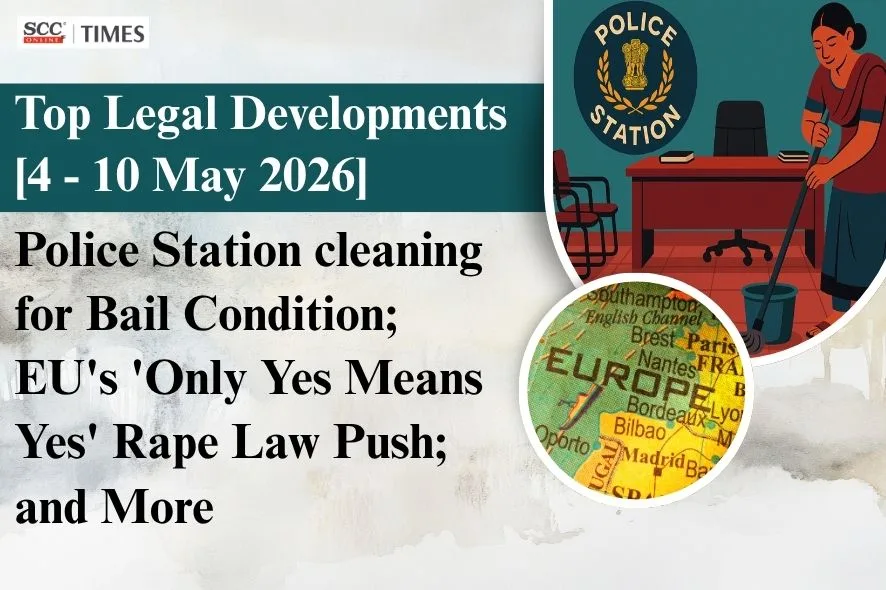
Bail Conditions | “Abhorrent, Degrading, and Unknown to Law”; Imposition of Bail Conditions Such as Cleaning of Police Stations Declared as Null and Void
In Condition Being Imposed While Granting Bail by High Court of Orissa and District Courts in the State of Odisha and Ancillary Issues, In re, 2026 SCC OnLine SC 809, the Supreme Court noting the same to be “abhorrent, degrading, and unknown to law”, declared all such conditions, requiring cleaning of police stations or similar acts, as null and void. Recognising broader implications, the Court further issued omnibus directions
Read more HERE
SUPREME COURT HIGHLIGHTS OF THE WEEK
Dowry Death | Young Girls Don’t Get Married to Be Killed for Dowry; Supreme Court Cancels Bail Granted in Dowry Death Case
In Mahesh Chand v. State of U.P., 2026 SCC OnLine SC 793, the Supreme Court cancelled bail in dowry death case, holding that bail cannot be granted on tenuous grounds such as alleged delay in FIR or superficial reading of cause of death in dowry death cases. The Court held that in cases involving dowry death, where there exists prima facie evidence of cruelty and death within 7 years of marriage, bail courts must apply statutory presumption under Section 118, Sakshya Adhiniyam, 2023 (BSA) [erstwhile Section 113(B), Evidence Act, 1872] and carefully scrutinise material evidence.
Read more HERE
Company Law | Oppression Petition Maintainable Even Without Name in Register of Members under Companies Act, 1956
In Dr Bais Surgical and Medical Institute (P) Ltd. v. Dhananjay Pande, 2026 SCC OnLine SC 794, the Supreme Court upheld the judgments of the High Court and the Company Law Board treating Respondent 1 as a “member” of the Company despite the absence of his name in the register of members. The Court held that the expression “member” occurring in Sections 397 and 398 cannot be construed in a narrow or technical sense confined solely to formal entry in the register of members, particularly having regard to the equitable nature of the jurisdiction exercised under the said provisions.
Read more HERE
Labour Law | Regularisation of ISRO daily-wage workers directed, quashes Gang Labourers Scheme, 2012 for non-compliance with binding CAT directions
In R. Iyyappan v. Union of India, 2026 SCC OnLine SC 742, the Supreme Court set aside the judgment of the Madras High Court which had upheld the rejection of the appellants’ claim. The Court held that the Gang Labourers (Employment for Sporadic Types of Work) Scheme, 2012 (Gang Labourers Scheme, 2012), framed by the respondents, failed to comply with the binding directions issued by the Central Administrative Tribunal in the earlier round of litigation, which had attained finality up to the Supreme Cou
Read more HERE
Article 21 | Right to Speedy Trial Prevails Over Gravity of Offence; Bail Must Be Considered When Article 21 Infringed
In Sahil Manoj Machare v. State of Maharashtra, 2026 SCC OnLine SC 810, the Supreme Court directed the petitioner to be released on bail, holding that in case of infringement of the right to speedy trial, the Court must consider a plea for bail, even where the alleged offence is of a serious nature.
Read more HERE
Education Law | ReT Closure: Litigation-based exclusion quashed; Relief to select panel candidates subject to TET
In State (UT of J&K) v. Saba Wani, 2026 SCC OnLine SC 752, the Supreme Court modified the judgment of the High Court, which had upheld the validity of Government Order No. 919-Edu of 2018 dated 16 November 2018. While affirming the closure of the scheme, the Court held that denial of engagement to candidates solely on the ground of pendency of litigation as on the date of the closure order is arbitrary and violative of Article 14 of the Constitution.
Read more HERE
HIGH COURT HIGHLIGHTS OF THIS WEEK
Recruitment | Mandatory Driving License Rule for Male SI Candidates Upheld
In Vikram Kumar Jha v. Union of India, 2026 SCC OnLine Del 1787, the Delhi High Court dismissed the petition, holding that possession of a valid LMV driving licence on the date of Physical Endurance and Measurement Test (PEMT) is an essential eligibility condition which cannot be relaxed or fulfilled at a later stage. The Court held that a learner’s licence cannot be equated with a valid driving licence for the purpose of eligibility and that the stipulation requiring such licence for male candidates flows from the statutory framework under the Delhi Police (Appointment and Recruitment) Rules, 1980.
Read more HERE
Sports Law | Challenge to AITA Elections Dismissed; Orders Fresh Polls Under National Sports Governance Act, 2025
In Anil Dhupar v. Chintan N. Parikh, 2026 SCC OnLine Del 1950, the Delhi High Court dismissed the petition as devoid of merit, holding that the petitioner’s disqualification was in accordance with the applicable rules and did not suffer from arbitrariness or illegality.
Read more HERE
Labour Law | Corruption Charge Not Proved, Yet Employee Removed: Delhi HC Sets Aside Penalty, Directs Reinstatement
In Rajesh Choudhary v. Union of India, 2026 SCC OnLine Del 2028, the Delhi High Court held that failure of core charge in disciplinary proceedings, i.e., corruption under Article III, vitiated the penalty of removal from service and punishment must be reassessed on surviving minor charges under Article I and limited part of Article II. The Court set aside the disciplinary order dated 29 November 2022 and the appellate decision dated 31 August; quashed the findings of corruption under Article III and the “sleeping on duty” allegation under Article II; directed the reinstatement of the petitioner with continuity of service, while monetary benefits were kept open. It further permitted the respondents to reconsider the penalty only on the surviving charges on the existing record, only after granting an opportunity of hearing to the petitioner.
Read more HERE
Plagiarism | Filmmaker Claims Dhurandhar 2 Copied His Script: Here’s Why Dismissed Plea to Revoke CBFC Certification
In Santosh Kumar R.S. v. Aditya Dhar, 2026 SCC OnLine Kar 2943, the Karnataka High Court held that merely because a film was certified under Section 5-A, Cinematograph Act, 1952 (Cinematograph Act), the same could not be interfered with under Article 226 of the Constitution, on the ground of alleged plagiarism, particularly when such allegations pertains to private proprietary rights disputes, which require trial. Accordingly, the Court dismissed the said petition.
Read more HERE
Motor Accidents Claims | No Medical Certificate, No Disability: 50% Disability Finding Based On Fractured Vertebrae Rejected
In New India Assurance Co. Ltd. v. Gyandup Tshering Lepcha, 2026 SCC OnLine Sikk 28, the Sikkim High Court set aside the order passed by the Motor Accidents Claims Tribunal (MACT), Gangtok, where the compensation of Rs 29,12,887 with interest at 6 per cent per annum was awarded to the respondent citing 50 per cent permanent disability. The Court held that fractured ribs, hip dislocation and vertebral fracture cannot lead to 50 per cent disability, in the absence of any medical or disability certificate.
Read more HERE
RTI | No “Larger Public Interest”; Wife Cannot Use RTI to Access Husband’s Income Tax Details in Matrimonial Disputes
In Kapil Agarwal v. CPIO Income Tax Officer, Moradabad, 2026 SCC OnLine Del 2276, the Delhi High Court set aside the impugned order, holding that wife cannot use RTI to access husband’s income details. The Court held that personal financial information, including income details and tax returns, constitutes “personal information” under Section 8(1)(j), Right to Information Act, 2005 (RTI Act) and matrimonial disputes do not constitute “larger public interest”, therefore exempted from disclosure under the Act.
Read more HERE
Customs, Excise and Service Tax | Customs Broker Not to Be Penalised for Mis-Description While Filing Shipping Bills
In Seaswan Shipping & Logistics v. Commr. of Customs, 2026 SCC OnLine Mad 3627, the Madras High Court set aside the order passed by the Customs, Excise and Service Tax Appellate Tribunal (CESTAT), Chennai, holding that a mere mis-description of the classification will not attribute mens rea to impose penalty under Section 114-AA, Customs Act, 1962 (Customs Act). The Tribunal was wrong in invoking Sections 28 and 28-AAA, Customs Act, and since Merchandise Exports from India Scheme (MEIS) scrips were granted by Directorate General of Foreign Trade (DGFT), the Customs Department did not have jurisdiction to initiate action against the appellant.
Read more HERE
Criminal Law | FIR quashed over ‘Ya Allah! Rasgulla! Dahi Bhalla!’ remark; No offence under S. 295-A IPC
In Shekhar Suman v. State of Maharashtra, 2026 SCC OnLine Bom 2837, the Bombay High Court examined the content of the television programme “Comedy Circus Ka Jadoo” wherein the complaint alleged that the expressions “Ya Allah! Rasgulla! Dahi Bhalla!” used during the show offended religious sentiments. The Court held that these words, spoken in rhyme and comic effect, did not disclose any deliberate or malicious intent to outrage religious feelings as they are common food items consumed across communities and carry no religious colour. Concluding that the FIR lacked the essential ingredients of the offence and that sanction under Section 196, Criminal Procedure Code, 1973 (CrPC) had not been obtained, the Court quashed the FIR and all consequential proceedings.
Read more HERE
Wildlife Poaching | “International gang of wildlife poachers & traffickers”: Madhya Pradesh HC denies bail to alleged pangolin poacher, noting prima facie involvement
In Yangchen Lachungpa v. State of M.P., 2026 SCC OnLine MP 9017, the Madhya Pradesh High Court dismissed the application, holding that the record suggested the accused’s prima facie involvement in the crime. Additionally, the apprehension that she might not be available for trial appeared well-founded.
Read more HERE
Religious Practice/Custom | No Right to Conduct Regular Religious Congregation on Public Land; Private Use Also Subject to Regulation
In Aseen v. State of U.P., 2026 SCC OnLine All 3689, the Allahabad High Court, noting the limits on religious practice under Articles 25 and 26, held that no individual can claim a right to use public land as an exclusive or recurring religious space, and even private property cannot be converted into an unregulated congregational venue and finding no enforceable legal right, dismissed the writ petition.
Read more HERE
NDPS Act | Mere Driving of Vehicle Insufficient to Establish “Constructive Possession” of Passenger’s Contraband; Bail Granted
In Saw Herald v. State of W.B., 2026 SCC OnLine Cal 4607, the Calcutta High Court held that the rigours of Section 37 were not prima facie attracted and granted bail to the petitioner subject to conditions.
Read more HERE
Insolvency and Bankruptcy | Section 14 IBC Moratorium a Protective Shield Against Asset Depletion; Statutory Authorities Cannot Recover Leasehold Property During CIRP
In Gujarat Industrial Development Corpn. v. Gujarat Hydrocarbons and Power SEZ Ltd., 2026 SCC OnLine Guj 2517, the Gujarat High Court affirmed the judgment of the Single Judge and dismissed the appeal holding that once a moratorium under Section 14, Insolvency and Bankruptcy Code, 2016 (IBC) comes into force, a lessor, including a statutory authority, cannot terminate a subsisting lease or seek recovery of possession of leased premises occupied by the corporate debtor, even if such an action is based on alleged contractual breaches, non-utilisation of land or non-payment of pre-CIRP dues. The Court further held that, leasehold rights constitute “property” within the meaning of Section 3(27) IBC and are protected under Section 14(1)(d), and further, by virtue of Section 238 IBC, the provisions of the Code would override the PP Act rendering any eviction action during the moratorium legally unsustainable
Read more HERE
Corruption | Caught Red-Handed Taking Bribe? No Prior Sanction Required Under S. 17A PC Act; Corruption Not an Act of Official Duty
In Achche Lal v. CBI, 2026 SCC OnLine All 3353, the Allahabad High Court upheld the impugned orders, holding that no additional sanction under Section 218 BNSS [erstwhile Section 197 Criminal Procedure Code, 1973 (CrPC)] is required once sanction under Section 19, Prevention of Corruption Act, 1988 (PC Act) has been granted, as acts of corruption cannot be treated as acts done in discharge of official duty and conspiracy under Section 61(2), Nagarik Suraksha Sanhita, 2023 (BNSS) is not independent of the substantive offence. It was further held that in trap cases where the accused is caught red-handed, prior sanction under Section 17-A, PC Act is not required, and subsequently the Court dismissed the petitions.
Read more HERE
Bareilly Violence Case | Bail granted to man for “I love Mohammed” post after 7 months in jail
In Nadeem v. State of U.P., 2026 SCC OnLine All 4466, the Allahabad High Court allowed the application, holding that it was appropriate to enlarge him on bail as the alleged objectionable post did not name any caste or community.
Read more HERE
Akasa Air Dispute | ₹1.08 Crore Decree Stayed in Akasa Air Dispute; Raises Concern Over Prima Facie Impression of AI use in Trial Court Judgment
In SNV Aviation (P) Ltd v. ABS Tour and Travels1, the Delhi High Court issued notice and stayed the operation of the impugned judgment, prima facie observing that the grant of the entire ticket revenue as loss of profits appeared untenable. The dispute arose out of a transaction wherein the respondent, a tour operator, had booked 640 airline tickets with the appellant, operating under the name “Akasa Air”.
Read more HERE
POCSO | “Not a single whisper of force”: POCSO Case Quashed After Accused Marries Minor Prosecutrix, Now 7 Months Pregnant
In Vijay Laxman Rotke v. State of Maharashtra2, the Bombay High Court quashed the POCSO case citing subsequent marriage, pregnancy and lack of force allegations by the prosecutrix and held that the criminal proceedings against the accused and his parents must be ended in the interest of complete justice.
Read more HERE
Cow Slaughter Act | “Manifest Arbitrariness”: Compensation & damages granted to man whose vehicle was wrongly seized and auctioned under U.P. Cow Slaughter Act
In Chandrabhan Kumar v. State of U.P., 2026 SCC OnLine All 4456, the Allahabad High Court allowed the petition, holding that the State action of confiscating the petitioner’s vehicle was arbitrary, illegal, and unsupported by the statutory provisions of the Uttar Pradesh Prevention of Cow Slaughter Act, 1955 (U.P. Cow Slaughter Act). The Court also held that the sole basis of confiscation appeared to be that the animals were allegedly being transported without a permit, and there was no cogent material on record to establish that the animals were being transported to Bihar for slaughter.
Read more HERE
Family Law | “Illegal But Not Immoral”: Family Pension Granted to Second Wife, Held Economically Dependent Spouse Cannot Be Left Destitute
In Umawati v. H.P. SEB3, the Himachal Pradesh High Court held that although the marriage between the appellant and the deceased employee (deceased) was held to be illegal under Section 5(i), Hindu Marriage Act, 1955 (HMA), it could not be treated as immoral. The Court set aside the impugned judgment and granted the family pension despite void marriage, emphasising social justice and economic empowerment of women.
Read more HERE
GST | “[1] Others” Not a Clear Reason: Non-Speaking GST Registration Cancellation Order Quashed
In Yamang Siram v. Union of India4, decided on 29-04-2026, the Gauhati HC: The writ petition filed under Article 226 of the Constitution, against the order passed by the Proper Officer, which cancelled the GST Registration of the petitioner under the Goods and Services Tax Act, 2017, was allowed by a Single Judge Bench of Manish Choudhury, J., and the impugned order was set aside on the grounds of not being a speaking order as it was found to be passed arbitrarily, without recording reasons and due application of mind.
Read more HERE
VJNT Reservation | Unfilled Reserved Vacancies Must Go to Other Reserved Categories in Proportion, Not on Common Merit List
In Nikhil Ashok Dumane v. Police Recruitment Board, Writ Petition No. 5999 of 2025, decided on 30-4-2026, the Bombay High Court examined whether vacancies in Vimukta Jatis [VJ(A)] and Nomadic Tribes [NT(D)] categories left unfilled due to non-availability of suitable candidates should be filled by preparing a common merit list of (NT) (B) and NT(C) candidates or by distributing them proportionately according to reservation percentages. The Court held that proportional distribution was the correct method under Section 4(3), Maharashtra State Public Services Reservation for Scheduled Castes, Scheduled Tribes, De-Notified Tribes (Vimukta Jatis), Nomadic Tribes, Special Backward Category and other Backward Classes Act, 2001 (Act of 2001), and dismissed the petitions.
Read more HERE
Education Law | ‘Teach constitutional journey through lives who shaped it’: State directed to include Dr B.R. Ambedkar in TN school curriculum
In G. Rajesh v. State of T.N.5, the Madras High Court on being fully satisfied that the petitioners displayed genuine regret and remorse, stated that the present matter has moved beyond the stage of mere compromise. Thus, the Court quashed the criminal proceedings against the petitioners. Further, the Court emphasised that schools should not teach the Constitution as mere facts, rather, teach the constitutional journey of India through the lives of those who shaped it. Among them, Dr B.R. Ambedkar stands foremost.
Read more HERE
Also Read: “Hon’ble” Honorific Must be Used for Constitutional Functionaries; Not for Civil Servant | SCC Times
Land Acquisition | Government cannot “pick and choose” judgments to accept or assail later as it undermines the principle of finality
In State (UT of J&K) v. Ravinder Kanta, 2026 SCC OnLine J&K 287, the Jammu & Kashmir and Ladakh High Court held that the Government cannot “pick and choose” judgments to accept or assail later as it undermines the principle of finality. The Court observed that the condition of obtaining prior permission for alienation, as stipulated in the GO, stood rendered otiose and could not be insisted upon, and therefore upheld the judgment of the writ court.
Read more HERE
2012 Riot Case | “Involvement merely based on accused persons’ statements”; Withdrawal of prosecution against MLA Ram Chander in 2012 Riot Case allowed
In Ram Chander Yadav v. State of U.P.6, the Allahabad High Court allowed the application, holding that it could not be said that opinion for withdrawal of the prosecution was not taken and, therefore, the trial court wrongly presumed that the opinion of the Public Prosecutor was not obtained. The Court also noted that the withdrawal application filed under Section 321, Criminal Procedure Code, 1973 (CrPC), appeared to be filed by the Public Prosecutor in good faith after careful consideration of the material available on record.
Read more HERE
FOREIGN COURT UPDATES OF THE WEEK
Data Protection | Valid Consent Under GDPR and PECR Must Be Assessed Objectively: UK Court of Appeal on Cookies and Targeted Direct Marketing
In RTM v. Bonne Terre Ltd., 2026 SCC OnLine EWCA 2, the United Kingdom Court of Appeal held that the valid consent under GDPR and PECR must be assessed objectively. The Court stated that whether consent is freely given must be judged objectively. This depends on factors such as the relative position of the data controller and the data subject, and the nature of their relationship. Data controllers must offer a real and non-misleading choice, which can be exercised freely and without pressure arising from the relationship. The assessment focuses on the parties’ status or the general characteristics of a group, not on the individual’s personal circumstances.
Read more HERE
Arbitration | DIFC ruling on Enforcement of Arbitration Agreement between parties explained
In Oswin v. Otila7, the Dubai International Financial Centre Courts (DIFC) through the ASI order dated 21 October 2025, emphasised that an arbitration agreement is in the nature of an exclusive jurisdiction agreement excluding court proceedings except to the extent permissible under the applicable law. This is recognised by the DIFC Arbitration Law under Article 13(1). Thus, unless the Court finds that the arbitration agreement is void or unenforceable, both the DIFC Courts and Federal Courts are bound to dismiss any claim brought in breach of the arbitration agreement (although the DIFC Courts also have the option to stay the claim).
Read more HERE
OTHER DEVELOPMENTS OF THIS WEEK
LEGISLATION UPDATES
Foreign Legislation | ‘Only Yes Means Yes’: Sex Without Consent Must Be Rape Across EU; European Parliament Urges Commission to Legislate
On 28 April 2026, the European Parliament adopted a resolution calling for a common, consent-based definition of rape across all Member States. The decision responds to wide disparities in national laws and follows the exclusion of rape definitions from the EU’s 2024 Directive on Combating Violence Against Women. Parliament reaffirmed that rape must be defined by the absence of freely given, informed, and revocable consent, an approach commonly described as ‘only yes means yes.’ The resolution urges the European Commission to bring forward EU-wide legislation to ensure equal protection and a survivor-centred approach to justice across the Union.
Read more HERE
Jan Vishwas (Amendment of Provisions) Act, 2026 Provisions Effective from 15 May 2026
On 30 April 2026, the Ministry of Home Affairs appointed the date 15 May 2026 on which various provisions of Jan Vishwas (Amendment of Provisions) Act, 2026, come into effect. These provisions mainly enforce the amendments made in several Acts that have been introduced through the Jan Vishwas (Amendment of Provisions) Act, 2026.
Read more HERE
Insurance Sector Opened to 100% Foreign Investment Under FEMA; LIC Retains 20% Cap
On 2 May 2026, the Ministry of Finance notified the Foreign Exchange Management (Non-debt Instruments) (Second Amendment) Rules, 2026, liberalising foreign investment rules in the insurance sector. These Rules came into force on 2 May 2026.
Read more HERE
Cabinet Clears Proposal to Add Four More Supreme Court Judges, Taking Total Strength to 38
On 5 May 2026, the Union Cabinet, chaired by Prime Minister Mr Narendra Modi, approved a proposal to enhance the judge strength of the Supreme Court of India, increasing the sanctioned number of judges from 34 to 38, including the Chief Justice of India (CJI).
Read more HERE
What Ayush manufacturers need to know about Ashwagandha products: FSSAI issues Advisory
On April 16, 2026, the Food Safety and Standards Authority of India (FSSAI) issued an advisory drawing attention to the mandatory use of Ashwagandha (Withania somnifera) roots only in Ayush drugs and related products, following directions issued by the Ministry of Ayush on April 15, 2026.
Read more HERE
Inside the SCBA and BCI Letters on the Andhra Pradesh High Court Incident That Has the Entire Legal Community Talking
The Supreme Court Bar Association (SCBA) has voiced serious concern over a courtroom incident at the Andhra Pradesh High Court. The incident has sparked a nationwide debate within the legal community on judicial temperament, proportionality in the exercise of authority, and the balance that governs relations between the Bench and the Bar. The episode, which involved a young advocate being directed toward judicial custody during court proceedings, led to strong institutional responses from the SCBA and the Bar Council of India (BCI), and prompted administrative attention from the Chief Justice of India (CJI) Justice Surya Kant
Read more HERE
Meghalaya’s Largest Communities Finally Heard: Khasi and Garo Declared Official Languages
On 27 April 2026, the Governor of Meghalaya brought into force a landmark linguistic reform with the promulgation of the Meghalaya Official Languages Ordinance, 2026, officially recognising Khasi and Garo as the state’s official languages alongside English. The Ordinance extends to the entire State of Meghalaya and enforcement will be announced later.
Read more HERE
Haryana Govt Allows Single Registration of Businesses under Occupational Safety, Health and Working Conditions Code, 2020
On 4 May 2026, the Haryana Government issued a notification enabling the Governor of Haryana to allow any “Establishment” situated in the State of Haryana to get its business registered only under the Occupational Safety, Health and Working Conditions Code, 2020.
Read more HERE
RERA Amendment vide Jan Vishwas (Amendment of Provisions) Act, 2026 enforced: Allottee Penalty Revised and Jail Provision Removed
On 7 May 2026, the Ministry of Housing and Urban Affairs appointed the date 7 May 2026 on which the provisions of Jan Vishwas (Amendment of Provisions) Act, 2026 relating to the Real Estate (Regulation and Development) Act, 2016 comes into force
Read more HERE
OP.ED.
-
India’s Mining Revolution: Balancing National Security with Environmental Democracy by Megharanjani Chandu, Senior Associate, SKV Law Offices; Vedant Choudhary, Associate, SKV Law Offices; and Ankit Chugh, Law Student
-
The Right Against Self-Incrimination in Regulatory Enforcement by Saloni Agnihotri, Advocate, Graduate from Rajiv Gandhi National University of Law
-
Lost in Translation or Faithful to Principle? Delhi High Court on Rajdhani, Capital, Fauji and Officer by Sidhartha Das, Partner, Vera Lex
-
What Recent Raids and Crackdowns Reveal About India’s Anti-Counterfeiting Landscape by Alhan Kayser, Partner, Kayser and Company
-
Post-Award Section 9: The Remedy Survives, but the Threshold Must Do the Work by Rishabh Gandhi, Arbitrator, former trial court judge, and founder of Rishabh Gandhi and Advocates
KNOW THY JUDGE
Also Read:
1. RFA(COMM) 284 of 2026, decided on 30-4-2026
2. Criminal Application (Apl) No. 394 of 2026, decided on 29-4-2026
3. LPA No. 545 of 2025, decided on 25-4-2026
4. WP(C)/185/2026, 2026:GAU-AP:413
5. Crl.OP(MD)No. 22813 of 2025, decided on 30-4-2026
6. Application u/s 482 No. 9838 of 2022, decided on 4-5-2026
7. Claim No. ARB 032/2025