Disclaimer: This has been reported after the availability of the order of the Court and not on media reports so as to give an accurate report to our readers.
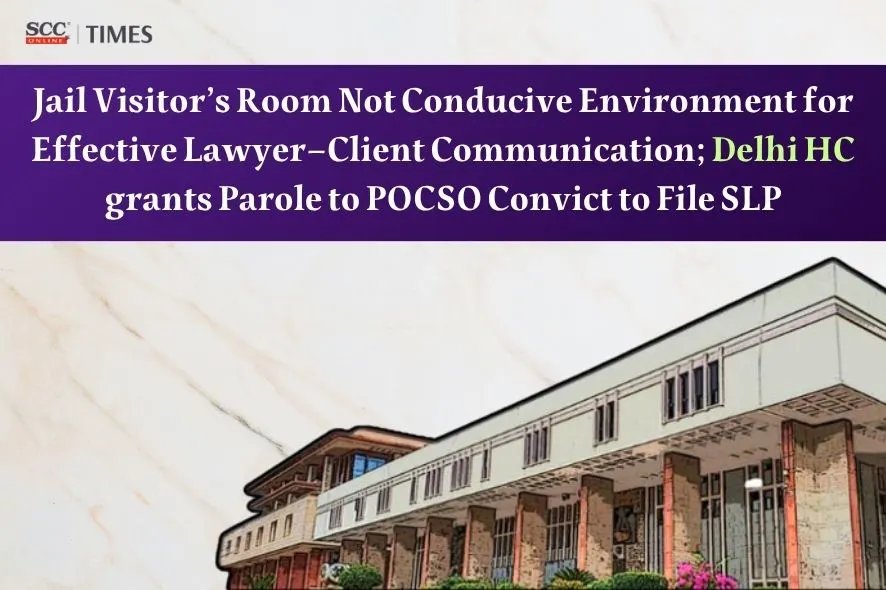
Delhi High Court: In a petition seeking quashment of the competent authority’s order dated 5 December 2025 rejecting his application for parole and prayed for grant of parole for 2 months in connection with FIR for offences punishable under Sections 5(m)(n)(p) and 6, Protection of Children from Sexual Offences Act, 2012 (POCSO Act), the Single Judge Bench of Girish Kathpalia, J., granted parole to the petitioner for a period of four weeks to ensure that he could file special leave petition (SLP) against upholding of his conviction and sentence, and not deprived of a right to be effectively heard by the Supreme Court.
Brief Facts
The petitioner had undergone approximately 6 years of incarceration out of a total sentence of 20 years of rigorous imprisonment. He applied for parole on the ground that he intended to file a SLP before the Supreme Court against the judgment upholding his conviction and sentence. The parole request was rejected by the competent authority citing Rule 1211(7), Delhi Prison Rules, 2018 which prohibits grant of parole to convicts under the POCSO Act.
Issue for Determination
-
Whether Rule 1211(7), Delhi Prison Rules creates an absolute bar on grant of parole to convicts under POCSO Act?
-
Whether the petitioner could be granted parole to enable him to effectively pursue filing of an SLP before the Supreme Court?
Parties’ Contentions
The petitioner contended that Rule 1211(7) must be read harmoniously with Rule 1208(viii), which carves out an exception permitting parole for filing legal proceedings such as an SLP. Thus, parole cannot be denied to the petitioner is a POCSO.
However, the State opposed the petition on grounds that the local police of Aligarh (place of petitioner’s residence) had objected to grant of parole, apprehending that the petitioner might abscond and filing of SLP could be facilitated through legal aid counsel or by private counsel visiting the jail; hence parole was unnecessary.
Analysis
The Court examined the police report and found it to be “completely mechanical”. The apprehension that the petitioner might flee was unsupported by any reasoning or material particulars.
On the issue of legal representation, the Court acknowledged that although an SLP can be filed by the prisoner through legal aid counsel, but “in order to ensure right to be effectively heard, the right of the prisoner to choose his private counsel cannot be denied to him”. Similarly, “no doubt the private counsel can take instructions from the petitioner by visiting the jail, but in order to ensure effective communication between the prisoner and his counsel, visitor’s room in jail is not a conducive environment”.
The Court opined that denial of parole in such circumstances would impede the petitioner’s right to be effectively heard by the Supreme Court.
Decision
The Court set aside the impugned order rejecting parole and directed that the petitioner be released on parole for a period of four weeks, subject to the following conditions:
1. Furnishing a personal bond of ₹10,000 with one surety of like amount to the satisfaction of the Jail Superintendent.
2. Providing mobile number and details to the local police of Aligarh and remaining accessible with the phone switched on.
3. Submission of a copy of the SLP to the Jail Superintendent at the time of surrender.
4. No extension of parole shall be granted on any ground whatsoever.
5. The Jail Superintendent shall inform the petitioner in writing of the exact date of surrender at the time of release.
[Jaswinder Singh v. State (NCT of Delhi), 2026 SCC OnLine Del 2052, decided on 23-4-2026]
Advocates who appeared in this case :
Mr. Sumer Singh Boparai and Mr. Abhilash Kr. Pathak, Counsel for the Petitioner
Mr. Abhijeet Kumar, Advocate with W/SI Radha, PS Uttam Nagar and SI Satish Kumar, PS Raj Park, Counsel for the Respondent/State