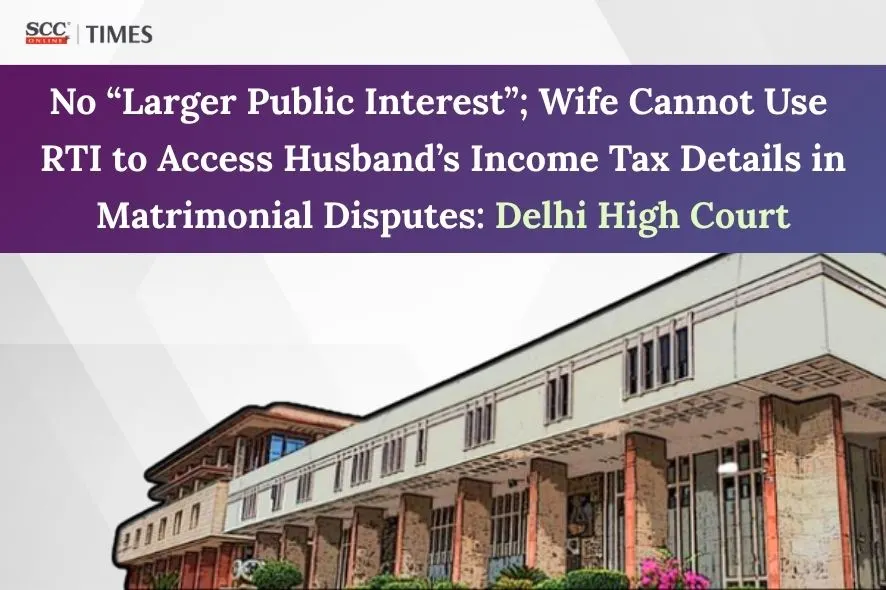
Delhi High Court: In a writ petition filed by the husband-petitioner challenging the order dated 22 July 2021 passed by the Central Information Commission (CIC) in a second appeal, directing disclosure of the petitioner’s net taxable income from the Financial Year 2007—2008 onwards, the Single Judge Bench of Purushaindra Kumar Kaurav,* J., set aside the impugned order, holding that wife cannot use RTI to access husband’s income details. The Court held that personal financial information, including income details and tax returns, constitutes “personal information” under Section 8(1)(j), Right to Information Act, 2005 (RTI Act) and matrimonial disputes do not constitute “larger public interest”, therefore exempted from disclosure under the Act.
Brief Facts
In the instant matter, the dispute arose in the backdrop of matrimonial proceedings between the petitioner and Respondent 2, wife. The wife had sought the petitioner’s income details through an application under the RTI Act, ostensibly to support her claim for maintenance. The maintenance proceedings had been remitted by the Allahabad High Court to the Principal Judge in criminal revision.
Aggrieved by the CIC’s order dated 22 July 2021, permitting disclosure of his income details, the petitioner approached the High Court. The petitioner sought for setting aside of the impugned CIC order; a direction restraining Respondent 1 from sharing his income details with Respondent 2; and any other appropriate relief in the interest of justice.
Issues for Determination
-
Whether the petitioner’s income details constitute “personal information” under Section 8(1)(j) RTI Act?
-
Whether disclosure of such information can be justified under the exception of “larger public interest”?
-
Whether the wife is entitled to access such information under the RTI Act for purposes of maintenance proceedings.
Analysis
At the outset the Court noted that Section 8(1)(j) RTI Act, provides exemption from disclosure of “personal information” which has no relation to public activity or interest or would cause unwarranted invasion of privacy, unless larger public interest justifies disclosure.
The Court held that the petitioner’s income details undeniably fall within the ambit of “personal information”. It referred to Girish Ramchandra Deshpande v. CIC, (2013) 1 SCC 212, wherein income tax return of an individual, was held to be personal information exempt from disclosure under Section 8(1)(j) RTI Act.
The Court asserted that the statutory scheme of RTI Act establishes that personal information is ordinarily exempt from disclosure unless it satisfies the test of “larger public interest”. The Court clarified that the concept of “larger public interest” must align with the object of the RTI Act, which is to promote transparency in public authorities, not to enable disclosure of private information unrelated to public affairs. The provision cannot be interpreted to permit misuse of the Act for private disputes.
Therefore, the Court found that “the information directed to be disclosed by way of the impugned order, does not fall under the exception of “larger public interest””
The Court rejected Respondent 2’s argument that RTI disclosure was necessary for maintenance proceedings. It relied on Rajnesh v. Neha, (2020) 2 SCC 324, which mandates filing of affidavits of income, assets, and liabilities by both parties in maintenance cases.
Thus, it was stated that Respondent 2 had an adequate legal mechanism to obtain relevant financial disclosures through the appropriate court.
Decision
The Court set aside the impugned order dated 22 July 2021, holding that the CIC’s direction to disclose the petitioner’s income details was unsustainable in law. It disposed of the writ petition, along with pending applications.
[Kapil Agarwal v. CPIO Income Tax Officer, Moradabad, 2026 SCC OnLine Del 2276, decided on 28-4-2026]
*Judgment by Justice Purushaindra Kumar Kaurav
Advocates who appeared in this case:
Mr. Vineet Sinha and Ms. Ankita Gupta, Counsel for the Petitioner
Mr. Manish Raghav, Mr. Prakash Srivastava, Mr. Rajan Thakur and Ms. Smriti Dubey, Counsel for the Respondent 2