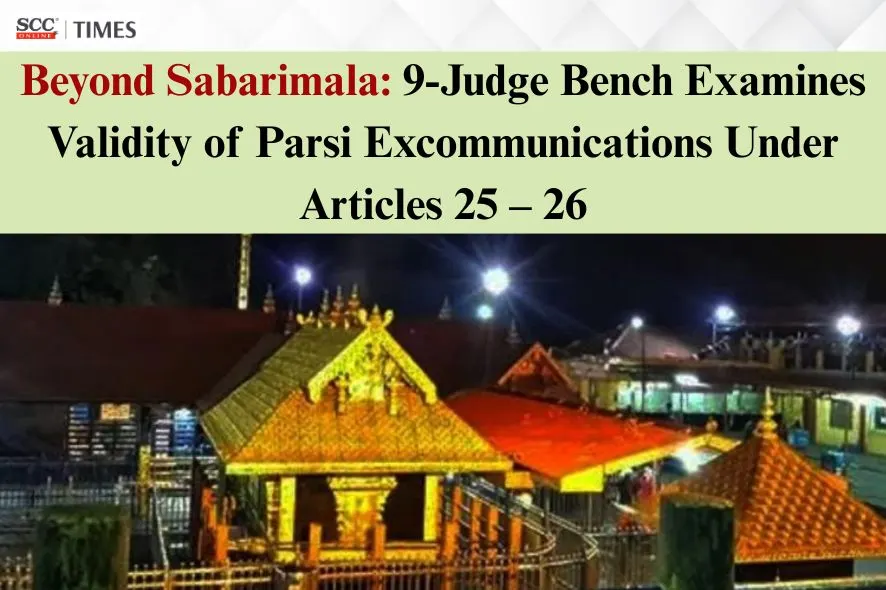
Supreme Court: A nine-judge Constitution Bench of the Court comprising of Surya Kant, CJ., B.V. Nagarathna, M.M Sundresh, Ahsanuddin Amanullah, Aravind Kumar, Augustine George Masih, Prasanna B Varale, R Mahadevan and Joymalya Bagchi, JJ., is hearing a seminal reference arising from the Indian Young Lawyers Assn. (Sabarimala Temple-5J.) v. State of Kerala, (2019) 11 SCC 1. The Bench has been considering foundational constitutional questions on the balance between individual religious freedom under Article 25 and denominational autonomy under Article 26, the permissibility of gender-based exclusions in matters of faith, and the extent to which courts may scrutinize excommunicatory practices, including those within the Parsi community.
Background
In Indian Young Lawyers Association v. State of Kerala, a Constitution Bench of the Supreme Court of India with a ratio of 4:1 held that not allowing entry to women of the age group of 10 to 50 years in the Sabarimala Temple is unconstitutional. The majority held that the practice, based on physiological characteristics, could not be protected as an essential religious custom.
The aforestated decisions opened floodgates for review petitions and a 5-judge Bench subsequently referred broader constitutional questions to a nine-judge Bench, thereby expanding the controversy beyond Sabarimala to foundational issues in religious freedom jurisprudence.
Issues
The nine-judge Bench is seized of core constitutional issues:
-
Interplay between individual religious freedom under Article 25 and denominational autonomy under Article 26.
-
Meaning and scope of ‘morality’ in Articles 25—26, including whether it encompasses ‘constitutional morality’.
-
Extent of judicial review over religious practices, particularly exclusionary ones.
Also Watch: Sabarimala Review Day 9: Can Non-Believers Claim Entry Under Article 25?
The Parsi Dimension
The reference also covers excommunication practices within the Parsi community, especially concerning women marrying outside the faith. Such women face denial of access to Fire Temples and Towers of Silence.
The question before the Court is whether such practices are protected under Article 26, or whether affected women retain enforceable rights under Articles 14, 15, 21 and 25 that override denominational exclusion.
Future Implications
The ruling of the nine-judge Bench will have binding, far-reaching consequences. It is expected to:
-
Revisit or redefine the essential religious practices doctrine.
-
Clarify limits of denominational autonomy vis-à-vis individual fundamental rights.
-
Expound the meaning of ‘constitutional morality’.
-
Impact legality of excommunication across religions.
-
Potentially unsettle long-standing precedents on religion—rights interface.
The reference marks a pivotal constitutional moment, with the Court poised to recalibrate the doctrinal foundations of religious freedom in India.
Also Watch: Sabarimala Temple Entry Hearing: Constitutional Morality vs Articles 25 & 26 Explained
Source: Press
Appearances: Darius Khambatta, Shiraz Patodia, Senior Solicitor from Dua Associates, Ashish Singh, Nina Nariman, Divya Sharma, Juhi Chawla, Mayank Singhal and Adityaraj Patodia, Advocates (Dua Associates)