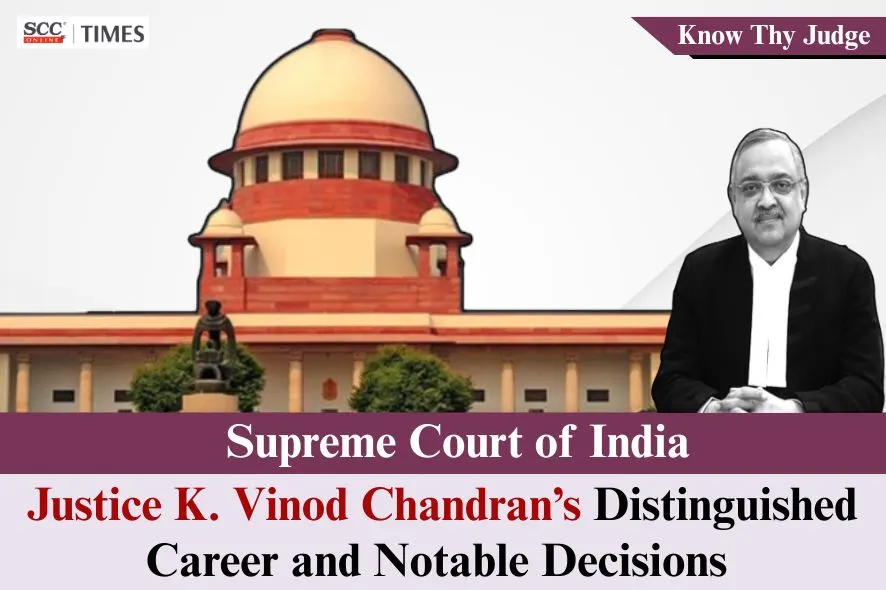
Born on 25 April 1963, Justice K. Vinod Chandran started his legal career in the state of Kerala. known for being “by the book”, Justice Chandran has displayed remarkable sensitivity and foresightedness in his decision. Having displayed his expertise in diverse fields of law, Justice Chandran, over the years, has exhibited immense commitment towards the cause of justice.
Early Life and Advocacy1
Justice K. Vinod Chandran obtained his Law Degree from Kerala Law Academy Law College, Thiruvananthapuram.
As an advocate Justice Chandran started his practice in 1991 in Court at Paravoor, Ernakulam and later extended the same to Kerala High Court. He practiced mainly in Civil, Constitutional, Taxation, Labor and Company Laws.2 He also served as Special Government Pleader (Taxes) of the Government of Kerala from 2007 to 2011.
Judgeship
Justice K. Vinod Chandran was appointed as Additional Judge of Kerala High Court and was sworn in on 8 November 2011. He was elevated as Permanent Judge of the Kerala High Court with effect from 24 June 2013.3
With an experience of over a decade adjudicating diverse aspects of law, Justice K. Vinod Chandran was subsequently appointed as Patna High Court’s Chief Justice on 24 March 20234. He was administered the oath of office by Governor of Bihar, Rajendra Vishwanath Arlekar at Raj Bhavan on 29 March 2023.
*Did you Know? Justice Chandran was originally recommended by the Supreme Court Collegium to be appointed as the Chief Justice of Gauhati High Court.5
At the farewell ceremony held at Kerala High Court, the then Chief Justice S. Manikumar said that, Justice Chandran has authored many judgments in different branches of law and made remarkable contributions to the development of law in the state. According to him, Justice Chandran’s farsightedness, coupled with extraordinary intellect and ability to decide even the most complex issues, is vividly reflected in his judgments. He is also known for his “by the book” approach within the legal fraternity.6
Considering Justice K. Vinod Chandran’s considerable experience in diverse fields of law, the Supreme Court Collegium on 7-1-2025 recommended his name, as Judge of Supreme Court of India. Recommending his name, the Collegium took into consideration the fact that there is no representation on the Bench of the Supreme Court from the High Court of Kerala.
Accepting the recommendation, the President of India appointed Justice K. Vinod Chandran as Judge of Supreme Court of India on 13-1-2025 and he took oath of office on 16-1-2025.
Notable Supreme Court Judgments by Justice K. Vinod Chandran
*Did you Know? Since his elevation to the Supreme Court in January 2025, Justice K. Vinod Chandran has been part of 300+ decisions and has also authored 100+ judgments7.
Can Complainant Wife and Her Family Be Prosecuted for ‘Giving Dowry’? Supreme Court Clarifies
In a special leave petition (SLP) arising out of matrimonial discord between the parties, where petitioner-husband sought to initiate criminal proceedings against his wife and her family members on the ground that their own statements disclosed the offence of “giving dowry” under the Dowry Prohibition Act, 1961 (Dowry Prohibition Act), thereby raising an important question as to whether such statements could form the sole basis for prosecuting the alleged “givers” of dowry, the Division Bench of Sanjay Kumar* and K. Vinod Chandran, JJ., dismissed the SLP, holding that a wife cannot be prosecuted for giving dowry solely on the basis of such statements. The Court explained that where the only material relied upon to allege the offence of “giving dowry” under Section 3, Dowry Prohibition Act is the complaint or statements made by the wife and her family members, they, being the “persons aggrieved”, would be fully covered by the shield of immunity raised under Section 7(3) and would not be liable to be prosecuted on the strength thereof. [Rahul Gupta v. Station House Officer, 2026 SCC OnLine SC 604] Read more
SC issues major clarification on 3-year legal practice requirement for Judicial Officers appointed prior to its 20 May judgment
While considering an application seeking that the applicant be exempted from the directions passed by the Court in paragraph 89 (ii), (vii) and (viii) in All India Judges Assn. v. Union of India, 2025 SCC OnLine SC 1184 dated 20-5-2025, the Division Bench of B.R. Gavai, CJI., and K. Vinod Chandran, J., in order to remove any ambiguity, clarified that in case of Judicial Officers (JOs), who are appointed prior to the passing of the judgment dated 20-05-2025, the requirement of three years practice at the Bar would not be necessary, in case they apply for Judicial Services in any other State. This, however, will be subject to such JOs completing three years’ service in their present State. [All India Judges Assn. v. Union of India, 2025 SCC OnLine SC 2574] Read more
Supreme Court directs Centre to prepare Sustainable Mining Plan for Aravali Range; no new mining leases to be granted until plan is finalized
In a matter concerning the definition of Aravali Hills and Ranges and the need for its proper conservation in the States of Delhi, Haryana, Gujarat and Rajasthan, the three-judges bench of B.R. Gavai, CJI* and K. Vinod Chandran, and N.V. Anjaria, JJ., directed the Ministry of Environment, Forests and Climate Change (‘MoEF&CC’) to prepare an Management Plan for Sustainable Mining (‘MPSM’) for the entire Aravali Range. Regarding the ban on mining is concerned, the Court opined that a complete ban on mining might lead to illegal mining activities, and thus, no such ban is imposed on the present legal mining activities that are already being undertaken in the Aravali Hills and Ranges. Further, the Court directed that till the MPSM is finalized, no new mining leases should be granted, and once finalized, the mining would be permitted as per the MPSM. [Aravalli Hills & Ranges Definition, In re, (2026) 2 SCC 299] Read more
Annual 4-point roster to determine seniority in HJS; This & other Supreme Court Directions impacting statewide HJS cadres
While considering this matter seeking to revisit the principles governing the determination of seniority within the cadre of statewide Higher Judicial Services (HJS), the 5-Judge Bench of B.R. Gavai, CJI, Surya Kant, Vikram Nath, K. Vinod Chandran and Joymalya Bagchi, JJ., stated that the Court intends to lay down general and mandatory guidelines which shall, henceforth, be incorporated into the respective statutory service rules governing the determination of inter se seniority among officers appointed from different sources to the Higher Judicial Services. [All India Judges Assn. v. Union of India, 2025 SCC OnLine SC 2500] Read more
Ex-Post Environmental Clearances: What the Supreme Court’s 2:1 Verdict Says
In a petition by Confederation of Real Estate Developers of India (CREDAI) seeking review of the earlier judgment in Vanashakti v. Union of India, 2025 SCC OnLine SC 1139 (Vanashakti judgment) which had barred post-facto (ex-post) environmental clearances (ECs), the 3-judge bench of BR Gavai, CJI and K. Vinod Chandran, and Ujjal Bhuyan, JJ, in a 2:1 verdict recalled the Vanashakti judgment and has held that retrospective ECs may be granted, but only for “permissible activities” as defined in the relevant regulatory framework. Further, these ECs will typically require payment of penalties/fines. BR Gavai, CJI, and K. Vinod Chandran, JJ formed the majority, while Ujjal Bhuyan, J dissented.
Chandran, J, concurring with Gavai, CJI held that the Not. of 2017 and O.M. of 2021, without holding on its validity, was brought in, not as a regressive measure but reckoning the ground realities. He stressed that demolition of the structures raised, merely for the purpose of applying for a prior EC to construct afresh, would not only cause undue hardship but also result in further depredation of the environment by the debris generated, which will not be possible of reuse leading to abject waste of resources and massive loss of revenue. [Confederation of Real Estate Developers of India v. Vanashakti, 2025 SCC OnLine SC 2474] Read more
To Summon or not to Summon an Advocate? Inside important SC directions to guide Investigators & protect Client-Advocate privilege
While considering this reference made by a Division Bench of the Court in a Special Leave Petition filed against notice issued against an Advocate under Section 179 of the Bharatiya Nagarik Suraksha Sanhita, 2023 (BNSS), the 3-Judge Bench of B.R. Gavai, CJI., K. Vinod Chandran* and N.V. Anjaria, JJ., issued important directions to ensure that the client-advocate privilege is not impinged upon by valiant investigators or overzealous parties to a litigation, purely on the basis of the interpretation of the evidentiary rules codified. [Summoning Advocates Who Give Legal Opinion Or Represent Parties During Investigation of Cases & Related Issues, In re, (2026) 2 SCC 233] Read more
“High Courts are expected to keep their hands away when Supreme Court is seized of any judicial matter”: SC in Corbett Tiger Reserve case
While considering this case wherein the Supreme Court while dealing with a suo moto action pertaining to Corbett Tiger Reserve, noted that its order on sanctioning prosecution of an officer was stayed by Uttaranchal High Court; the Division Bench of B.R. Gavai, CJI and K. Vinod Chandran, J., opined that the High Court is a Constitutional Court and not inferior to the Supreme Court. However, in the judicial matters, when Supreme Court is seized of the matter it is expected of the High Courts to keep their hands away. [In Re: T.N. Godavarman Thirumulpad v. Union of India, 2025 SCC OnLine SC 2325] Read more
Judicial Officers with 7 years’ experience in law practice are eligible for direct appointment as District Judge/Additional District Judge: Supreme Court
In a landmark ruling, a 5-Judge Constitution Bench comprising of B.R. Gavai, CJI.*, M.M. Sundresh, Aravind Kumar, S.C. Sharma and K. Vinod Chandran, JJ., while deciding a reference on issues related to appointment of Judicial Officers as District Judges, held that Judicial Officers who have already completed 7 years in Bar before they were recruited in the subordinate judicial service, would be entitled for being appointed as a District Judge/Additional District Judge in the selection process for the post of District Judges in the direct recruitment process. [Rejanish K.V. v. K. Deepa, 2025 SCC OnLine SC 2196] Read more
Supreme Court restores minimum three-year legal practice requirement for eligibility in civil judge exams
In a series of petitions pertaining to the qualification, promotion and selection of candidates who are desirous of either entering the Judicial Services as Civil Judge (Junior Division) or Higher Judicial Service, and with regard to the promotions at different levels within the Judicial Services, the three-judge bench of BR Gavai, CJI and AG Masih and K Vinod Chandran, JJ., held that all High Courts and State Governments shall amend the relevant service rules to increase the quota of promotion through the Limited Departmental Competitive Examination (‘LDCE’) from 10% to 25% for the cadre of Civil Judge (Senior Division) to Higher Judicial Service. It was further held that all candidates applying for the post of Civil Judge (Junior Division) must have practiced law for a minimum of 3 years. [All India Judges Association v. Union of India, 2025 SCC OnLine SC 1184] Read more
Supreme Court acquits accused in 14-year-old murder case whose acquittal was reversed by HC relying on testimony of the Investigating Officers
While considering the instant appeal challenging reversal of acquittal in a murder case, the Division Bench of Sudhanshu Dhulia and K. Vinod Chandran*, JJ., noted that the Karnataka High Court in the instant matter, had reversed the accused’s acquittal on mere surmises and conjectures relying wholly on the testimony of the Investigating Officers, who merely repeated the statements recorded under Section 161 of the CrPC and the voluntary statements of the accused.
The Court said that it understood the consternation of the High Court Judges examining a cold-blooded murder where the elaborate investigation collapsed during the trial and majority of the witnesses turned hostile. However, that was no reason to rely on Section 161 statements, or the story scripted by the investigating agency based on the so-called voluntary statements and the recoveries made, which the prosecution failed to prove to have a nexus with the crime. [Renuka Prasad v. State, 2025 SCC OnLine SC 1074] Read more
Supreme Court quashes FIR filed by a wife who alleged that her husband lied to her about his profession
While considering the instant appeal challenging the non-quashment of FIR filed by an estranged wife on the ground that she was lied about her husband’s profession; the Division Bench of Sudhanshu Dhulia and K. Vinod Chandran, JJ., opined that the FIR against the husband and his family was filed for totally extraneous reasons which should have been quashed by the Gujarat High Court. [Rohan v. State of Gujarat, 2025 SCC OnLine SC 1056] Read more
Nepotism in Government Welfare Societies: Supreme Court quashes arbitrary allotment of Super Deluxe Flats and imposes costs
In an appeal against the judgment of the Punjab & Haryana High Court concerning the legality of allotment of two super deluxe flats by HUDA, Urban Estate and Town and Country Planning Employees Welfare Organization (‘HEWO’), a welfare society of government employees and allegations of favouritism, arbitrariness, and violation of eligibility conditions, a Division Bench of Sanjay Kumar and K. Vinod Chandran,* JJ., while condemning nepotism in Government Welfare Societies flat allotment, set aside the High Court’s judgment, quashed the impugned allotments and imposed costs of ₹1,00,000 on the HEWO-respondent 2, ₹50,000 on the respondent 3 and ₹25,000 on the respondent 4. [Dinesh Kumar v. State of Haryana, 2026 SCC OnLine SC 210] Read more
Supreme Court enhances compensation for BDO who lost both his legs in a 25-year-old motor accident
In an appeal filed against the compensation granted in a motor accident case, where the claimant lost both his legs, the Division Bench of Sudhanshu Dhulia and K. Vinod Chandran*, JJ. held that the Tribunal had erred in finding contributory negligence on the part of the scooter driver, and the High Court had similarly committed the same error in affirming the Tribunal’s decision. The Court ruled that the appellant was entitled to compensation from the insurer of the offending vehicle. The Court further opined that the entire amount of ₹16,00,000/- should be awarded as compensation, considering that the accident occurred in 1999, and it would be unjust to base the award on the present circumstances, 25 years later. The long delay in the proceedings was compensated by the interest awarded. [Srikrishna Kanta Singh v. Oriental Insurance Co. Ltd., 2025 SCC OnLine SC 636] Read more
‘Not enough material to upset Trial Court’s acquittal order, especially when there was no evidence regarding death being result of homicide’; SC sets aside husband’s conviction under S. 302 IPC
In a criminal appeal against the Chhattisgarh High Court’s decision convicting the accused-husband for an offence under Section 302 of the Penal Code, 1860 (‘IPC’) and upholding the acquittal of the in-laws for alleged murder of the daughter-in-law, the Division Bench of Sudhanshu Dhulia and K. Vinod Chandran*, JJ. allowed the appeal, considering that the husband-accused had a plausible explanation that he was on duty when the death of his wife occurred. It was the husband who first intimated to the police about the sudden and unnatural death of his wife. [Jagdish Gond v. State of Chhattisgarh, 2025 SCC OnLine SC 744] Read more
‘Alleged offence was repeated thrice in the same manner, when woman willingly accompanied accused to hotel room’: SC quashes rape case against 22-year-old man
In a criminal appeal against the Madras High Court’s decision rejecting the accused person’s application under Section 482 of the Code of Criminal Procedure, 1973 (‘CrPC’) for allegations of having forceful sexual intercourse with the complainant on the pretext of marriage, the Division Bench of Sudhanshu Dhulia and K. Vinod Chandran*, JJ. held that the matter at hand was precisely a case where the High Court should have interfered in the exercise of its inherent and extraordinary powers under Section 482 of the CrPC and directed that the proceedings initiated at the instance of the complainant before the Sessions Judge (Mahila Court) be quashed. The Court held that the sexual relationship admitted by both parties was not without the consent of the complainant. [Jothiragawan v. State, 2025 SCC OnLine SC 628] Read more
SC dismisses appeal against use of Urdu as additional language alongside Marathi on a new signboard for Municipal Council, Patur
In the instant matter, the appellant had been aggrieved at the use of Urdu on the signboard of the new building of the Municipal Council, Patur (‘Municipal Council’) in district Akola, Maharashtra, the board of the Council displayed “Municipal Council, Patur”, in Marathi at the top, with its translation below in Urdu language. The Division Bench of Sudhanshu Dhulia* and K. Vinod Chandran, JJ., while dismissing the appeal, held that display of an additional language cannot by itself, be said to be in violation of the provisions of the Maharashtra Local Authorities (Official Languages) Act, 2022 (‘2022 Act’) as there is no prohibition on the use of Urdu under the 2022 Act or in any provision of law. [Varshatai v. State of Maharashtra, (2025) 7 SCC 293] Read more
‘Eligibility criteria declared by fresh advertisement cannot be changed midway through recruitment process’; Supreme Court upholds reservation of DSP post for SC Sports (Women)
In an appeal filed against the order passed by the Punjab and Haryana High Court concerning the reservation of posts in the State of Punjab’s government services, including provisions for women’s reservation, the Division Bench of Sudhanshu Dhulia* and K. Vinod Chandran, JJ. emphasized that no alterations could be made to the recruitment process once the advertisement was issued and deemed it unnecessary to examine the legality of the subsequent roster system for the purpose of the case. Since neither the advertisement nor the Punjab Civil Services (Reservation of Posts for Women) Rules, 2020 (‘2020 Rules’) providing 33% horizontal reservation for women were challenged, the reservation stood valid. [Prabhjot Kaur v. State of Punjab, 2025 SCC OnLine SC 761] Read more
Supreme Court sets aside preventive detention order for ignoring bail conditions imposed by Magistrate for the same offence
In a criminal appeal, filed by the wife of the detenu detained under the provisions of the Conservation of Foreign Exchange and Prevention of Smuggling Activities Act, 1974 (‘COFEPOSA Act’), challenging the order of detention, the division bench of Sudhanshu Dhulia and K. Vinod Chandran, JJ. while noting that the detaining authority had failed to consider whether the conditions imposed by the Magistrate, when granting bail for the same offence, were adequate to restrain the detenu from engaging in further smuggling activities, allowed the appeal and set aside the detention order. [Joyi Kitty Joseph v. Union of India, (2025) 4 SCC 476] Read more
Notable High Court Decisions by Justice K. Vinod Chandran
Patna HC dismisses candidates’ plea to appear for main examination for District Judge (Entry Level) due to incorrect questions in Preliminary Examination
In the present case, a batch of four writ petitions were taken up peremptorily as the main examination for selection to the post of District Judge (Entry Level) was scheduled on 14-07-2024.The Division Bench of K. Vinod Chandran*, CJ., and Partha Sarthy, J., held that even if petitioners were granted marks for the questions challenged, they would not get sufficient marks which would permit their participation since the cut-off marks were more than what they would get. The Court dismissed the petitions and held that there was no reason to cause interference to the results of the screening test or the main examination that was scheduled on 14-07-2024.
[Gopal Bihari v. High Court of Judicature at Patna, 2024 SCC OnLine Pat 3772]
Patna HC sets aside 2023 Amendment Acts increasing reservation for SCs, STs, and Backward Classes to 65%
In the present case, batch of writ petitions were filed challenging the enhanced reservation to 65% within the State of Bihar, irrespective of 50% limit prescribed in Indra Sawhney v. Union of India, 1992 Supp (3) SCC 217. The Division Bench of K. Vinod Chandran*, CJ., and Harish Kumar, J., set aside the Bihar Reservation of Vacancies in Posts and Services (for Scheduled Caste, Scheduled Tribes and Other Backward Classes) Amendment Act, 2023 and the Bihar Reservation (in Admission to Educational Institutions) Amendment Act, 2023 (‘collectively ‘Amendment Acts’) as ultra vires the Constitution and violative of the equality clause under Articles 14, 15 and 16 of the Constitution.
[Gaurav Kumar v. State of Bihar, 2024 SCC OnLine Pat 2308]
‘Aimed at ensuring that education is not commercialized’; Patna HC rejects petition challenging validity of provisions of Bihar Private Schools (Fee Regulation) Act, 2019
A writ petition was filed by petitioner, Association of Independent Schools, Bihar, being aggrieved with the fee regulatory measure attempted by the State through a legislation, Bihar Private Schools (Fee Regulation) Act, 2019 (‘the Act’) and petitioner also sought to declare some provisions of the Act ultra vires. The Division Bench of K. Vinod Chandran, CJ.*, and Rajiv Roy, J., rejected the writ petition and upheld the validity of the Act subject to certain directions. Further, the Court opined that there were no guidelines prescribed insofar for determination of reasonable fees and thus the absence of such guidelines could not result in invalidation of the Act. [Assn. of Independent Schools v. State of Bihar, 2024 SCC OnLine Pat 326]
Penalty imposable under Section 56(4)(b) of Bihar VAT Act on account of clerical mistake in mentioning of invoice number in SUVIDHA form: Patna High Court
In a case wherein a writ petition was filed by Ceat Ltd. against the penalty order passed under Section 60(4)(b) read with Section 56(4)(b) of the Bihar Value Added Tax Act, 2005 (‘the Act’), after detention of a truck carrying goods at the integrated check-post, the Division Bench of K. Vinod Chandran, CJ.* and Rajiv Roy, J., dismissed the petition in absence of ground for interference with imposed penalty and opined that the penalty was imposable under the Act on account of clerical mistake in mentioning of invoice number in SUVIDHA Outgoing form (‘the form’). [Ceat Ltd. v. State of Bihar, 2023 SCC OnLine Pat 6405]
Solid waste management activities are exempted from payment of tax under Bihar Goods and Services Tax Act, 2017: Patna High Court
In a case wherein a writ petition was filed by the Petitioner, Mahavir Sharmik and Nirman Swalambi Sahkari Samiti Limited, challenging an assessment order, as confirmed by the first Appellate Authority under the Bihar Goods and Services Tax Act, 2017 (‘BGST Act’), the Division Bench of K. Vinod Chandran, C.J.*, and Partha Sarthy, J., held that the solid waste management activity undertaken by the petitioner was exempted from payment of tax under the BGST Act.
[Mahavir Sharmik and Nirman Swalambi Sahkari Samiti Ltd. v. State of Bihar, 2023 SCC OnLine Pat 5724]
Kerala High Court | To Wear or Not to Wear Headscarf?
While hearing petitions by two female students belonging to the Muslim community contending that the dress code prescribed by the Central Board of Secondary Education (CBSE) of wearing half sleeve kurta/salvar would prejudice them, as their religious custom mandates them to wear a headscarf and also full sleeve dresses, K. Vinod Chandran, J*., held that the Muslim girl students could seek the imposition of their individual rights as against the larger right of the institution. Therefore, it was for the institution to decide whether the petitioners could be permitted to attend the classes with the headscarf and full sleeve shirt.
“(…) the analysis of the Quranic injunctions and the Hadiths would show that it is a farz to cover the head and wear the long sleeved dress except face part and exposing the body otherwise is forbidden (haram). When farz is violated by any action opposite to farz that action becomes forbidden (haram).”
“The right of women to have the choice of dress based on religious injunctions is a fundamental right protected under Article 25(1), when such prescription of dress is an essential part of the religion.”
Nadha Raheem v. CBSE, 2015 SCC OnLine Ker 21660
Kerala High Court | Husband harasses wife, portrays her as a psychiatric patient; Court slams Child Right Commission for directing psychiatric treatment of wife without any medical assessment
The Division Bench of K. Vinod Chandran and C. Jayachandran, JJ., slammed the Kerala State Commission for Child Rights for directing psychiatric treatment for wife of the accused without any jurisdiction. Expressing anguish over the factum that the Commission had aided the accused in trespassing the house of the victim and forcefully admitting her in the hospital, the Bench remarked,
“The case is very distressing insofar as, the 4th respondent, prima facie has been attempting to style his wife as a mental patient before various forums. By the continued harassment by the 4th respondent; employed in the Law Department of the State and was also once appointed as a temporary Magistrate, who was wont to use his official clout to witch-hunt the wife and children.”
[Balakrishnan v. Inspector General of Police8 ]
Kerala High Court | “Child molestation is a shame on society; but if the allegations are false, it is lethal to the life of the accused”; Court acquits father accused of raping his minor daughter
The Division Bench of K. Vinod Chandran* and C. Jayachandran, JJ., acquitted the father accused of raping his own minor daughter. Considering the contention that the allegation was raised due to instigation by the stepmother, observing discrepancies in statements of victim and her stepmother and failure to prove age of the victim by the prosecution, the Bench remarked,
“Forensic and semantics apart, child molestation is a shame on society; but if the allegations are false, it is lethal to the life of the accused, more so if the accused is a parent; even if he is eventually acquitted.”
[K. Raghavan v. State of Kerala, 2021 SCC OnLine Ker 4134]
Kerala High Court | Priest of Temple commits penetrative sexual assault on young girl; Court observes which God would accept obeisance and offerings of such Priest or make him a medium?
Expressing, “When a man abandons his wife and children, roving vultures wait to prey on not only the abandoned woman, but also the helpless children” Division Bench of K. Vinod Chandran* and Ziyad Rahman A.A., JJ., noted a case wherein a priest/oracle of a temple took the abandoned woman and three children under his wing and repeatedly molested the elder girl child in the presence of her siblings. Noting the above stated horrendous act of the priest, Bench expressed,
“We wonder which God would accept the obeisance and offerings of such. Priest or make him a medium?”
[Madhu v. State of Kerala, 2021 SCC OnLine Ker 3561]
Kerala High Court | Observing the signs of mental disturbance; Court refuses to remove a 21-year-old from the custody of parents
In an interesting case regarding custody of a major the Division Bench of K. Vinod Chandran* and M.R. Anitha, JJ., refused to invoke parens patriae doctrine on observing signs of obsession coupled with hysteria in the detenue and directed the detenue to be retained with her parents at her parental home.
[Kailas Natarajan v. District Police Chief, 2021 SCC OnLine Ker 337]
Kerala High Court | From promotions to vacancies, even where there is no direct recruitment, the 3% quota for disabled persons has to be complied with; Court reiterates
While allowing the petition filed by BSNL against the order of Central Administrative Tribunal, the Division Bench of K. Vinod Chandran* and V. G. Arun, JJ., upheld the claim of the respondent for consideration of promotion as Sub Divisional Engineer (“SDE”) in 3% disability quota under the Persons with Disabilities Act, 1995.
[Bharat Sanchar Nigam Ltd. v. M.G Prabhakara Panicker, 2020 SCC OnLine Ker 8664]
Kerala High Court | If a particular income is not taxable under Income Tax Act, it cannot be taxed on basis of estoppel or any other equitable doctrine; Court reiterates principles for recovery under Income Tax Act
While answering the law points in favour of the Revenue department, restrained from any recovery of the amounts refunded, K. Vinod Chandran J., held that since as of now the levy of service tax on the payment in lieu of foreign agency commission will not be leviable as ‘Business Auxiliary service’ prior to 18-04-2006.
[Uniroyal Marine Exports v. CCE, 2020 SCC OnLine Ker 5175]
Kerala High Court | Judicial Officer who completed age of 58 ½ years cannot be recommended by Supreme Court Collegium as a Judge
While addressing an appeal by one of the senior-most District Judges in High Judicial Service of the State, a Division Bench of K. Vinod Chandran* and V.G. Arun, JJ., held that Judicial Officer who completed age of 58 ½ years cannot be recommended by Supreme Court Collegium as a Judge.
[John K. Illikkadan v. Union of India, 2020 SCC OnLine Ker 495]
Kerala High Court | Court prohibits publications seeking kidney donations even if they do not establish any commercial arrangement
While deciding a batch of writ petitions dealing with permission to publish advertisements in print media seeking donation of kidneys from altruistic donors from the public, K. Vinod Chandran, J*. held that the Transplantation of Human Organs and Tissues Act of 1994 does not prohibit such publications as long as no financial arrangement is made between the parties.
[Moideen E.M. v. State of Kerala, 2017 SCC OnLine Ker 21219]
Kerala High Court | Disqualification from contesting as candidate in a local authority election on ground of defection, upheld
In a writ filed by the petitioner against an order of the Kerala State Election Commission, according to which the petitioner had defected and was disqualified to be a member of the Ramamangalam Gama Panchayat and also from contesting as candidate in an election to any local authority for a period of six years as per Kerala Local Authorities (Prohibition of Defection) Act, 1999, K. Vinod Chandran, J*. upheld the Commission’s order and dismissed the petition.
[Jessie Raju v. Communist Party of India, 2017 SCC OnLine Ker 7860]
1. Justice K Vinod Chandran, State of Kerala
2. Four advocates appointed HC Judges, New Indian Express
3. Justice K Vinod Chandran, State of Kerala
4. Justice K. Vinod Chandran appointed as Chief Justice of Patna HC, Department of Justice Notification
5. Delay in elevation made everyone happy: Justice K Vinod Chandran, The Times of India
6. Delay in elevation made everyone happy: Justice K Vinod Chandran, Times of India
7. https://www.scconline.com/ | “Judge only” feature and “Coram only” feature
8. WP(Crl.) No. 413 of 2021(S),
Most Read
Khaitan & Co. advises JSW Steel and JSW Cement on JSW One Platforms’ proposed ₹30,540.10 Million IPO
“Justice J.B. Pardiwala Calls for an Indicator-Driven Framework at the National Consultation on Ten Years of the Juvenile Justice Act, 2015
Can public servants facing corruption trials be reinstated into active service after bail? Punjab & Haryana HC seeks Haryana Chief Secretary’s response
President appoints Dharmalingam Lingeswaran, Balathandayutham Karthikeyan as Additional Judges of Madras High Court
Top Legal Developments [5-11 October]: Delhi Metro shutdown Jantar Mantar protest, Bangalore Water Supply Triple Test judgment, JIO trademark infringement rogue websites and other Key verdicts and Policy Updates