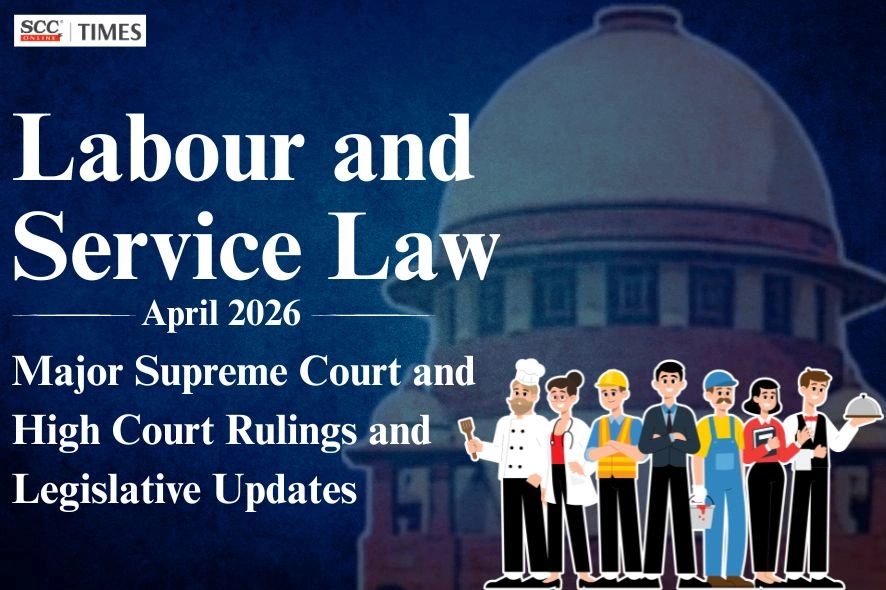
This Labour and Service Law roundup provides an overview of important cases and key legislative updates that made headlines this month, such as rulings on essential qualifications in recruitment, denial of retrospective retirement benefits in CAPF cases, and protection of employees from denial of EPF pension benefits due to employer lapses, among other significant developments.. On the legislative and regulatory front, the roundup also covers the All India Services (Implementation of National Pension System) Rules, 2026, the Draft Maharashtra Industrial Relations Rules, 2026, and the Haryana Government’s notification relaxing operating hours for Shops and Establishments.
IMPORTANT LEGISLATIVE UPDATES
Industrial Relations
Draft Maharashtra Industrial Relations Rules, 2026 issued to regulate industrial relations framework
In the Draft Maharashtra Industrial Relations Rules, 2026, the State Government has issued draft rules under the industrial relations framework providing for mechanisms relating to trade unions, dispute resolution, conciliation proceedings, and other matters governing employer-employee relations under the proposed regulatory structure. Read Draft Maharashtra Industrial Relations Rules, 2026 update HERE
Pension
All India Services: Implementation of National Pension System Rules, 2026 notified for AIS officers
In the All India Services (Implementation of National Pension System) Rules, 2026, the Central Government has implemented the National Pension System for All India Services, laying down the framework governing contribution by employees and the Government, maintenance of PRAN, and pensionary entitlements under the contributory pension regime applicable to AIS officers. Read All India Services NPS Implementation Rules, 2026 update HERE
Cabinet approves per cent Dearness Allowance and Dearness Relief hike from 1 January 2026
The Union Cabinet has approved an additional 2 per cent increase in Dearness Allowance (DA) for Central Government employees and Dearness Relief (DR) for pensioners, effective from 1 January 2026, raising the rate from 58 per cent to 60 per cent of basic pay/pension to offset inflation. The revision, based on the 7th Central Pay Commission formula linked to CPI-IW, benefits around 50 lakh employees and 68 lakh pensioners, with arrears payable for the applicable period. Read DA/DR hike update HERE
Shops and Establishments
Haryana Government relaxes operating hours for Shops and Establishments
The Haryana Government has relaxed operating hours for Shops and Establishments under the applicable regulatory framework, subject to compliance with statutory conditions governing labour welfare, working hours, and other applicable safeguards for employees. Read Haryana Shops and Establishments operating hours relaxation update HERE
Wages
Government revised Variable Dearness Allowance rates, effective from 1 April 2026 notified
The Ministry of Labour and Employment has revised the Variable Dearness Allowance (VDA) for workers under scheduled employments, with effect from 1 April 2026, based on changes in the Consumer Price Index for Industrial Workers. The revision leads to an increase in VDA across different categories and areas, payable along with minimum wages.
The updated rates apply to various sectors including loading, unloading and other scheduled employments under the central sphere. Read revised VDA rates update HERE
DISCIPLINARY PROCEEDINGS
De novo inquiry impermissible under Rule 10; “Further inquiry” means continuation, not fresh proceedings
In Chandni Prateek Sharma v. Gujarat High Court, SLP (C) No. 28356 of 2024, the Supreme Court held that the disciplinary authority could not order a de novo inquiry under the guise of “further inquiry” under Rule 10 of the Gujarat Civil Services (Discipline and Appeal) Rules, 1971, as the provision contemplates only a continuation of existing proceedings and not a fresh inquiry. The Court held that the High Court erred in upholding such direction, and accordingly quashed the impugned judgment, directing reinstatement of the appellant with all consequential benefits. Read De novo inquiry case HERE
INDUSTRIAL DISPUTES
Delay under Section 33-C(1) ID Act can be condoned without separate application; procedural formality not mandatory
In Management of Bosch Ltd. v. Andrew C. Shekaran K.P., 2026 SCC OnLine Kar 1919, the Karnataka High Court held that the Deputy Labour Commissioner’s decision to condone delay in entertaining pension claims under the Industrial Disputes Act, 1947 could not be interfered with under Article 227 of the Constitution. The Court further held that the absence of a separate application for condonation of delay, which is not mandated under the Act, cannot be a ground to reject claims solely on limitation. Read delay condonation case HERE
PENSION
Pension cannot be reduced without grave misconduct; Mandatory conditions under Pension Rules must be satisfied
In State of Jharkhand v. Brajeshwar Singh, 2026 SCC OnLine Jhar 412, the Jharkhand High Court held that deduction of pension was unsustainable in the absence of compliance with the mandatory requirements under Rules 43(b) and 139(c) of the Jharkhand Pension Rules, 2000. The Court emphasised that mere allegations of irregularity cannot justify reduction of pension, and that such action is permissible only where grave misconduct is established in a duly instituted departmental or judicial proceeding. Read pension reduction case HERE
Employee cannot be denied pension for employer’s EPF lapses; beneficial scheme to be construed liberally
In Durga Srinivas Kallakuri v. EPFO, 2026 SCC OnLine Bom 2633, the Bombay High Court held that employees cannot be made to suffer for non-compliance or lapses attributable to the employer or the EPFO authorities in matters relating to pension under the Employees’ Pension Scheme, 1995. The Court further held that rejection of pension claims solely on the ground of non-production of Form 6A and challans was arbitrary and contrary to the beneficial object of the Scheme and accordingly quashed the impugned orders with directions for reconsideration of the claims. Read EPF pension denial case HERE
PROMOTION
Right to be considered for promotion is fundamental; Quarterly DPC meetings mandated
In Kulwant Singh v. State of Punjab, 2026 SCC OnLine P&H 5078, the Punjab and Haryana High Court held that the right to be considered for promotion is a fundamental right under Articles 14 and 16(1) of the Constitution. The Court directed the respondents to conduct Departmental Promotion Committee meetings every three months in a calendar year to ensure timely consideration of eligible employees against vacant posts. Read right to promotion consideration case HERE
RECRUITMENT
Essential qualification cannot be relaxed by implication; Higher qualification no substitute for mandatory experience
In Himakshi v. Rahul Verma, 2026 SCC OnLine SC 642, the Supreme Court held that the requirement of minimum five years’ work experience, being an essential eligibility condition under the Recruitment and Promotion Rules and the advertisement dated 21 July, 2016, could not be relaxed or substituted on the basis of higher academic qualification or merit. The Court further held that in the absence of any conscious exercise of the power of relaxation supported by reasons on record, the selection of an ineligible candidate was unsustainable in law, and equitable considerations such as continued service or regularisation cannot override statutory rules where the selection process itself is vitiated. Read essential qualification case HERE
No indefeasible right to appointment against unfilled vacancies; selection confined to cut-off and waiting list
In Jyoti v. DSSB, 2026 SCC OnLine Del 1534, the Delhi High Court held that candidates who do not meet the prescribed cut-off or fall within the notified waiting list have no indefeasible right to appointment merely because vacancies remain unfilled in the OBC category for the post of Assistant Teacher (Primary). The Court reiterated that public employment must adhere strictly to the terms of the recruitment process, and no direction for appointment can be issued dehors the merit list or statutory selection criteria. Read unfilled vacancies case HERE
RETIREMENT
No retrospective benefit of enhanced retirement age; benefit limited to personnel below cut-off age
In Charanjit Lal v. Union of India, 2026 SCC OnLine Del 1755, the Delhi High Court held that consequential pensionary and service benefits arising from enhancement of the retirement age in the Central Armed Police Forces could not be extended to personnel who had already crossed the age of 60 years as on 31 January, 2019. The Court clarified that while the benefit under Dev Sharma v. Indo-Tibetan Border Security Force, 2019 SCC OnLine Del 6797, may apply to similarly situated personnel, it is restricted to those who had not attained the cut-off age, and cannot be claimed retrospectively in the absence of actual service rendered. Read enhanced retirement age case HERE
TRANSFER
Judicial interference in transfer orders unjustified; transfer is an incident of service within executive domain
In State of Bihar v. Deepak Kumar, 2026 SCC OnLine Pat 2033, the Patna High Court held that the Single Judge erred in directing the transfer of a Divisional Forest Officer in a matter arising from confiscation proceedings involving a truck carrying stone chips. The Court reiterated that transfer and posting of government servants is an incident of service within the exclusive domain of the executive, and judicial interference in such administrative decisions is unwarranted. Accordingly, the transfer direction was quashed to that extent. Read Judicial restraint in government servant transfer case HERE