Disclaimer: This has been reported after the availability of the order of the Court and not on media reports so as to give an accurate report to our readers.
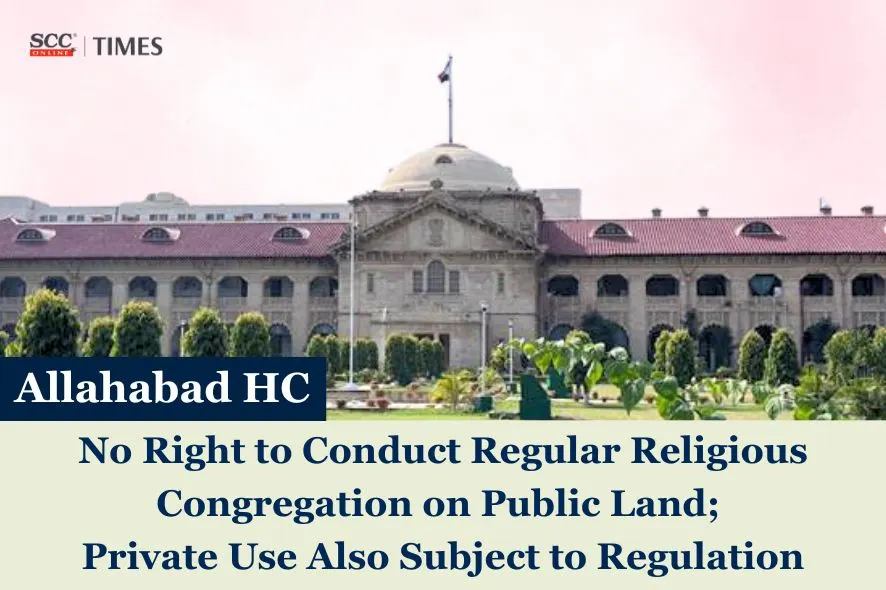
Allahabad High Court: In a writ petition seeking protection and permission to offer Namaz at the alleged private premises, the Division Bench of Saral Srivastava and Garima Prashad, JJ., noting the limits on religious practice under Articles 25 and 26, held that no individual can claim a right to use public land as an exclusive or recurring religious space, and even private property cannot be converted into an unregulated congregational venue and finding no enforceable legal right, dismissed the writ petition.
Background
In the instant case, the petitioner sought directions for security and permission to offer namaz (prayer) at a piece of land in Village Ikona, District Sambhal, claiming it to be his private property on the basis of a registered gift deed dated 16 June 2023. He alleged that the authorities were restraining such prayers in violation of his fundamental rights under Articles 19, 25, 26, 27 and 28 of the Constitution.
The State contended that no legal title can be conferred upon the petitioner for the land as the land in question was recorded as abadi land falling under Category Shreni-6(2) which means land for public use and that the gift deed relied upon by the petitioner did not disclose any khata number or identifiable revenue particulars. It was further submitted that namaz had traditionally been offered at the said location only on Eid, for which no restriction was imposed, whereas, the petitioner was attempting to introduce regular large-scale congregational prayers by inviting persons from within and outside the village.
Issue
“Whether, and to what extent, the rights guaranteed under Articles 25 and 26 extend to the conduct of congregational religious activities, whether on public land or private premises.”
Analysis and decision
The Court observed that the Constitution does protects the rights to practice religion but is not an unlimited right and is subject to public order, morality and health. The Court also observed that it cannot be exercised in a way that affects others normal functioning of public life and reiterated that, one person’s freedom ends where it begins to affect someone else.
“Freedom, in a constitutional society, is always accompanied by responsibility towards others.”
The Court noted that public land is meant for everyone and is governed by law and that no individual can claim a right to use it for regular religious gatherings. Observing that the State is duty-bound to ensure equal access, civic order and non-discriminatory administration, the Court relied upon Commissioner, Hindu Religious Endowments, Madras v. Sri Lakshmindra Thirtha Swamiar of Shirur Mutt, 1954 SCR 1005, where the Supreme Court recognised protection in matters of religion, but also clarified that the right is not dissociated from the constitutional limitations expressly written into Article 25.
The Court further relied upon Tehseen S. Poonawalla v. Union of India, (2018) 9 SCC 501, wherein it was held that where a claim to hold religious congregation on public land has the potential to create social tension, the Constitutional Court must ensure that conditions necessary for peaceful coexistence are maintained and observed the State to be constitutionally entitled and duty-bound in appropriate cases to prevent unlawful use of public land.
In M. Ismail Faruqui v. Union of India, (1994) 6 SCC 360, it was observed that Namaz may be offered anywhere, which means that no particular place can be claimed as a matter of right.
Observing that the private property stands on a different footing, the Court noted that limited devotional activity like private prayer, which genuinely remains internal to the premises, ordinarily fall within the protected domain of Articles 25 and 26, however, such protection is confined to activity that is truly private, occasional and non-disruptive, and does not extend to converting private premises into a de facto public religious venue.
The Court observed that once the activity becomes congregational, it produces external effects like repeated attendance, traffic affecting ingress and egress, and parking concerns which eventually would create potential tension at some sensitive areas. “At that stage, the activity assumes a public or quasi-public dimension.” The Court further observed that the private property does not loses all protection, but its use, to that extent, ceases to remain purely private for constitutional purposes and becomes subject to reasonable regulation.
The Court noted that the law does not require authorities to wait for an actual disturbance and where an activity is likely to affect public order, the State is entitled to act in advance.
“The test is not the religious nature of the activity, but its public consequences.”
Highlighting the significance of balance for functioning of Articles 25 and 26 in a constitutional system, the Court noted that the State must permit private worship but is equally obligated to regulate activities affecting public order, whether on public or private property.
The Court then answered the issue in following terms:
-
Public land is meant for common use, and cannot be claimed as an exclusive or recurring religious space; the State must ensure equal access and cannot permit its preferential or exclusive use.
-
The right to practice religion is subject to public order, including access, movement and peaceful living, and cannot be exercised in a manner that interferes with the rights of others.
-
Private property may be used for limited, private religious activity, however, regular or organised congregational use beyond that sphere falls outside protection and is subject to regulation.
-
Regular, organised or large-scale religious activity in private property may amount to a change in land use and is subject to applicable laws and regulations.
-
The introduction or expansion of a new religious practice that disturbs social balance is not protected under Articles 25 and 26, and the State may take preventive action without waiting for actual disruption.
The Court found no material on record which supported the petitioner’s claim, and found the pleadings to be vague, with no specific incident, date, time or identifiable act disclosed, and allegations of interference and threats being general and unsupported the Court noted such pleadings do not meet the standard required to invoke the Court’s jurisdiction under Article 226.
The Court further found the land in question to be recorded as public land, and in absence of any basic land particulars such as gata or khata numbers in the gift deed, identifiable title is not established and such document cannot displace the revenue record. The Court noted that even if the land was private, the petitioner is not entitled to the relief sought as he was not protecting an existing practice but seeking to introduce regular congregational gatherings beyond the earlier limited practice confined to specific occasions such as Eid, which falls outside the protected domain and is subject to regulation.
Holding that no enforceable legal right was made out, and rejecting to grant any relief where the matter has implications for public order and social harmony, the Court dismissed the writ petition.
[Aseen v. State of U.P., 2026 SCC OnLine All 3689, decided on 6-4-2026]
Advocates who appeared in this case:
For the petitioner: Intekhab Alam Khan, Janardan Singh
For the respondent: C.S.C.
Buy Constitution of India HERE