“Law is not static; it goes with the society. You should keep your eyes and ears open to see what is happening in the society.”1
-Justice Rajesh Bindal
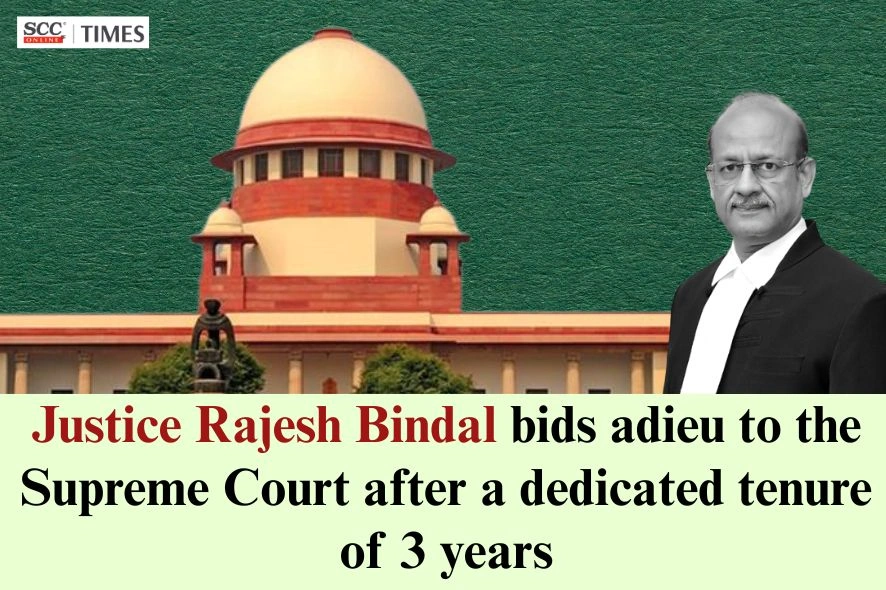
Elevated to the Supreme Court in 2023, Justice Rajesh Bindal has an expansive wealth of experience and wisdom that he gained during a long tenure as an advocate and equally lengthy tenure as Judge and later Chief Justice of the High Courts of Punjab and Haryana, Jammu & Kashmir and Ladakh, Calcutta, Allahabad. As he prepares to bid adieu to the hallowed halls of the Supreme Court, we have curated Justice Bindal’s career trajectory and notable judgments delivered during a dedicated tenure so far.
Justice Rajesh Bindal’s Early Life, Education and Advocacy
Born on 16 April 1961, at Ambala City in Haryana, Justice Rajesh Bindal did his LLB from Kurukshetra University in 1985 and joined the legal profession in the Punjab and Haryana High Court in September 19852
During his tenure as an advocate, Justice Bindal represented the Income Tax Department, Haryana region before the High Court; Chandigarh Administration before Central Administrative Tribunal for more than a decade till 2004 and Punjab and Haryana regions of Employees Provident Fund Organization before the High Court and Central Administrative Tribunal from 1992 till his elevation as Judge. Furthermore, he represented the State of Haryana, in settlement of the dispute concerning Sutlej Yamuna Water with State of Punjab before Eradi Tribunal and the Supreme Court.3
Judgeship of the High Courts4
Justice Bindal was elevated as a Judge of High Court of Punjab & Haryana on 22 March 2006. Subsequently in 2018 he was transferred to the High Court of Jammu & Kashmir and Ladakh and, in 2020 was appointed as the Acting Chief Justice of the Common High Court for the Union Territory of Jammu & Kashmir and Ladakh.
Did You Know? During his tenure as a Judge in Punjab and Haryana High Court, Justice Bindal disposed of around 80,000 cases!
Further on Justice Bindal was transferred to the High Court at Calcutta and was later sworn in as the Chief Justice of the High Court at Calcutta with effect from 29 April 2021. On 11 October 2021, Justice Bindal took oath as the Chief Justice of Allahabad High Court.
Chairmanship of Various Committees5
During his tenure as a High Court Judge, Justice Bindal chaired several Committees of import:
-
Justice Bindal was the Chairman of the Committee constituted pursuant to Resolution adopted in the Chief Justices’ Conference, 2016, for framing draft rules for electronic evidence.
-
Justice Bindal was the Chairman of a multi-member committee constituted by Ministry of Women and Child Development to study Civil Aspects of International Child Abduction Bill, 2016, he submitted report accompanied by the recommendations and draft of the Protection of Children (Inter-Country Removal and Retention) Bill, 2018 to the Ministry in April 2018.
-
Justice Bindal also headed various Committees including Computer Committee, Arrears Committee, Finance Committee, Building and Infrastructure Committee, Information Technology Committee, State Court Management Systems Committee in the High Court and also Chairman of J&K State Legal Services Authority.
-
He was also the Chairman of the Committee constituted for conducting assessment for optimal use of technology by NALSA and the State Legal Services Authorities including use of artificial intelligence.
-
He was also Member of the Committee constituted to go into the existing framework of Lok Adalats and mediation and to suggest ways for enhancing operational efficiency and plugging gaps, if any, or better application of these ADR mechanisms for weaker sections of the society.
Judgeship of Supreme Court of India
Justice Rajesh Bindal’s elevation was recommended by the Supreme Court Collegium on 31 January 2023. The recommendation was approved by the President of India and with a Notification dated 10 February 2023, the Ministry of Law and Justice, notified the appointment of Justice Bindal to the Supreme Court. Justice Rajesh Bindal took oath as a Supreme Court Judge on 13 February 2023.
Notable Judgments by Justice Rajesh Bindal
Supreme Court of India
Did You Know? Since his appointment to the Supreme Court in 2023, Justice Rajesh Bindal has authored more than 130+ judgments and has been part of over 600 decisions6.
₹2 Crores for faulty haircut? Supreme Court ‘Trims’ Compensation to ₹25 Lakh
In ITC Ltd. v. Aashna Roy, 2026 SCC OnLine SC 168, which was an appeal arising out of a consumer dispute in which the complainant alleged deficiency in service on account of an allegedly faulty haircut received at a beauty salon operated in a five-star hotel. While deficiency in service stood concluded against the service provider in earlier proceedings, the controversy before the Court was confined to the legality and justification of the quantum of compensation, particularly whether compensation amounting to ₹2 crores could be sustained in the absence of legally acceptable evidence of loss. A Division Bench of Manmohan and Rajesh Bindal,* JJ., modified the impugned order of the NCDRC to the extent that the compensation payable to the respondent was restricted to ₹25,00,000, being the amount already released pursuant to earlier orders. Read more
Know why Supreme Court deprecated the practise of compensation enhancement & sentence reduction in grave offences
In Parameshwari v. State of T.N., 2026 SCC OnLine SC 209, while upholding the conviction of the accused for offences under Sections 307, 326 and 324, Penal Code, 1860 (IPC), the sentence of 3 years’ rigorous imprisonment imposed by the trial court and affirmed in appeal, was reduced to the period already undergone, coupled with enhancement of fine and payment of compensation to the victim’s wife, the Division Bench of Rajesh Bindal and Vijay Bishnoi,* JJ., were called upon to determine whether such reduction of sentence in exercise of revisional jurisdiction was legally sustainable. While condemning “the practice of enhancing the compensation payable to the victim and reducing the sentence, especially in cases of grave offence”, as it sends wrong message to society, the Court , set aside the High Court’s judgment and restored the sentence imposed by the trial court as affirmed by the appellate court. The Court further culled out following basic factors which are to be kept in mind by the courts while dealing with imposition of sentence:
-
proportionality between crime and punishment,
-
consideration of the factual matrix and findings of the trial court,
-
impact on society, and
-
balancing of aggravating and mitigating circumstances. Read more
State Govt cannot whimsically interfere in recruitment processes governed/driven by Statutes and Rules via Executive Orders: Supreme Court
While considering Partha Das v. State of Tripura, 2025 SCC OnLine SC 1844, revolving around cancellation of the ongoing recruitment processes by the State on the pretext of a policy decision, the Division Bench of J.K. Maheshwari* and Rajesh Bindal, JJ., held that when recruitment processes are held under strength of the relevant statutes and rules framed under such statutes, then it cannot be left at the whims and fancies of the State to interfere in it through executive orders, without adhering to the principles of consistency and predictability, which are warranted by the rule of law and are pillars of non-arbitrariness. Read more
Supreme Court overturns Sikkim High Court ruling on leave encashment for re-employed retired government employees beyond 300 days under Sikkim Leave Rules
In State of Sikkim v. Mool Raj Kotwal, (2025) 10 SCC 584, the Division Bench of J.K. Maheshwari* and Rajesh Bindal, JJ., concluded that, under Rule 36 of the Sikkim Government Service (Leave) Rules, 1982 (Leave Rules), a regular government servant who retires under the Sikkim Government Service Rules, 1974 (Service Rules) was entitled to leave encashment only up to a maximum of 300 days. If a government servant was re-employed after attaining the age of 58 years and continues in service for an extended period, thereby accumulating additional leave, such re-employment does not entitle him or her to a second leave encashment merely based on leave accrued during the re-employment period. Consequently, the orders passed by the Single Judge and the Division Bench were set aside, and both appeals were allowed. Read more
Setting aside administrative action on grounds of violation of natural justice principles doesn’t bar administrative authorities from proceeding afresh: SC
While considering CBI v. Surendra Patwa, 2025 SCC OnLine SC 934 wherein the issue pertained to the nature and scope of administrative actions initiated in pursuance of the Master Directions on Frauds — Classification and Reporting by commercial banks and select FIs, dated 1 July 2016 (Master Directions) vis-à-vis criminal proceedings initiated, against the respondents; the Division Bench of M.M. Sundresh* and Rajesh Bindal, JJ., clarified that there is an apparent distinction between the two. While the former (Master Directions) is within the domain of RBI and the Complainant-Banks; the latter (criminal proceedings) is within the domain of the CBI. The Court further pointed out that the administrative actions initiated in pursuance of RBI’s Master Directions were set aside only on the ground of nonadherence to the principle of audi alteram partem and not on merits. Setting aside of an administrative action on the grounds of violation of the principles of natural justice does not bar the administrative authorities from proceeding afresh. Read more
Supreme Court bats for direct bank transfer of compensation to streamline motor accident claims process
In Parminder Singh v. Honey Goyal, (2025) 9 SCC 539 , concerning the enhancement of motor accident compensation, the Division Bench of J.K. Maheshwari and Rajesh Bindal, JJ., concluded that the appellant is entitled to receive a total compensation of ₹36,84,000. As a result, the impugned award of the Punjab and Haryana High Court was modified to reflect this amount. Further, the Court expressed its concern regarding the mode of payment of compensation in motor accident cases. The Court highlighted that the existing process could be streamlined by directly transferring the compensation amount into the bank accounts of the claimants with intimation to the Tribunal. This approach, the Court noted, would help avoid unnecessary hassles for both the Insurance Companies and the claimants, and eliminate the need for cumbersome court processes. Read more
‘Litigant cannot claim negative discrimination seeking direction to department to act in violation of statutory Rules’; SC rejects retired peon’s plea for promotion to Tracer post
In Jyostnamayee Mishra v. State of Odisha, 2025 SCC OnLine SC 117, which was a civil appeal against Orissa High Court’s decision, setting aside the decision of the Orissa Administrative Tribunal, Bhubaneshwar (Tribunal) directing for promotion of the present appellant to the post of Tracer from Peon, the Division Bench of J.K. Maheshwari and Rajesh Bindal*, JJ., dismissed the appeal stating that the post of Tracer, not being promotional post from the post of Peon, there was no merit in the claim. The Court also noted the lackadaisical approach of the State, which lead to several rounds of litigation. Hence, the Court observed that the case in hand was a glaring example of casualness on the part of the State Authorities while dealing with the litigation. Read more
Not all private properties are ‘material resources of community’ under Art. 39(b) for state to equally distribute; Supreme Court rules in landmark 7:2 verdict
The nine-Judge Constitution Bench comprising of Dr D.Y. Chandrachud, CJI, Hrishikesh Roy, B.V. Nagarathna, Sudhanshu Dhulia, J.B. Pardiwala, Manoj Misra, Rajesh Bindal, Satish Chandra Sharma and Augustine George Masih, JJ., in Property Owners Assn. v. State of Maharashtra, (2024) 18 SCC 1 delivered its judgment on the issue of whether private resources form part of the “material resource of the community” under Article 39(b) of the Constitution. The majority judgment delivered by CJI Dr D.Y. Chandrachud by the ratio of 7:2 held that all the “private properties” cannot form part of the “material resources of the community” under Article 39(b) of the Constitution. The Court unanimously held that Article 31-C of the Constitution to the extent that it was upheld in Kesavananda Bharati v. State of Kerala, (1973) 4 SCC 225 remains in force. The majority view held that the view expressed by Justice Krishna Iyer in State of Karnataka v. Ranganatha Reddy, (1977) 4 SCC 471 that- material resources of the community covered all resources, natural and man-made, publicly and privately owned and relied on by Justice Chinnappa Reddy in Sanjeev Coke Mfg. Co. v. Bharat Coking Coal Ltd., (1983) 1 SCC 147 cannot be accepted. Read more
Presence only of advocates appearing or assisting during hearing, in person or online, to be marked: Supreme Court
In Baidya Nath Choudhary v. Surendra Kumar Singh, 2024 SCC OnLine SC 2399 the Division Bench of J.K. Maheshwari and Rajesh Bindal, JJ., directed that in this Court, online presence of only those advocates be furnished and be marked who are appearing or assisting during hearing as indicated above and not of those who are not present in Court but may be associated in office of the advocates. During hearing, on being asked as to who is appearing for the respondent, it is informed by an advocate, that an Advocate-on-Record (AoR), is representing them. He made a request to accommodate him because he is out of town and not available. Upon checking whether the AoR is connected to Court proceedings through video conferencing, it was revealed that the AoR is not connected online, however, his name was submitted through an online portal to mark his presence in the proceedings. The Court viewed that without AoR’s presence in Court in person or appearance through VC, submission of online appearance is completely unfair, especially when he is not in Court and not even in town. Further, the Court noted that there are more counsels representing the parties, who are neither present physically before this Court nor joined through videoconferencing. Read more
Is 3-month period for completion of preliminary assessment under Juvenile Justice Act mandatory? Supreme Court answers
In X (Juvenile) v. State of Karnataka, (2024) 8 SCC 473, which was an appeal filed by the Child in Conflict with Law (CCL) against the order passed by Karnataka High Court, wherein the Court set aside the order passed by the Additional Juvenile Justice Board (JJB) and directed the Board to transmit the record to the Children’s Court for trial of the CCL as an adult, the Division Bench of C.T. Ravikumar and Rajesh Bindal, JJ., held that the provision of Section 14(3) of the Act, providing three months for completion of a preliminary assessment under Section 15 of the Act, is not mandatory, and is directory. The period can be extended, for the reasons to be recorded in writing, by the Chief Judicial Magistrate or the Chief Metropolitan Magistrate. Read more
Supreme Court’s verdict on Tenants right to pre-emption in the ‘urban immovable property’ under Punjab Pre-Emption Act
In Jagmohan v. Badri Nath, (2024) 3 SCC 588, the Division Bench of C.T. Ravikumar and Rajesh Bindal, JJ., while upholding tenants’ pre-emption rights in the “urban immovable property” under the Punjab Pre-emption Act, 1913 (1913 Act) said that “land” and “immovable property” are two different terms. The immovable property is more than the land on which certain construction has been made. Read more
‘No rape on false promise to marry’; Supreme Court quashes rape case by married woman
In an appeal titled XXXX v. State of M.P.,(2024) 3 SCC 496, challenging order passed by Madhya Pradesh High Court on 1 August 2022 dismissing the petition under Section 482, Criminal Procedure Code, 1973 (CrPC) for quashment of first information report (FIR), the Division Bench of C.T. Ravikumar and Rajesh Bindal, JJ., quashed the FIR and further criminal proceedings while noting the fact of absence of any false promise to marry, and the consent of complainant, her daughter and even parents who were living in the same house. Read more
SC upholds Karnataka HC order quashing proceedings against man accused of rape on false promise to marry due to inconsistent Prosecutrix testimonies
In a criminal appeal titled X v. A, 2024 SCC OnLine SC 316, filed against the order passed by the Karnataka High Court, wherein the Court allowed the petition filed under Section 482, Criminal Procedure Code, 1973 (CrPC) preferred by the accused persons and quashed the entire proceedings pending against them before the Additional District and Sessions Judge, the three-Judge Bench of BR Gavai*, Rajesh Bindal and Sandeep Mehta, JJ., while upholding the impugned order, said that there are no sufficient grounds for proceeding against the accused, and no error has been committed by the High Court by holding that permitting further proceedings to continue would be an abuse of process of law and result in miscarriage of justice. Read more
‘Child is not a Chattel’: Supreme Court sets aside Orissa HC judgment granting father custody of child living with aunt for 14 years
In an appeal filed against the judgment of the Orissa High Court, wherein the Court directed the Registrar of the Court to recover the child from the custody of the sister of the child, particularly from her aunt and uncle and to hand over to the father, the Division Bench of C.T. Ravikumar and Rajesh Bindal, JJ., in Shazia Aman Khan v. State of Orissa, (2024) 7 SCC 564 while setting aside the impugned judgment, said that the child cannot be treated as a chattel at the age of 14 years to hand over her custody to the father, where she has not lived ever since her birth. Stability of the child is also of paramount consideration. Read More
Supreme Court’s verdict on master and servant relationship following suspension
In U.P. Singh v. Punjab National Bank, (2024) 11 SCC 574 filed by the workman/appellant against the order passed by the Division Bench of Delhi High Court, wherein the Court upheld the Single Judge order setting aside the Tribunal’s award directing Punjab National Bank (PNB) to reinstate the workman/appellant with full back wages along with interest and consequential benefits, the Division Bench of Hima Kohli and Rajesh Bindal, JJ., while upholding the impugned order, said that as per Clause XVI in the Bipartite Agreement the workman could have been treated to have been voluntarily retired immediately upon expiry of 90 days from 28 September 1983 as he had failed to join duty. Despite this, the Bank was magnanimous enough to have issued a final notice to the workman granting him 30 days’ time to report for duty. Read more
Mere acquittal in criminal case will not automatically qualify candidate for appointment to a post in law enforcement agency: Supreme Court
In State of M.P. v. Bhupendra Yadav, (2024) 18 SCC 628, filed by the State against the judgment of Madhya Pradesh High Court, wherein the Court set aside the order passed by the Superintendent of Police (SP) communicating to the respondent that he was found to be unfit to be recruited as a constable, after he disclosed his involvement in a criminal case; and relegated the matter back to the competent authority for passing a fresh order, the Division Bench of Hima Kohli* and Rajesh Bindal, JJ., while upholding the judgment dated 17 November 2017, passed by the Single Judge, quashed the impugned judgment passed by the Division Bench of the High Court, and said that even though the respondent had truthfully declared that he was involved in a criminal case, as per the judgment, this was not a case of clean acquittal, as it was based on benefit of doubt. Therefore, it was held that the said decision taken by the State Government is not tainted by any mala fides or arbitrariness for the High Court to have interfered therewith. Read more
Investigating Agencies not obliged to submit translation of charge sheet in language of the Court
In CBI v. Narottam Dhakad, 2023 SCC OnLine SC 1069 filed by the Central Bureau of Investigation (CBI) against the High Court order allowing translation of two charge-sheets in VYAPAM Scam case, the Division Bench of Abhay S. Oka* and Rajesh Bindal, JJ., held that there was no specific provision for translation of charge-sheet in the language of the Court and allowed the instant appeals. The instant matter roams around State Government’s power to determine the language of each Court within such State, other than the High Court, for the purposes of Criminal Procedure Code, 1973, such courts including Sessions Courts, Judicial Magistrates of First Class, Metropolitan Magistrates, Judicial Magistrates of Second Class and Executive Magistrates. Read more
Woman’s unnatural death in matrimonial home, within 7 years of marriage, not sufficient to convict husband/in-laws for dowry death
In Charan Singh v. State of Uttarakhand, (2024) 13 SCC 649 , dating back to 1995, wherein a woman died an unnatural death in her matrimonial home, the Bench of Abhay S. Oka and Rajesh Bindal*, JJ., has held that mere death of the deceased being unnatural in the matrimonial home within 7 years of marriage will not be sufficient to convict the accused under Sections 304-B and 498-A IPC if the cruelty or harassment has not been proved to be soon before the death. Read more
Constitutional Courts can exercise power of imposing a modified or fixed-term sentence even where capital punishment is not imposed or proposed
In an appeal, the Division Bench of Abhay S. Oka* and Rajesh Bindal, JJ., in Shiva Kumar v. State of Karnataka, (2023) 9 SCC 817 , allowed the appeal against order of life sentence to the accused by the trial court for offence punishable under Section 302, Penal Code, 1860 and modified the sentence to a fixed-term period of 30 years. The appeal before the Court was limited to the modification of the awarded sentence by the trial court for the offence punishable under Section 302, Penal Code, 1860. Read More
Labour Disputes| Workmen must mention their permanent address, even if they are represented by Labour Unions
In Creative Garments Ltd. v. Kashiram Verma, 2023 SCC OnLine SC 277, after noticing that workmen do not mention their permanent address in cases where labour disputes are filed through Unions, the Bench of Abhay S. Oka and Rajesh Bindal*, JJ., directed the authorities to take some corrective steps. It was directed that parties shall be required to furnish their permanent address(es), even if the representative of the workman is appearing, he shall furnish permanent address of the workman as well. Merely mentioning through Labour Union or authorised representatives, who are sometimes union leaders or legal practitioners, will not be sufficient. Service of notice of workman will have to be effected on the permanent address of the workman. Read More
Allegation of demand of gratification and acceptance made by a public servant must be established beyond a reasonable doubt
In Neeraj Dutta v. State (NCT of Delhi),(2023) 18 SCC 251, where an appeal was filed against order of the Delhi High Court upholding the order of conviction for illegal gratification under the provisions of the Prevention of Corruption Act, 1988, the Division Bench of Abhay S. Oka* and Rajesh Bindal, JJ., reiterated that in the absence of direct evidence, reliance can be placed on circumstantial evidence to prove demand of illegal gratification. Read More
High Courts
Allahabad High Court | Manual Scavenging | No protective gears provided to the sanitation workers; summons issued to DM and Nagar Ayukt
The Division Bench of Rajesh Bindal, CJ., and J.J. Munir, J., in In Re Ensuring the Security of Life and Safety of Health of the Workmen and Employees Engaged v. State of U.P.,2022 SCC OnLine All 475, had taken note of a news item published in a newspaper on 24 May 2022 regarding cleaning of drains in the city where the workers were carrying out their job without any protective gears, this petition was registered in public interest. Read More
Does advertisement issued in a newspaper with barely any circulation affect fair opportunity to candidates? Allahabad High Court answers
The Division Bench of Rajesh Bindal, CJ., and J.J. Munir, J., in Ravi Pratap Mishra v. State of U.P., 2022 SCC OnLine All 397 dismissed an appeal which was filed against the order of the Single Judge who had dismissed the writ petition filed by the appellant with the observation that prior to his appointment, the vacancy was not properly advertised. Read More
Even after ‘Levana Suites fire’ case, unauthorised hotels still functioning in the city as Lucknow Development Authority has failed to take any action: Allahabad High Court
The Division Bench of Rajesh Bindal, CJ., and Brij Raj Singh, J., in Surendra Kumar v. State of U.P., 2023 SCC OnLine All 18, ordered for a comprehensive affidavit to be filed by the State furnishing explanation regarding the inaction against the unauthorised hotels functioning in Lucknow. Read More
Did Sourav Ganguly play with the ‘System’? Cal HC pens down its decision in illegal allotment of plot to cricketer against State’s land allotment policy
Opining that “process of applying the pick and choose a policy and making allotments at the whims and fancies of the persons in power continued in the State” Division Bench of Rajesh Bindal, CJ., and Arijit Banerjee, J., in Humanity, Salt Lake v. State of W.B., 2021 SCC OnLine Cal 2610 remarked that,
…It is also a fact that Sourav Ganguly has brought laurels for the country in Cricket. But when it comes to law, our Constitutional Scheme is that all are equal and no one can claim to be exclusive, above the law and seek benefits from the State, especially when question arises for allotment of plots for commercial ventures.
Mismanagement and Wastage of Medicines in Government Hospitals | Taxpayers money cannot be wasted; Calcutta High Court directs State to produce records of medicines, maintain system through IT
The Division Bench of Rajesh Bindal, ACJ., and Arijit Banerjee, J., in Court on its own motion v. State of W.B., 2021 SCC OnLine Cal 2029. suo motu took up a matter in larger public interest which was brought into notice by Shivakant Prasad, J., wherein he had noticed disturbing news published in the daily Hindi newspaper “Sanmarg”’Read more
CM Mamta Banerjee’s Dharna at CBI office: Public trust and confidence in the judicial system is more important; Mob cannot have an upper hand: Calcutta High Court
The Division Bench of Rajesh Bindal, CJ(A)., and Arijit Banerjee, J., in CBI ACB Kolkata v. Firhad Hakim, 2021 SCC OnLine Cal 1629, were called upon to deal with an extra-ordinary situation where Chief Minister of the State can sit on a dharna outside the office of the Central Bureau of Investigation (CBI) along with her supporters, which had investigated the case and was to present a charge-sheet in court against the accused who are senior party leaders of the party in power in the State, some of them being Ministers. Law Minister of the State was also present in Court where the accused were to be presented along with mob of 2000 to 3000 supporters. Read more
Non-applicant cannot be convicted on the statement of co-accused recorded under S. 67 of the NDPS Act, 1985: Jammu & Kashmir and Ladakh High Court
A Division Bench of Sanjay Dhar and Rajesh Bindal, JJ., in Union of India v. Rafi Ahmed, 2020 SCC OnLine J&K 643 while dismissing the present application seeking leave to appeal, said,
…the non-applicant cannot be convicted on the statement of co-accused Irshad Ahmed recorded under Section 67 of the NDPS Act, as the same cannot be used as a confessional statement being barred under the provision of Section 25 of the Evidence Act.Read More
Importer will not be held responsible for bearing the cost of inordinate delay which was condoned by Authorities: Punjab and Haryana High Court
While deciding the case of detainment of imported goods of petitioner for the inordinate period by Directorate of Revenue Intelligence (DRI) or the customs authorities, the Bench of Rajesh Bindal and Harinder Singh Sidhu, JJ., inShri Lakshmi Steels v. Union of India, 2016 SCC OnLine P&H 12111, said that the importing company cannot be burdened to incur unnecessary detention and demurrage charges if the delay is condoned by the Port Authority. Read More
Notable Viewpoints
Reflecting on his journey as a law student and advocate, Justice Rajesh Bindal emphasised on the practical exposure for law students and appreciated the moot courts for providing such exposure to the students. “Being judged by High Court judges and sometimes even Supreme Court judges in the finals gives you that kind of exposure and confidence that no classroom alone can provide.”7 Justice Bindal also encouraged students to go forth into litigation as a proper career choice.
Speaking at the inauguration of 22nd K.K. Luthra Memorial Moot Court, 2026, Justice Rajesh Bindal also batted for a system of continuous legal education for practicing lawyers, noting that the law was changing very fast, and that lawyers who were unaware should be periodically re-educated and required to earn mandatory credits, otherwise the profession would fall short of the demands of a rapidly evolving legal landscape.
Justice Bindal has also, time and again, acknowledged the digital transformation taking place in the Indian judiciary. However, he has raised caution over excessive reliance on digital tools.
With the advent of artificial intelligence (AI), Justice Bindal has also flagged the growing menace of AI-generated fake citations being filed in courts across the world, including India. He urged students to always verify citations.
Legacy of Justice Rajesh Bindal
Justice Rajesh Bindal’s career graph reveals an impactful journey be it as an advocate or as a Judge. With an impressive track record for case disposals, Justice Rajesh Bindal surely displayed his dedication towards ensuring justice for all. His written judgments also reveal his commitment towards providing discernible rationale for his decisions, thereby upholding the principle of access to justice.
Drawing upon his life experiences as a law student, Justice Bindal has sought to encourage students to choose litigation as career with pride rather than as a last resort and has acknowledged and highlighted the necessity for consistent study of law8.
All in all, Justice Rajesh Bindal’s life and career have provided a beacon for lawyers and law students alike. Like a true teacher and mentor, Justice Rajesh Bindal has ensured that his experiences and his judgments keep guiding the future law practitioners.
We wish Justice Rajesh Bindal a pleasant retirement, with a hope that whatever role he takes up in future, he keeps on guiding the legal fraternity with his deep and practical wisdom.
1. Address to Trainee Judicial Officers at Chandigarh Judicial Academy, Saurabh Malik, “Embrace Independence, Fairness, Justice Rajesh Bindal Urges Judicial Officers”, The Tribune, available at <https://www.tribuneindia.com/news/chandigarh/embrace-independence-fairness-justice-bindal-urges-judicial-officers-609830>.
2. Justice Rajesh Bindal, Jammu & Kashmir and Ladakh High Court.
3. Justice Rajesh Bindal, Calcutta High Court.
4. Justice Rajesh Bindal, Allahabad High Court.
5. Justice Rajesh Bindal, Allahabad High Court.
6. www.scconline.com | “Judge Only” and “Quorum only” feature.
7. “ ‘Technology Should Serve as a Tool, Not a Substitute’: Justice Rajesh Bindal Speaks at the Inaugural Function of 22nd K.K. Luthra Memorial Moot Court, 2026”, SCC Times, 21-2-2026, available at <https://www.scconline.com/blog/post/2026/02/21/kk-luthra-memorial-moot-court-2026-campus-law-centre/>
8. Supra.