
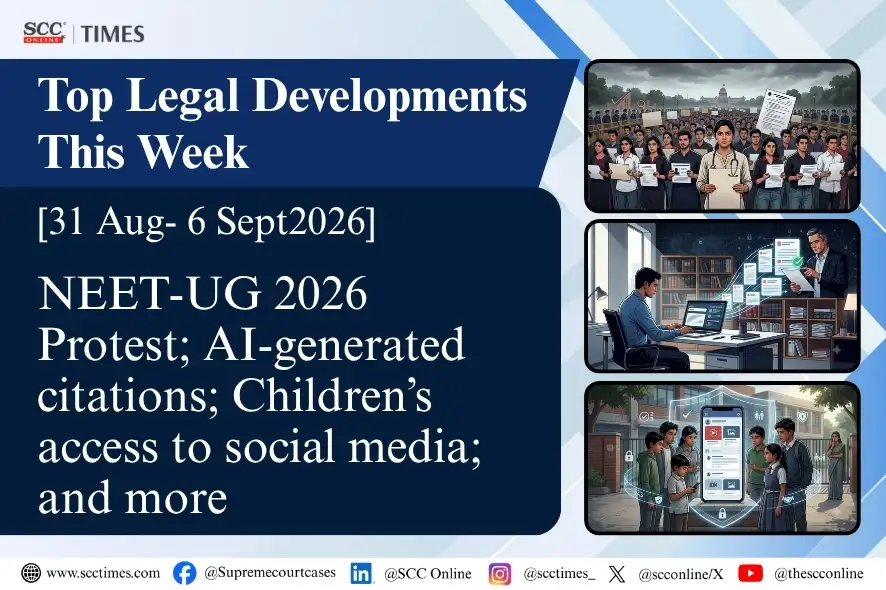
Catch up on the top legal developments this week (31 August- 6 September 2026), including Priyadarshini Bus Scheme case, Fox & Mandal ruling, homeless electors, maintenance liability, DLF Flats, Perplexity AI, GHAC Arbitration Week 2026, CADRA International Arbitration School 2026, Singapore Convention Week 2026, and much more.
STORY OF THE WEEK
CRIMINAL LAW | FIRs quashed, pan-India compensation policy directed: Inside the NEET-UG 2026 Protest order
In Shailendra Mani Tripathi v. Union of India,2026 SCC OnLine SC 1754, wherein a batch of applications was filed seeking invocation of its powers under Article 142 of the Constitution for quashing FIRs arising from the students’ protests against irregularities in the NEET-UG Examination, 2026, the Supreme Court held that it was a fit case to invoke its extraordinary powers in order to do complete justice between the parties. Keeping in view the future prospects of the young protesters who had bona fide participated in peaceful protests, the Court quashed the subject FIRs and directed that any other FIR relating to the same incidents between 20 July 2026 and 25 July 2026 shall not be pursued or investigated and shall be taken to have been closed. The Court, however, permitted registration of a fresh FIR against the 2873 individuals identified by the Delhi Police, and directed formulation of a pan-India policy for compensation to families of students who committed suicide in connection with NEET-UG Examination, 2026 within 90 days.
Read more HERE
SUPREME COURT HIGHLIGHTS
SERVICE LAW | SLP against interim protection granted to contractual Junior Engineers appointed under World Bank-funded project, dismissed
In State of H.P. v. Nitin Thakur, 2026 SCC OnLine SC 1712, the Supreme Court dismissed the Special Leave Petition challenging the Himachal Pradesh High Court’s refusal to modify the interim protection granted to the employees. The High Court had permitted the employees, whose services had been extended from time to time, to continue in service on the same terms and conditions, while noting that they had worked diligently for about seven years and “cannot be left in limbo”. The Supreme Court, having considered the contentions made across the Bar, found no reason to grant Special Leave to Appeal against the impugned order dated 3 July 2026 passed in CMP No. 12572 of 2026 and accordingly dismissed the SLP on merits.
Read more HERE
FAMILY LAW | “Astonished”: Family Court faulted for acting “in the teeth of” High Court’s express visitation order; judicial caution called for
In a custody and visitation dispute concerning the minor daughter of the parties titled Sandeep R. v. Manpreeth R, 2026 SCC OnLine SC 1733, while also taking serious exception to the manner in which the Family Court dealt with the mother’s application seeking restoration of custody, the Supreme Court was “astonished” that, despite the High Court having expressly taken note of the mother’s relocation to Pune while modifying the visitation arrangement, the Family Court acted “in the teeth of the express directions of the High Court” and proceeded on findings that disregarded that position. Accordingly, the Court declined to interfere with the High Court’s order and directed the father to comply with the High Court’s directions. The Court stated that the judicial officer was expected “to be more cautious in future”.
Read more HERE
ELECTION LAW | Defects in Form-25 may bar corrupt-practice allegations, but does not render entire election petition non-maintainable
In an appeal titled Hafiz Rashid Ahmed Choudhury v. Kripanath Mallah, 2026 SCC OnLine SC 1698, arising from the Gauhati High Court’s order passed under Section 86, Representation of the People Act, 1951 (the Act), whereby the election petition filed by the appellant, an advocate and politician (INC) against the respondent (Lok Sabha MP), the successful candidate elected from No. 7 Karimganj Parliamentary Constituency, Assam, in the 2024 Lok Sabha elections, was rejected due to manner of attestation of the petition copies, absence of attestation in the copy of Form-25, and alleged missing pages, the Supreme Court held that defects in the attestation of Form-25 do not warrant the peremptory dismissal of the entire election petition under Section 86 of the Act. Where due attestation is absent, the allegations of corrupt practices may be struck off, while independent grounds challenging the election must be considered on merits. The Court further clarified that no particular form of attestation is prescribed under Section 81(3), and different endorsements may suffice where they convey the same meaning. Consequently, the Court held that there was absolutely no reason to sustain the High Court’s order.
Read more HERE
TAX LAW | Section 74 CGST Act cannot be invoked without foundational facts of fraud, wilful misstatement or suppression
In a case titled Tata Steel Ltd. v. Union of India, 2026 SCC OnLine SC 1702, concerning the validity of a show-cause notice (SCN) issued under Section 74, Central Goods and Services Tax Act, 2017 (CGST Act), pursuant to an audit objection for the Financial Years 2018-2019 to 2020-2021, the Supreme Court held that proceedings under Section 74 could be initiated only upon the satisfaction of the assessing officer that fraud, wilful misrepresentation or suppression of facts had led to the mismatch of input tax credit or short payment of tax. The Court observed that mere mechanical recital of such expressions, without foundational facts in the SCN, would not constitute application of mind. Finding that the SCN contained only a bland allegation of suppression and that the department’s conduct in keeping the matter in the “call book” indicated absence of satisfaction, the Court set aside the SCN dated 13 June 2025 and the consequential order-in-original dated 26 December 2025.
Read more HERE
CUSTOMS | ₹425.27-crore Customs penalty order built on AI-generated fake citations, set aside
In a case titled Vijay Ghanshyam Gadiya v. Union of India, 2026 SCC OnLine SC 1741, concerning imposition of penalty under Section 114, Customs Act, 1962 for misdeclaration of natural diamonds as lab-grown diamonds, the Supreme Court held that reliance upon non-existent case laws, fake citations and AI-hallucinated ratios proved fatal to the sustainability of the order-in-original. The Court observed that while use of artificial intelligence (AI) as an assistive tool to speed up the decision-making process could not be denied, “assistance can never be substituted for adjudication” and entrusting AI with “the pilot’s seat” would be “both imprudent and dangerous”. Finding that the respondent had relied upon dubious material in the Order-in-Original dated 8 October 2025 imposing a penalty of ₹425,27,99,100 on the appellant, the Court set aside the impugned order of the Gujarat High Court dated 20 January 2026 as well as the Order-in-Original.
Read more HERE
HIGH COURT HIGHLIGHTS
PRACTICE AND PROCEDURE | Individual causes of action, separate court fees; Common cause, single court fees
While considering an interim application titled Satyam A. Surana v. High Court of Bombay, 2026 SCC OnLine Bom 10661, which sought a declaration that court fees prescribed under Entry 1(f)(ii) of Schedule II, Maharashtra Court Fees Act, 1959 (Court Fees Act) should be levied “per petition” and not “per petitioner” in proceedings under Articles 226 and 227 of the Constitution, the Bombay High Court held that the issue must be determined on the basis of the nature of the cause of action and the character of the relief claimed. The Court clarified that where a writ petition combines individual causes of action, separate court fees are payable by each petitioner, whereas a single court fee is sufficient where a common cause of action is espoused by multiple petitioners.
Read more HERE
CRIMINAL LAW | Four days of alleged detention, ₹14 lakh jewellery allegedly looted: SP probe & CCTV preservation at Unnao Police Station ordered
In a criminal miscellaneous writ petition titled Ram Kumar v. State of U.P., 2026 SCC OnLine All 27797, alleging illegal detention and loot by police personnel and Opposite Party 7, the Allahabad High Court directed the Superintendent of Police, Unnao to conduct an inquiry into the allegations, examine and preserve the CCTV footage of Police Station Hasanganj for the relevant period, and produce the same before the Court along with the inquiry report.
Read more HERE
FAMILY AND PERSONAL LAWS | Stray instances of living together after separation do not amount to “condonation of cruelty” in divorce proceedings
In a first appeal filed by wife (appellant) against a divorce decree passed in favour of her husband (respondent) titled Munmun Karmakar nee Ghosh v. Abhishek Karmakar, 2026 SCC OnLine Cal 12448, on the ground of cruelty, contending that the ingredients of mental cruelty were not made out as Section 27(1)(d), Special Marriage Act operates on the principle of fault, which was not established in the present case, the Calcutta High Court dismissed the appeal and affirmed the judgment and decree of divorce dated 30 December 2021 passed by the Additional Principal Judge, Family Court at Calcutta, holding that the appellant-wife was guilty of mental cruelty and that the marriage had broken down irretrievably. The Court accordingly dissolved the marriage by a decree of divorce, while clarifying that the judgment would not preclude the appellant-wife from seeking permanent alimony before the jurisdictional court.
Read more HERE
ROADS AND RAILWAYS | Speculative challenge to Priyadarshini Bus Scheme dismissed; No material found linking bus accidents to overcrowding
While considering a public interest litigation (PIL) titled Akhila P.R. v. State of Kerala, 2026 SCC OnLine Ker 12388, alleging that vehicles operated under the Priyadarshini Bus Scheme were involved in accidents owing to overcrowding, the Kerala High Court held that the allegation was not corroborated by any document and that no material had been produced to substantiate the assertion that the accidents occurred on account of overcrowding. Consequently, the Court dismissed the PIL but observed that the Government must ensure that the safety of passengers travelling in the buses is adequately safeguarded.
Read more HERE
CHILD RIGHTS | Centre directed to decide on regulating children’s social-media access
In a writ petition titled Ms Kirti Dua v. Union of India,2026 SCC OnLine Del 6685, raising concerns regarding the protection of children from potential harms associated with social-media access and inappropriate online content and seeking directions to the Union of India and other authorities for framing guidelines, regulations and legislation concerning children’s access to social-media platforms, age-based regulation of content, stronger implementation of existing laws, content filtering, protection against circulation of exploitative material and verification of users, the Delhi High Court directed the Union of India to consider the writ petition together with the petitioners’ note of suggestions and to pass a reasoned order.
Read more HERE
INTELLECTUAL PROPERTY | A century of goodwill belongs to the Firm, not the family: What the Fox & Mandal ruling means
The Calcutta High Court granted summary judgment in favour of Fox & Mandal in a passing-off dispute titled Fox & Mandal v. Somabrata Mandal, 2026 SCC OnLine Cal 12350. The Court held that Fox & Mandal had established prior use, reputation and goodwill dating from 1896, while the defendants had no legal entitlement to the firm’s goodwill or marks. Finding no real prospect of a successful defence, the Court permanently restrained the defendants from representing any association with Fox & Mandal. The Court observed that an action for passing off can succeed even if there is a likelihood of injury or damage. Likelihood of damage is sufficient. Deliberate violation of restraint orders, amount to a misrepresentation and deception to the public at large. All the issues sought to be raised by the defendants were a camouflage only to delay and procrastinate matters.
Read more HERE
EDUCATION LAW | Caught with cheating material but not caught cheating? That’s not enough for major unfair means penalty
In a petition filed under Article 226 of the Constitution of India titled A v. University of Delhi1, seeking issuance of writ of mandamus directing the respondent to set aside the adverse findings recorded in the impugned Unfair Means (UFM) proceeding and declare petitioner’s examination result, in view of the absence of any incriminating material found in the petitioner’s possession, the Delhi High Court held that for imposing the major penalty under Clause B of the applicable guidelines, it is not enough that cheating material is found in the candidate’s possession or vicinity, but the record must establish “actual use” of the material for copying or cheating. Where such actual use is not proved even on a preponderance of probabilities, the harsher semester-wide penalty cannot be sustained. Consequently, the Court held that the petitioner’s case fell under Clause A, rather than Clause B, of the applicable UFM Guidelines and notification and directed to impose punishment accordingly.
Read more HERE
Also Read: Transmission is not the same as receipt: Delhi High Court on due service of summons via WhatsApp
EMPLOYMENT LAW | Role, status, career: Scope of what “returning from maternity leave” actually means, widened
In a significant ruling, titled Rakhi Bisht v. Union of India2, on maternity protection in private employment, the Delhi High Court declared that the prohibition under Section 12(1), Maternity Benefit Act, 1961 and Section , 68(1), Code on Social Security, 2020 against varying a woman’s conditions of service to her disadvantage during her statutorily protected absence is not limited to termination of employment or reduction in salary/designation. It extends to the substantive incidents of employment, including the nature of duties, grade, functional status, reporting hierarchy, supervisory responsibilities, and opportunities for appraisal and promotion.
Read more HERE
ELECTION LAW | Existing ECI mechanism adequately protects homeless electors, no separate facilitative framework required
In a public interest litigation (PIL) titled Indu Prakash Singh v. State (NCT of Delhi)3, arising out of the Special Intensive Revision (SIR) of the electoral rolls being undertaken in Delhi, expressing concern that persons who were homeless, displaced, or rendered homeless following demolition drives could be left out of the electoral rolls, the Delhi High Court noted that the Draft Electoral Roll itself demonstrated inclusion of homeless persons and that persons affected by demolition could seek enrolment through Form 6. Since the existing mechanism was adequate and already being implemented, the Court found no “vacuum” warranting judicial directions for a separate facilitative mechanism.
Read more HERE
FAMILY AND PERSONAL LAWS | Husband cannot have “another bite at the cherry” and re-agitate a settled marital status dispute to escape maintenance liability
In a revision petition4 concerning the husband’s liability to maintain his wife under Section 125, Criminal Procedure Code, 1973 (CrPC), where the husband sought to reopen the question of their marital status, despite the issue having already been conclusively determined in earlier proceedings and challenged the family court’s maintenance order, the Delhi High Court reaffirmed the finality of earlier judicial findings and held that husband cannot have “another bite at the cherry” and reopen a previously decided martial status issue in a subsequent proceeding merely to escape a maintenance liability, a legal obligation arising from that determination. Accordingly, the Court dismissed the revision petition holding that the husband had failed to establish grounds warranting interference in revision.
Read more HERE
TRIBUNALS AND COMMISSIONS
CENTRAL INFORMATION COMMISSION | Student seeks evaluated answer script, University demands ₹1,000: RTI Rules Override
In a second appeal, titled Ahmed Shakir v. The CPIO Assam University5, filed against the demand of ₹1000 for providing a copy of the appellant’s evaluated answer script for the FYUG 2nd Semester Examination, 2025, the Central Information Commission allowed the appeal and set aside the impugned decision of Patharkandi College affiliated with Assam University. Relying on Section 22, RTI Act, the Commission held that where an answer script is sought under the Right to Information Act, 2005 (RTI Act), the Central Public Information Officer (CPIO) can charge only the photocopying fee prescribed under the Right to Information (Regulation of Fee and Cost) Rules, 2012 (RTI Rules), and cannot enforce university regulations inconsistent with the statutory fee structure.
Read more HERE
NATIONAL COMPANY LAW TRIBUNAL | Prior filing cannot ipso facto be a ground to transfer connected proceedings: Earlier-filed company petition transferred to the Court where connected proceeding was pending
The present application titled Anil Kumar Singh v. AI NXT Technovations (P) Ltd.6, was filed under Rule 16(d) of the National Company Law Tribunal Rules, 2016 (NCLT Rules, 2016), seeking transfer of Amit Singh v. AI NXT Technovations (P) Ltd., CP No. 135(MB)/2026 (Company Petition 2), pending before Court-I, NCLT, Mumbai Bench (Court-I), to Court-III, NCLT, Mumbai Bench (Court-III), where Anil Kumar Singh v. AI NXT Technovations (P) Ltd., CP No. 122(MB)/2026 (Company Petition 1) was pending. The National Company Law Tribunal, Principal Bench, Mumbai, disposed of the application by transferring company petition 2 from Court-III to Court-I, to be heard along with company petition 1 and connected proceedings. The mere fact that one proceeding was instituted earlier could not, by itself, be determinative of the Court before which the connected proceedings ought to continue. The subsequent course of proceedings was also relevant while considering the appropriate forum for transfer. The proceedings before Court-I had subsequently progressed further. Thus, it was appropriate that the connected proceedings from Court-III be transferred to Court-I.
Read more HERE
REAL ESTATE APPELLATE TRIBUNAL | Homebuyer challenges DLF flat’s carpet area; seeks independent verification: Expert measurement allowed
While considering an application titled Ranjit Malhotra v. DLF Homes Developers (P) Ltd.7, filed under Sections 44(6) and 53, Real Estate (Regulation and Development) Act, 2016 (RERA Act) read with Rule 8 and Annexure A and Rule 25, Haryana Real Estate (Regulation and Development) Rules, 2017, seeking appointment of an independent expert for measurement of the allotted apartment, the Haryana Real Estate Appellate Tribunal allowed the application finding substance in the appellants’ request for independent measurement of the apartment in DLF Valley Gardens, Panchkula.
Read more HERE
FOREIGN COURTS
US Court of Appeals for the Ninth Circuit | AI assistant or user?: Why an AI agent doesn’t “access” a website in Amazon vs. Perplexity AI
While considering a case titled Amazon.Com Services, LLC v. Perplexity AI, INC., 2026 SCC OnLine US CA 9C 1, regarding seeking of a preliminary injunction Amazon.com Services, LLC (Amazon) against Perplexity AI, INC. (Perplexity), to prevent the use of Perplexity’s agentic web browser AI tool on Amazon.com in violation of the federal Computer Fraud and Abuse Act (CFAA) and its California State law analogue, the US Court of Appeals concluded that Amazon was not entitled to a preliminary injunction because it was unlikely to succeed on the merits of its CFAA claims by showing that Perplexity “accessed” Amazon computers for CFAA and Comprehensive Computer Data Access and Fraud Act (CDAFA) purposes. The Court found Perplexity did not use a tool to “access” Amazon’s computers; rather, it was the user who “accessed” Amazon’s computers, with the help of Perplexity’s AI agent, the “Assistant”, to carry out specific acts on Amazon.com.
Read more HERE
OTHER UPDATES
NEWS
-
BRICS Chief Justices’ Forum 2026: CJI Highlights Mediation, AI, Arbitration and Judicial Cooperation
-
President appoints Justice Sanjay Kumar Agrawal as Acting Chief Justice of Chhattisgarh High Court
-
BRICS Chief Justices’ Forum 2026: Supreme Court of India to Host Judicial Leaders in New Delhi
LEGISLATIONS
-
Centre Establishes Mediation Council of India Under Mediation Act, 2023
-
No Endless Refiling: NCLT Streamlines Scrutiny, Registration and First Listing
ALSO READ
-
Top Legal Developments [24-30th August]: Speedy Trials in Dowry Cases, Summons in Saurav Das privacy suit, SIT probe in Fraudulent Motor Accident Claims & Other Key Verdicts and Legal Updates
-
GHAC Arbitration Week 2026: From vision to action in Institutional Arbitration
-
From Law to Commerce: GCAI India—Singapore Legal Bridge Opens a New Chapter in Legal Collaboration
-
From cross-empanelment to shared facilities: AIAC and IAMC sign MoU to promote regional ADR
1. W.P.(C) 12856/2025 & CM APPL. 79213/2025, CM APPL. 20775/2026
2. W.P.(C) 14785/2024
3. W.P.(C) 11942/2026 & CM APPL. 55365/2026
4. CRL.REV.P. 1019/2018
5. CIC/ASUVR/A/2025/657621
6. TA (Co. Act) 23 of 2026
7. CM No. 736 of 2024