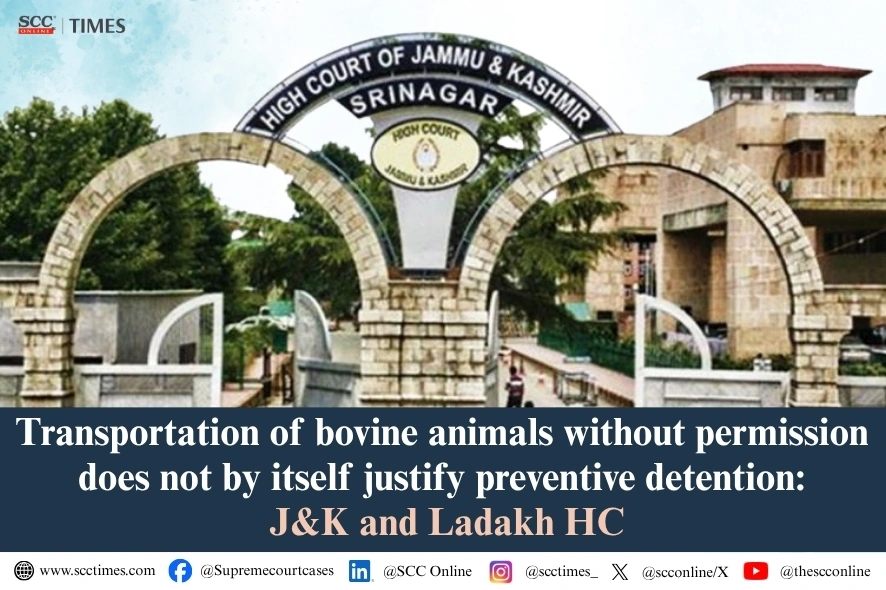
Jammu & Kashmir and Ladakh High Court: While considering a habeas corpus petition challenging a preventive detention order passed under Section 8, Jammu & Kashmir Public Safety Act, 1978 (PS Act), a Single Judge Bench of M.A. Chowdhary, J., held that preventive detention cannot be sustained merely on the basis of allegations relating to transportation of bovine animals without permission unless the material demonstrates prejudice to public order. The Court further held that non-communication of the detenue’s right to make a representation before the detaining authority constituted a violation of Article 22(5) of the Constitution, thereby vitiating the detention order.
Background
The petition challenged a detention order dated 3 March 2026 passed by the District Magistrate under Section 8, PS Act directing preventive detention of the detenue with a view to preventing him from acting in a manner allegedly highly prejudicial to the maintenance of public order.
The petitioner contended that the grounds of detention were vague, mechanical and based merely on registration of FIRs which did not disclose any activity prejudicial to maintenance of public order. It was further asserted that there was no proximate link between the alleged prejudicial activities and the detention order, as reliance had been placed on FIRs registered in 2023 and 2025. The petitioner also contended that the detenue had not been informed of his right to make an effective representation against the detention order to the government as well as to the detaining authority.
On the other hand, the respondents submitted that the detention order was based on relevant material, including police records and multiple FIRs showing the detenue’s involvement in bovine smuggling activities. According to the respondents, the detenue’s continued criminal and anti-social conduct had a direct bearing on public order and demonstrated a repeated disregard for the law. It was further contended that all relevant documents had been supplied to the detenue, that he had been informed of his right to make a representation, and that the detaining authority had reached the requisite subjective satisfaction after carefully considering the dossier submitted by the police authorities.
Analysis
The Court noted that the detention order principally relied upon 3 FIRs alleging transportation of bovine animals without permission from the District Magistrate. The respondents argued that repeated involvement in such offences demonstrated criminal propensity and activities prejudicial to public order.
The Court referred to the coordinate Bench decision in Bhupinder Kumar v. State (UT of J&K), 2025 SCC OnLine J&K 1420, wherein it was observed that mere transportation of bovine animals without permission and consequent registration of a case under Section 188, Penal Code, 1860 (IPC) does not ipso facto amount to bovine smuggling. It was further observed that transportation without permission may amount to disobedience of an order of a public authority but does not necessarily establish bovine smuggling or conduct warranting preventive detention. It was also highlighted that preventive detention is an extraordinary measure affecting the most cherished fundamental right of personal liberty and should not be invoked as a substitute for normal criminal prosecution.
The Court observed that mere allegations relating to transportation of bovine animals without permission could not by themselves justify invocation of preventive detention. The Court opined that the detaining authority had not recorded any subjective satisfaction that the alleged activities had either resulted in public outrage or possessed the potential to disturb public order. In the absence of any such material, the Court held that the detention order was unsustainable in law.
On the issue of proximity between the alleged activities and the detention order, the Court noted that the detention order had been passed in March 2026 while relying upon 1 FIR registered in 2023 and 2 FIRs registered in 2025. The Court observed that these incidents could not be treated as so remote in point of time as to snap the live link between the prejudicial activities and the detention order. Consequently, the Court rejected the challenge founded on lack of proximity.
The Court then examined the constitutional challenge based on Article 22(5) of the Constitution. Upon perusal of the detention record, the Court noted that the communication dated 3 March 2026 informed the detenue only about his right to make a representation to the government. However, the detenue had not been informed that such representation could also be made to the detaining authority.
The Court emphasised that the constitutional guarantee of making a representation is meaningful only when the detenue is informed of all the authorities before whom such representation can be presented and is afforded the earliest possible opportunity to exercise that right. The Court highlighted that non-communication of this valuable constitutional right deprived the detenue of an effective opportunity to challenge the detention at the earliest stage.
The Court held that the omission amounted to a violation of Article 22(5) of the Constitution. The Court further observed that procedural safeguards governing preventive detention are mandatory in nature and require strict compliance. Since the detenue had not been informed of his right to make a representation before the detaining authority, the detention order stood vitiated and was liable to be set aside.
Also Read: P&H HC : Preventive detention cannot bypass bail or judicial scrutiny
Decision
Consequently, while allowing the habeas corpus petition, the Court quashed the detention order dated 3 March 2026 and directed that the detenue be released forthwith, if not required in any other case.
[Sabeer Ahmed v. State (UT of J&K), 2026 SCC OnLine J&K 683, decided on 21-8-2026]
Advocates who appeared in this case:
For the Petitioner: Nitin Mohan, Advocate.
For the Respondents: Dewakar Sharma, Deputy Advocate General.