Disclaimer: This has been reported after the availability of the order of the Court and not on media reports so as to give an accurate report to our readers.
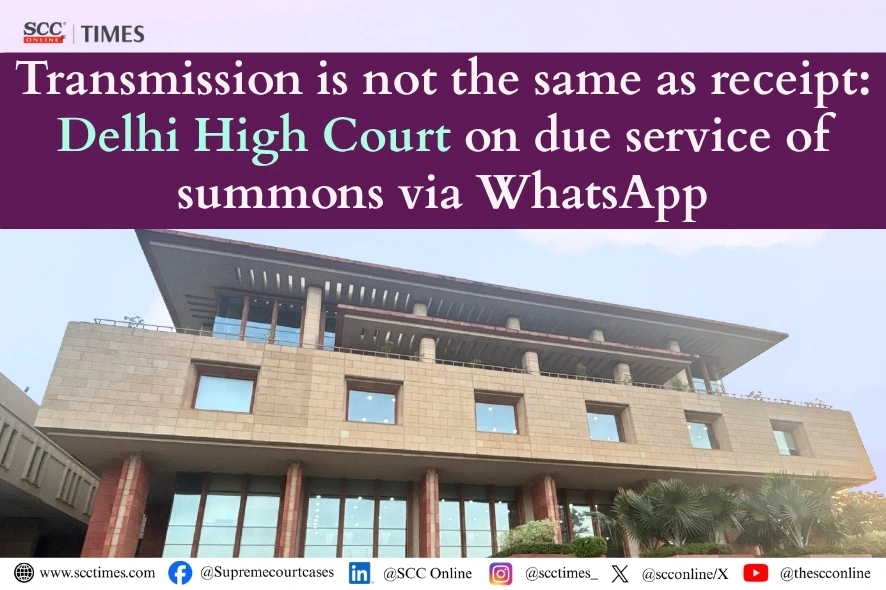
Delhi High Court: In an appeal challenging trial court’s order dated 26 May 2026 whereby his application under Order 9 Rule 13, Civil Procedure Code, 1908 (CPC), seeking setting aside of the ex parte judgment and decree dated 3 November 2023, came to be dismissed and examining whether transmission of summons through WhatsApp to a mobile number associated with the defendant could, in the circumstances of the case, be treated as conclusive proof of due service, the Single Judge Bench of Manoj Kumar Ohri, J., held that the factum of electronic transmission and proof of actual receipt are distinct, particularly where the process server’s report records that the communication was answered by a third person and the defendant consistently disputes having received the summons. Accordingly, the Court restored the appellant-defendant’s opportunity to contest the suit by setting aside the ex parte judgment and decree qua him under Order 9 Rule 13 CPC.
Also Read: Can Witness Statements Recorded Before Summoning Be Used Against an Accused? Allahabad HC Answers
Factual Matrix
In the instant matter, Respondent 1 instituted a civil suit seeking damages, permanent injunction and mandatory injunction concerning property bearing No. 17/6, West Patel Nagar, New Delhi. The appellant was arrayed as Defendant 1 and was stated to be residing on the first floor of the property, while Respondent 1 occupied the ground floor.
The dispute principally concerned alleged unauthorised construction on the first floor, installation of pipes and resultant seepage which allegedly damaged the ground-floor premises. It was also alleged that Respondents 2 and 3 had encroached upon the parking area and obstructed the ingress and egress of Respondent 1. Despite repeated requests and a PCR call dated 20 October 2020, the alleged problems were stated to have remained unresolved.
The suit was instituted on 18 November 2020. In view of the COVID-19 Pandemic, service of summons was sought to be effected electronically. The appellant did not appear before the trial court and was proceeded against ex parte on 8 June 2022. After Respondent 1 led ex parte evidence, the suit was decreed on 3 November 2023. The trial court awarded damages of ₹10,00,000 and granted the consequential injunctive reliefs.
The appellant subsequently moved an application under Order 9 Rule 13 CPC, asserting that he had never been served with the summons and had no knowledge of the suit. He stated that he first became aware of the ex parte decree in July 2025, when certain documents relating to proceedings before the High Court were received by him on WhatsApp from Respondent 2. He thereafter obtained the relevant record and filed the present application on 17 September 2025.
The trial court rejected the application, holding that the appellant had knowledge of the decree at least by 19 July 2025/22 July 2025 and that the application, having been filed beyond the prescribed 30-day period, was barred by limitation. Relying on the process server’s report concerning service through WhatsApp, it was concluded that the appellant had failed to establish absence of due service.
Issue for Consideration
Whether the material on record established due service of summons upon the appellant, and consequently whether his application under Order 9 Rule 13 CPC was rightly dismissed as barred by limitation?
Analysis
At the outset, the Court noted that the process server’s report showed that the summons were sent electronically to the mobile number concerned. However, the call was answered by someone, who represented himself as appellant’s relative and stated that he would intimate him about the summons. The appellant disputed the alleged communication and consistently maintained that he had not received the summons. The Court emphasised that the mere association of a mobile number with the appellant did not, in the circumstances, establish due service. The process server’s own record of interaction with a third person made the question of actual receipt material.
In proceedings under Order 9 Rule 13 CPC, the Court must determine whether the defendant was duly served or, where service is not established, whether sufficient cause prevented appearance. Further, the question of actual notice assumes particular significance where the defendant has remained completely absent from the proceedings and disputes the very receipt of summons.
The Court found that the trial court had proceeded substantially on the basis that the appellant’s mobile number had been used for transmitting the summons. However, the existence of the mobile number and the factum of transmission are distinct from proof that the summons were actually received by the appellant.
The Court further observed that the intervening circumstance of a third person answering the call, coupled with the appellant’s consistent denial of receipt, called for a more cautious examination. The electronic record could not, by itself, be treated as conclusive evidence of the appellant’s knowledge of the summons.
While considering the expression “sufficient cause”, the Court relied upon G.P. Srivastava v. R.K. Raizada, (2000) 3 SCC 54, wherein it was held that sufficient cause should be considered in a manner advancing substantial justice. It also referred to Parimal v. Veena, (2011) 3 SCC 545, reiterating that “sufficient cause” must be assessed on the facts and circumstances of each case and that discretion under Order 9 Rule 13 CPC must be exercised judiciously.
At the same time, the Court recognised that Order 9 Rule 13 CPC cannot be used merely to reopen an ex parte decree where the defendant had actually received due notice and had sufficient opportunity to appear. However, the present case was different because the Court found that due notice had not been satisfactorily established. The surrounding circumstances of the alleged electronic service and the appellant’s subsequent assertion of knowledge created sufficient doubt to justify permitting him an opportunity to contest the suit.
Decision
The Court held that, in the peculiar facts of the case, the appellant ought not to be deprived of an opportunity to contest the suit merely on the basis of a disputed mode of service, particularly when he approached the Court after claiming to have acquired knowledge of the decree and expressed willingness to contest the proceedings.
Accordingly, the appeal was allowed, the order dated 26 May 2026 dismissing the appellant’s application under Order 9 Rule 13 CPC was set aside, and the application under Order 9 Rule 13 CPC was allowed.
Consequently, the ex parte judgment and decree dated 3 November 2023 was set aside qua the appellant and directed the appellant to pay ₹20,000 as costs to Respondent 1 within 4 weeks. The consequential order directing release of ₹2,00,000 with accrued interest in favour of Respondent 1 was also set aside qua the appellant. If the amount had not already been released, it was to remain deposited with the trial court and abide by further orders in the suit; if already released, it would remain subject to appropriate orders of the trial court.
[Nirmaljeet Singh v. Guljeet Singh, 2026 SCC OnLine Del 6690, decided on 24-8-2026]
Advocates who appeared in this case:
For the Appellant: Mr. Varun Gaba, Adv.
For the Respondents: Mr. Kunal Madan, Adv.