The Central Asia Dispute Resolution Association (CADRA), organised its International Arbitration Summer School 2026 with an online session examining the increasingly important role of third-party funding in international disputes.
The session titled “Third-Party Funding and Costs Management” focused on the commercial and legal considerations involved in financing international disputes. Rather than limiting the discussion to the structure of funding arrangements, the session examined how potential cases are assessed, how funding decisions are made, the relationship between funders, claimants and counsel, and the importance of costs and enforcement in determining the viability of a funded claim.
The session featured:
-
Jurriaan Braat, Managing Director, Omni Bridgeway
-
Dmytro Shemelin, Investment Manager, Senior Legal Counsel, Omni Bridgeway
The discussion was moderated by Usen Tastanbekov, Program Advisor at CADRA, Associate at Kinstellar and Ilya Mashinskiy, Program Coordinator at CADRA, Associate at Magna Law Firm. The speakers drew on their experience in litigation and arbitration finance to explain the considerations that arise from the funder’s perspective, including case selection, quantum, litigation budgets, enforcement prospects, confidentiality, security for costs and the allocation of recoveries.
The speakers explained that while third-party funding is well established in many developed jurisdictions, it remains a developing area in Central Asia. The session was accordingly structured around the practical perspective of a funder, including how a dispute is assessed as an investment opportunity and what factors determine whether funding will be offered.
From legal claim to investable asset
Jurriaan Braat began by explaining the difference between the perspective of a lawyer and that of a litigation funder. While a lawyer generally approaches a client’s dispute as a legal problem to be resolved, a funder considers whether the claim represents an asset in which it can invest and ultimately recover money.
He described litigation funding as involving both risk management and the monetisation of legal assets. Funding is generally provided on a non-recourse basis. The funder pays specified costs and receives a return linked to the outcome of the case. If the funded party does not succeed, the funder ordinarily bears the loss of its investment.
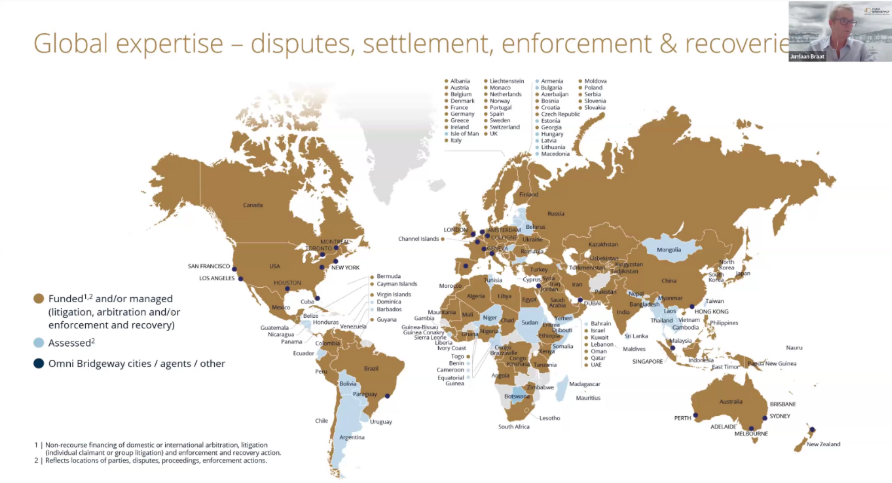
The speakers also explained that funding can take different forms. These include funding individual claims, portfolios of cases, collective redress proceedings, defence funding, claim monetisation, adverse-cost protection and enforcement of judgments or awards. Jurriaan Braat noted that enforcement can involve identifying and pursuing assets located outside the jurisdiction of the debtor.
Why a strong legal claim may still be rejected
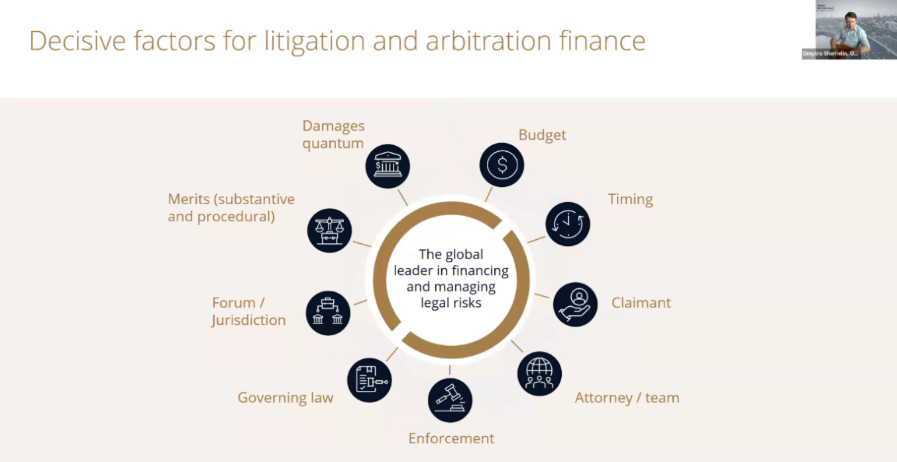
Dmytro Shemelin explained that the funder’s assessment is fundamentally different from the assessment undertaken by counsel. A case may be legally meritorious but still fail to satisfy the economic requirements for funding.
The first consideration is the quantum of the claim. According to Dmytro Shemelin, the potential recovery must be sufficiently large in relation to the costs required to pursue the dispute. A meritorious claim may therefore be rejected if its quantum does not support the economics of funding.
The budget and timing of the dispute are similarly important. A higher litigation budget requires a sufficiently large potential recovery. The length of proceedings also affects the economics because capital remains invested for a longer period. Dmytro Shemelin explained that a case expected to conclude within one or two years may support a different level of investment from one expected to continue for eight or ten years.
The speakers also identified the claimant, legal team, merits, forum and governing law as relevant considerations. Funders assess whether the claimant is likely to remain committed to the dispute and whether there is sufficient trust for a long-term relationship. The quality and suitability of counsel are also important because the funder’s investment depends substantially on the work undertaken by the legal team.
On merits, Dmytro Shemelin stated that the potential size of a recovery cannot compensate for a weak case. He explained that, as a general approach within their assessment, cases with a chance of success below 50% would not ordinarily be accepted, while a 60—70% assessment would be more favourable, although he characterised these figures as approximate.
Predictability and enforcement form part of the investment assessment
The speakers placed particular emphasis on the predictability of the relevant forum and governing law. A potentially valuable claim may not be suitable for funding if the applicable legal framework or the courts involved make the outcome too difficult to predict.
Enforcement was presented as a separate and critical component of the assessment. Dmytro Shemelin explained that the value of an award cannot be assessed solely by looking at the amount stated on paper. The funder is concerned with the amount that can actually be recovered.
“A big number on the paper, in the judgement, is not very valuable if you cannot effectively enforce the judgement.”
He explained that asset tracking and enforcement may require action across several jurisdictions. A case may therefore be rejected even where the merits and quantum appear attractive if the funder cannot identify a realistic route to recovery.
How the funding process works
Dmytro Shemelin outlined a three-stage process beginning with a preliminary assessment. After receiving basic information and entering into a non-disclosure agreement, the funder considers whether the case appears suitable for further assessment. He said that a substantial proportion of cases are rejected at this preliminary stage.
Where a case proceeds, the funder may provide indicative commercial terms before entering into a term sheet. This is followed by due diligence, which may take approximately four to eight weeks. The process can include further legal opinions, asset tracking and other investigations. A case that satisfies the assessment then proceeds to the funder’s investment committee before a binding funding agreement is entered into.
Jurriaan Braat also explained that confidentiality is addressed at the outset. According to him, the funder enters into a non-disclosure agreement before receiving detailed information about a prospective case.
Funding does not displace the lawyer-client relationship
A significant part of the discussion concerned the respective roles of the funder, claimant and legal advisers. Dmytro Shemelin described a funded matter as involving three principal participants: the funder, the claimant and the lawyers.
The speakers stressed that the funder does not become the lawyer’s client. The claimant remains the client of counsel, and the lawyer-client relationship continues to govern the conduct of the legal case. At the same time, the funding agreement can give the funder a role in strategic discussions because the funder has a financial interest in the outcome.
Jurriaan Braat explained that the funder may challenge or discuss strategic decisions, particularly where they have financial or settlement implications, but does not direct counsel in the conduct of the proceedings. He also noted that funding agreements may require the funder’s agreement before a settlement is accepted, as a means of protecting the investment.
Dmytro Shemelin similarly emphasised the importance of trust in counsel. The funder may possess experience in enforcement and cross-border matters, but local counsel remains important in assessing how a particular court or jurisdiction is likely to approach a procedural or substantive issue.
The economics of funding and the 1:10 approach
Dmytro Shemelin explained that one of the funder’s practical rules of thumb is to maintain a relationship of approximately 1:10 between the requested budget and the enforceable quantum. Thus, where the budget for pursuing a case is $1 million, the funder would seek to establish that approximately $10 million can realistically be recovered. The assessment is based on an enforceable figure rather than merely the nominal value of the claim.
The budget may cover legal fees, court fees, expert expenses, adverse costs and, in some circumstances, monetisation or working-capital requirements. The speakers explained that the calculation is adjusted for factors such as counterclaims and uncertainty concerning interest or recovery.
This approach also illustrates why costs management is central to the funding decision: increasing the litigation budget can directly affect the economics of the investment and the share ultimately retained by the claimant.
Protecting the claimant’s economic interest
Jurriaan Braat explained that keeping the funding budget proportionate to the expected recovery is also intended to ensure that the claimant retains a majority economic interest in the claim. He gave an example in which a $10 million investment carrying a three-times return would result in a total recovery allocation of $40 million, leaving the claimant with 60% of the claim in that example.
Dmytro Shemelin added that, as a general approach, the funder seeks not to take more than approximately 40—50% of the recovery because a significantly larger share could undermine the partnership with the claimant.
Disclosure, conflicts and confidentiality
The speakers distinguished between disclosure of the existence of a funder and disclosure of the funding agreement itself. Jurriaan Braat stated that the funding agreement is generally a private arrangement between the funder and funded party. In his account, disclosure of the funder’s identity may nevertheless be required or appropriate so that arbitrators and respondents can consider potential conflicts of interest.
This was followed by a discussion of confidentiality. Jurriaan Braat said that the parties enter into a non-disclosure agreement before detailed case information is shared with the funder. The NDA operates reciprocally, protecting information supplied by the prospective funded party as well as the commercial terms offered by the funder.
Security for costs and protection against adverse costs
The session also addressed the relationship between third-party funding and security for costs. Jurriaan Braat explained that where the funding agreement provides for it, the funder may cover adverse costs if the funded party loses. This issue can arise particularly in investor-State arbitration, where a respondent may question whether a funded claimant will be able to satisfy a costs award.
The speakers further discussed the forms of security that may be available depending on the applicable law. Jurriaan Braat referred to assignments of future proceeds under English law and, in other legal systems, the possibility of assigning or pledging claims. Personal guarantees may also be considered in particular circumstances.
Who gets paid first?
In response to a question on the distribution of proceeds following a successful claim, Jurriaan Braat explained that the funder would ordinarily be paid first under the funding arrangement, including recovery of its investment and agreed return. He noted, however, that arrangements can provide for the funded party to receive a minimum return from an earlier point in the distribution waterfall.
The speakers also explained that third-party funding is non-recourse in nature. If the funded claim fails, the funder generally does not recover the investment from the claimant, subject to the terms of the particular funding arrangement.
Third-party funding and artificial intelligence
A participant asked about the use of artificial intelligence in assessing prospective cases. Jurriaan Braat said that AI was being used to some extent as an input into the assessment process but had not replaced human evaluation. He noted that a significant amount of the funder’s time is spent reviewing and rejecting cases, making faster preliminary assessment potentially valuable.
Enforcement: from an award to actual recovery
The practical importance of enforcement was illustrated through case studies discussed by Jurriaan Braat. In one matter involving an arbitral award against one of the African states, the funding team was engaged at the enforcement stage rather than to finance the arbitration itself. The team-initiated recognition proceedings in several jurisdictions and used asset tracing to identify assets that could potentially be targeted for recovery.
Jurriaan Braat described how proceedings concerning aircraft ordered by one of the African Airlines ultimately formed part of settlement negotiations. The example was used to demonstrate the difference between obtaining an award and actually converting that award into a recovery. He noted that enforcement can require action across jurisdictions and persistence after an award has been rendered.
A second example similarly involved the seizure of assets in different jurisdictions and subsequent settlement discussions. Jurriaan Braat used the examples to emphasise that enforcement strategy may involve identifying assets outside the respondent’s home jurisdiction and using available legal mechanisms to bring parties to the negotiating table.
Third-party funding as a multidisciplinary practice
Responding to a question about professional pathways into the field, Jurriaan Braat said that a legal background is useful but that practitioners also need an understanding of finance and commercial decision-making. The assessment of a potential investment requires consideration of both legal prospects and the economics of the case, including how changes in timing, recovery and costs affect the investment.
The speakers also discussed the regulatory position of third-party funding. Jurriaan Braat said that, from his perspective, the financial arrangements are generally based on freedom of contract rather than a comprehensive regulatory framework. He noted that arbitration rules requiring disclosure of the existence of a funder can address conflict-of-interest concerns.
On the types of disputes suitable for funding, Jurriaan Braat said that the subject matter itself is not necessarily decisive. Investor-State arbitration, commercial arbitration and other disputes may be considered, provided the underlying merits, quantum, economics and prospects of recovery satisfy the funder’s criteria. He also observed that funders had become more cautious about investor-State arbitration following losses in the area.
Understanding the economics of funded disputes
The session brought together the legal and commercial dimensions of third-party funding. The discussion covered how funders assess a prospective claim, the importance of quantum, costs and enforceability, and the structure of the relationship between the claimant, counsel and funder. It also addressed practical questions concerning confidentiality, disclosure, security for costs, recovery and the allocation of proceeds.
The speakers’ examples demonstrated that the assessment of a dispute does not end with its legal merits. The likely costs of pursuing it, the prospects of recovery and the practical requirements of enforcement also form part of the funding analysis. At the same time, the discussion emphasised that the claimant remains the client of counsel and that the funder’s involvement operates within the framework agreed with the claimant.
Taken together, the session provided a practical account of how third-party funding is evaluated and managed in international disputes, while highlighting the legal, financial and strategic considerations that arise at different stages of a funded dispute.