


The Gujarat High Court Arbitration Centre (GHAC) inaugurated its first Arbitration Week on 3 September 2026 in Gandhinagar. Organised in collaboration with the High Court of Gujarat, the three-day programme is being held under the theme “Building Gujarat’s Institutional Arbitration Ecosystem”.
The opening ceremony was attended by several dignitaries, including:
-
Justice K. V. Viswanathan, Judge, Supreme Court of India
-
Justice N. V. Anjaria, Judge, Supreme Court of India
-
Justice Vipul M. Pancholi, Judge, Supreme Court of India
-
Harsh Sanghavi, Deputy Chief Minister, State of Gujarat
-
Justice Sunita Agarwal, Chief Justice, High Court of Gujarat
-
Justice A. Y. Kogje, Judge, High Court of Gujarat
-
Justice A. S.Supehia, Judge, High Court of Gujarat
-
Kaushik Vekariya, Minister of State for Law & Justice, State of Gujarat
-
Kamal Trivedi, Advocate General, State of Gujarat
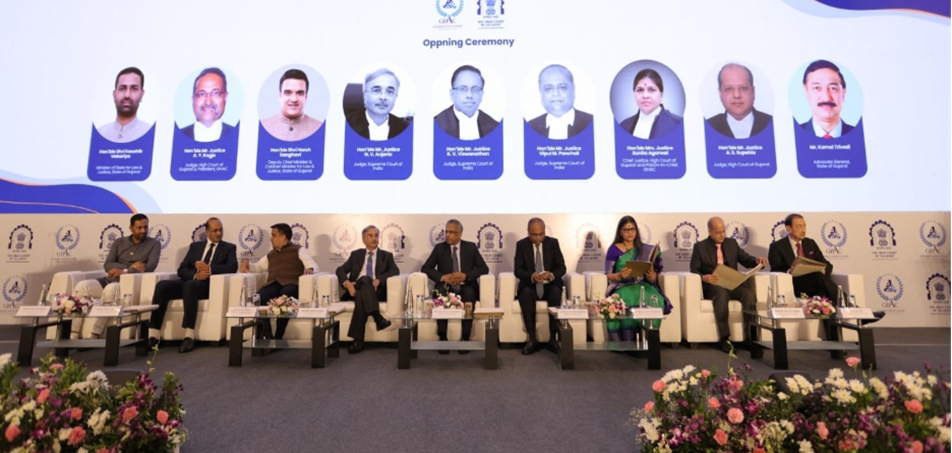
[In the picture from left to right: Kaushik Vekariya, Justice A.Y. Kogje, Deputy CM Harsh Sanghavi, Justice N.V. Anjaria, Justice K.V. Viswanathan, Justice Vipul M. Pancholi, Chief Justice Sunita Agarwal, Justice A. S. Supehia, Kamal Trivedi]
Justice V. M. Pancholi on building confidence in India’s arbitration ecosystem
Delivering the special address at the inaugural ceremony of GHAC Arbitration Week 2026, Justice V. M. Pancholi, Judge, Supreme Court of India, said arbitration had evolved from an alternative to litigation into an important component of commercial justice. He emphasised that changing business expectations, complex transactions, technology and international commerce require a dispute resolution system that balances speed with fairness, flexibility with due process, party autonomy with independence, and efficiency with quality adjudication.
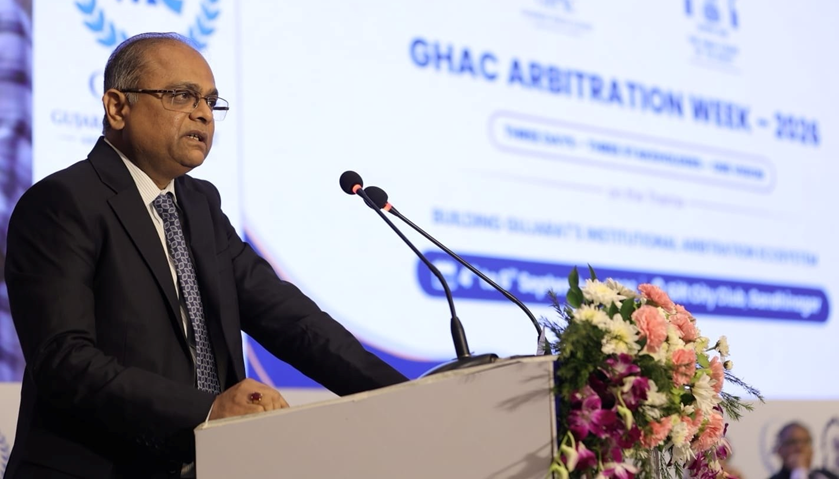
[In Picture: Justice V. M. Pancholi]
Post-2015 reforms and confidence in arbitration
Justice Pancholi observed that arbitration could no longer be viewed merely as an alternative to litigation but had become an important component of the architecture of commercial justice. Changing business expectations, complex transactions, technology and international commerce, he noted, require dispute resolution mechanisms to evolve accordingly.
Referring to the 2015, 2019 and 2021 reforms, Justice Pancholi noted that the legislative changes sought to address delay, excessive judicial intervention and procedural inefficiency, while placing greater emphasis on institutional arbitration, professional standards, enforcement and the integrity of arbitral awards.
However, he stressed that legislation alone could not determine the success of India’s arbitration regime. The real measure, according to Justice Pancholi, is the confidence it inspires among users. A party should know the rules and process, have confidence in the independence of the tribunal, expect efficient proceedings and be assured that the eventual award will receive meaningful and effective enforcement.
Institutional arbitration and disciplined judicial supervision
Justice Pancholi welcomed the emphasis on institutional arbitration, observing that strong arbitral institutions bring confidence, procedural discipline and consistency while reducing the burden on courts. He said institutions must continuously evolve, remaining efficient without becoming bureaucratic and accessible without compromising sophistication.
On conflicts, disclosure and arbitral independence, he stressed that the authority of an arbitrator ultimately rests upon the confidence of the parties. Disclosure, he observed, is not merely a technical formality but an essential safeguard of procedural legitimacy, while such standards must be applied with intelligence and proportionality.
On the role of courts, Justice Pancholi observed:
“The real objective is not the absence of judicial supervision. It is disciplined judicial supervision.”
He said courts must respect the arbitral process, while arbitral institutions must respect the boundaries of judicial authority. Maintaining this equilibrium, he observed, strengthens arbitration.
“Efficiency in dispute resolution is not merely an administrative virtue. It is an element of justice.”
Justice Pancholi placed the question of efficiency within the human and commercial consequences of disputes. An arbitral award, he noted, may determine the future of a business, represent the recovery of years of investment or determine whether a project continues or fails. Every unnecessary delay, avoidable procedural complication and uncertainty in enforcement, he said, carries a cost, while improvements in dispute resolution strengthen confidence in the rule of law.
Building India’s future as a preferred arbitration jurisdiction
Justice Pancholi urged that the deliberations during Arbitration Week should translate into institutional reforms and better practices. He expressed confidence that India could become a preferred seat for international commercial disputes and that its arbitral institutions could command the confidence enjoyed by leading institutions globally.
He called for an arbitration ecosystem in which party autonomy is respected, arbitrators are independent, courts are supportive, institutions are professional and awards are effectively enforced, while emphasising the need for the legal profession to continuously examine and improve itself.
Justice N.V. Anjaria on reviving the spirit of arbitration
Justice N.V. Anjaria, Judge, Supreme Court of India, reflected on the journey of arbitration, its present state and the need to revive the spirit with which the mechanism was originally conceived. He emphasised that while arbitration had grown into a global institution, its drawbacks, pitfalls and inherent ills required stakeholders to reconsider whether the process was still serving its intended purpose.
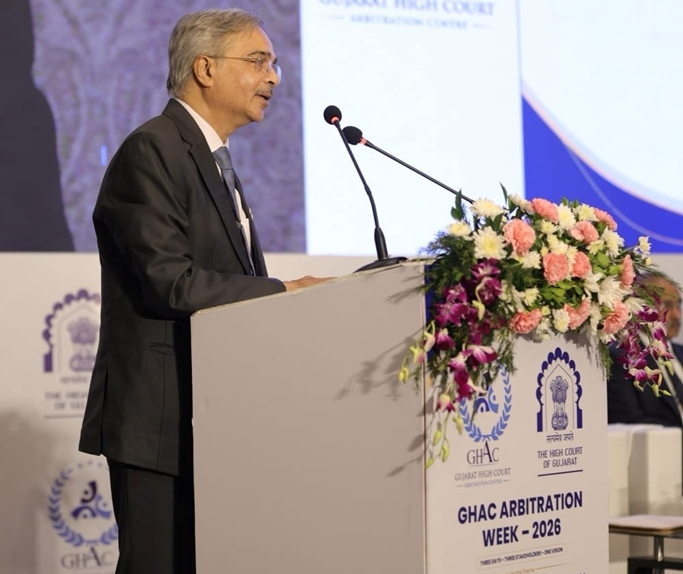
[In Picture: Justice N.V. Anjaria]
Arbitration must return to its original purpose
Justice Anjaria observed that the Arbitration Week should provide an opportunity to seriously ponder over the journey of arbitration movement, the destination arbitration has reached and the state of affairs prevalent in the present regime. Arbitration, he noted, was originally conceived as a justice system free from the costly and cumbersome process of court litigation but had now assumed global dimensions and become an institution in itself.
At the same time, he expressed concern that the growth of arbitration had been accompanied by drawbacks, pitfalls and inherent ills which were tainting the process.
“Arbitration has grown up in age but the stakeholders have not grown up in the wisdom and in the spirit of arbitration.”
Referring to late jurist Fali S. Nariman’s article Reviving the Spirit of Arbitration, Justice Anjaria highlighted the French expression “l’espirit de l’arbitrage” and referred to the emphasis on mutual understanding and cooperation between parties to achieve justice.
Five areas to revitalise arbitration
Justice Anjaria identified five areas requiring attention. First, arbitration should be cost-effective and should not be expensive in terms of money, time or procedure. Second, it should remain a party-centric process and should not degenerate into an arbitrator-centric mechanism.
Third, arbitration should not become an elitist club of rich litigants but must remain a common man’s forum that is easily accessible and readily available. Fourth, he called for the soul of arbitration to be rediscovered, identifying Section 30, Arbitration and Conciliation Act, 1996 (Arbitration and Conciliation Act) as central to this objective. Section 30, Arbitration and Conciliation Act encourages settlement through mediation, conciliation or other procedures during the process of arbitration and recognises that such processes are not incompatible with the arbitration agreement.
“In the conscience of every arbitration, there is a conciliator who is asleep”
Justice Anjaria observed that the proper use of mediation and conciliation as part of the arbitration process could yield miraculous results. Referring to the observation that “in the conscience of every arbitration, there is a conciliator who is asleep and we must wake him up”, he stressed that conciliation is a friendly mode and parties must be encouraged to get into it.
The fifth requirement, according to Justice Anjaria, was that judicial intervention should be minimal. Referring to recent Supreme Court judgments, he noted that intervention of courts in the arbitration process and in the decision-making of the arbitrator should be least and only in compelling circumstances.
Gujarat High Court Arbitration Centre and Med-Arb
Justice Anjaria also highlighted GHAC, noting that it has the first Med-Arb department, which he described as the first of its kind in India. He described the conference as in a way prognostication of future of GHAC, observing that even before its physical establishment, the Centre had started organising such an event, demonstrating how vital and active it could be.
Concluding, Justice Anjaria congratulated the Chief Justice, the Gujarat High Court, its officers and all those associated with GHAC for their efforts in organising the conference.





