


The Central Asia Dispute Resolution Association (CADRA) is conducting its International Arbitration Summer School 2026 from 10 to 29 August 2026. The online programme brings together students, researchers and practitioners for theoretical and practical engagement with cross-border dispute resolution, including arbitration agreements, arbitral proceedings, evidence-taking, recognition and enforcement of awards, and emerging trends in international arbitration.
As part of the Summer School, Simon Chapman KC, Managing Partner, Disputes, Asia and Australia, and Global Co-Head of the International Arbitration Practice at Herbert Smith Freehills Kramer, addressed a session on “Recognition, Enforcement, and Setting Aside of Arbitral Awards”.

Drawing primarily on Hong Kong arbitration practice, Simon Chapman KC examined the options available after an arbitral award, the distinction between setting aside an award and resisting its enforcement, the limited grounds for judicial intervention, and the approach of courts to issues such as due process, jurisdiction, public policy and procedural objections. The subsequent discussion and Q&A addressed practical questions concerning sanctions, defective arbitration agreements, inattentive arbitrators, surprise points, jurisdictional objections and anti-suit injunctions.
Post-award proceedings: setting aside or resisting enforcement
Simon Chapman KC began by distinguishing the various options available to a party after an arbitral award. A party may comply with the award or reach a commercial settlement. The focus of the session, however, was on recourse to domestic courts through setting aside proceedings and resistance to enforcement. He noted that challenges can also arise in relation to partial awards issued during the arbitral process, rather than only the final award.
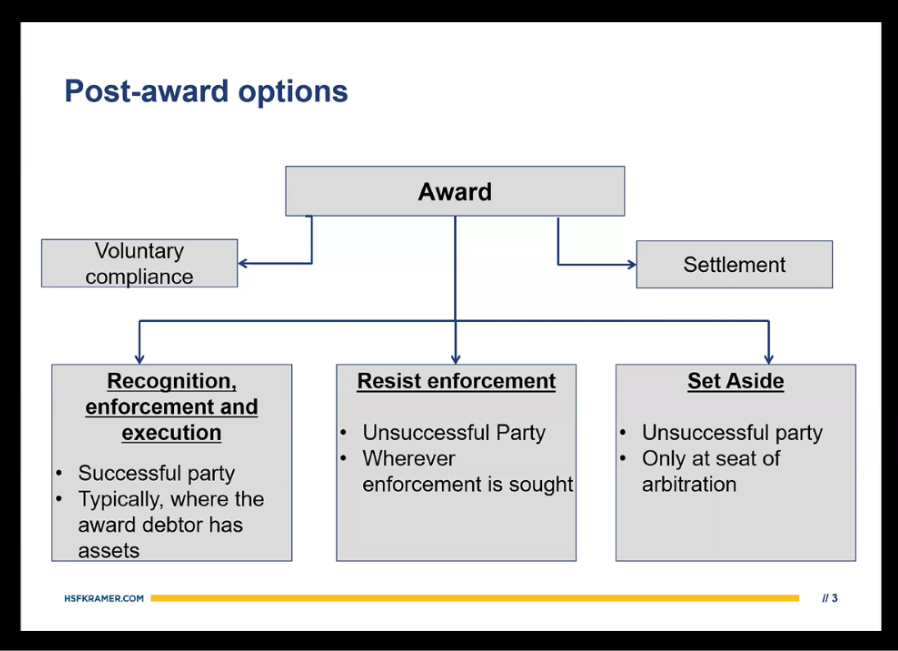
He described setting aside as the active remedy available before the courts at the seat of the arbitration. If successful, the award is annulled. Resistance to enforcement, by contrast, is a more passive remedy. It may be raised in a jurisdiction where enforcement of the award is sought. A successful challenge to enforcement does not itself annuls the award. Instead, the award remains valid but cannot be enforced in that particular jurisdiction.
The distinction also reflects the territorial approach adopted by the New York Convention1 and the UNCITRAL2 Model Law. Simon Chapman KC explained that, where an award has been set aside at the seat, that may provide a basis for another jurisdiction to refuse its recognition and enforcement.
New York Convention and Model Law provide the framework
The New York Convention was identified as the starting point for the post-award framework. Simon Chapman KC noted that the Convention establishes obligations on contracting States to recognise and enforce arbitral awards, subject to the conditions contained in Article V. He emphasised the importance of the limited grounds for refusing enforcement under the Convention.
The discussion then moved to the UNCITRAL Model Law on International Commercial Arbitration. Hong Kong, Singapore and several other jurisdictions have adopted Model Law-based arbitration regimes. Simon Chapman KC explained that this makes Hong Kong case law relevant beyond Hong Kong, although not every major arbitration jurisdiction follows the Model Law. He contrasted this with jurisdictions such as Mainland of China and England and Wales, whose legislative frameworks differ despite incorporating some comparable principles.
In Hong Kong, Section 81 of the Arbitration Ordinance adopts the Model Law framework concerning the setting aside of awards. Simon Chapman KC outlined the grounds, including incapacity or invalidity of the arbitration agreement, lack of proper notice or inability to present one’s case, decisions beyond the scope of the submission to arbitration, irregularities in the composition of the tribunal or arbitral procedure, non-arbitrability and public policy.
Courts maintain a high threshold for setting aside awards
A central theme of the session was the limited role of courts in reviewing arbitral awards. Simon Chapman KC explained that Hong Kong courts generally accord arbitrators a significant margin of appreciation and intervene only in serious cases. He referred to Grand Pacific, which he identified as a leading authority on the high threshold for setting aside. The complaint must be sufficiently serious or egregious to amount to a denial of due process.
He also referred to a more recent X&Y3 decision in which the court emphasised a generous and commercially reasonable reading of an award. According to Simon Chapman KC, an inference that a tribunal failed to consider an important issue should be drawn only where that conclusion is clear and virtually inescapable.
The underlying principle, he explained, is that a set-aside application is not an appeal on the merits. Courts do not ordinarily reassess the tribunal’s findings of fact or law. Instead, the supervisory court is concerned with the structural integrity of the arbitral proceedings, including whether due process was compromised.
Simon Chapman KC also observed that case law concerning setting aside and resistance to enforcement frequently overlaps. Courts and practitioners may therefore rely on authorities concerning one remedy when considering the other, particularly within Model Law jurisdictions.
Enforcement is intended to be a limited judicial exercise
Discussing the broader principles governing post-award proceedings, Simon Chapman KC referred to a set of principles developed by the Hong Kong courts in relation to enforcement and setting aside.
The first is that courts should facilitate the arbitral process and assist in the enforcement of awards. Judicial intervention should remain within the limits established by the applicable legislation. Parties are generally free to agree on how their disputes should be resolved, subject to necessary public-interest protections.
He further highlighted the principle that enforcement should be approached as an essentially administrative or mechanistic process, with limited grounds for intervention. A party resisting enforcement must demonstrate a real risk of prejudice and a material violation of its rights. The court’s concern remains the structural integrity of the proceedings rather than the merits of the underlying dispute.
Another important principle concerns objections raised during the arbitration. Simon Chapman KC stressed that a party should not deliberately retain an objection for use only after an unfavourable award. Where a party has an opportunity to raise a procedural objection before the tribunal, it should do so and give the tribunal an opportunity to address the alleged defect.
Due process does not convert case management decisions into grounds for setting aside
Simon Chapman KC identified inability to present one’s case as one of the grounds most frequently invoked in set-aside proceedings. He stressed, however, that the threshold remains high. The conduct must be sufficiently serious or egregious to amount to a denial of due process.
Ordinary case-management decisions generally do not meet that threshold. Decisions concerning the amount of time available for submissions, additional rounds of expert evidence or further witness statements are ordinarily matters for the tribunal. Courts are generally reluctant to interfere with such decisions merely because a party considers the procedural opportunity insufficient.
The discussion also touched upon what Simon Chapman KC described as “due process paranoia”, where arbitrators may go to considerable lengths to accommodate parties because of concerns that procedural decisions could later be challenged. The approach of the courts, as described during the session, is to distinguish genuine denial of due process from ordinary procedural case management.
Failure to address an issue is not enough unless the issue was essential
Simon Chapman KC also discussed challenges based on a tribunal’s alleged failure to address a particular issue. He noted that parties frequently identify an argument buried within lengthy written submissions and subsequently contend that the tribunal’s failure to address it constitutes a ground for challenging the award.
The courts, he explained, have sought to prevent such challenges from becoming a means of reopening awards. A party would generally need to establish that the tribunal failed to deal with an essential issue and that consideration of that issue could have affected the outcome.
A different situation may arise where a tribunal develops its own theory of the case or investigates a matter without giving the parties an opportunity to comment. Simon Chapman KC regarded this as potentially much more serious because of its implications for the parties’ opportunity to be heard.
He nevertheless noted that, particularly in contractual interpretation, a tribunal is not necessarily required to adopt either party’s proposed construction. It may reach its own interpretation of the agreement. As a matter of prudent practice, however, Simon Chapman KC suggested that where a tribunal is considering a significant interpretation not advanced by either party, it may be preferable to give the parties an opportunity to comment.
Public policy remains a narrow but significant ground
Public policy was discussed as an important but narrowly construed ground for resisting enforcement or challenging an award. Simon Chapman KC observed that parties sometimes seek to characterise substantive legal errors as public policy violations when no other available ground fits their challenge.
He explained that an error of law, by itself, does not generally provide a basis for setting aside an award under the Model Law framework discussed in the session. Public policy is not intended to operate as a general substitute for an appeal on the merits.
Successful public policy challenges remain exceptional. Simon Chapman KC referred to an example involving two related arbitrations in which the same arbitrator participated, and the tribunals reached conflicting decisions on identical issues. The court considered enforcement of the later award inconsistent with the fairness and due process underpinning the arbitral process, in circumstances where the same arbitrator had participated in two related arbitrations and the tribunals had reached conflicting decisions on broadly similar issues.
Finality versus local standards of justice
In response to a question on the tension between domestic legal values and the finality of international arbitration, Simon Chapman KC discussed Song Lihua v Lee Chee Hon4, involving enforcement of an award rendered in the Mainland of China.
The case concerned an arbitrator’s conduct during a virtual hearing. Simon Chapman KC explained that the Hong Kong court considered whether enforcement would meet the standards of justice and public policy applicable in Hong Kong, notwithstanding the treatment of the challenge in the seat of the arbitration. The court ultimately refused enforcement on public policy grounds.
For Simon Chapman KC, the example illustrated the tension between the finality of arbitral awards and the enforcing jurisdiction’s own standards concerning fairness and justice.
Public policy can differ between jurisdictions
A further question addressed whether a public policy determination in one jurisdiction should influence enforcement proceedings elsewhere.
Simon Chapman KC explained that another court’s findings concerning the same award may carry significant weight, but they are not necessarily binding on the court of another jurisdiction. The relevant court may have to apply its own public policy standards. He noted that jurisdictions may adopt different approaches, particularly where one jurisdiction takes a broader view of the public policy exception than another.
He therefore emphasised the jurisdiction-specific nature of public policy. While international arbitration seeks consistency through instruments such as the New York Convention and the Model Law, the application of public policy ultimately remains connected to the standards of the enforcing jurisdiction.
C v. D: distinguishing jurisdiction from admissibility
One of the principal case studies discussed during the session was C v. D5, a Hong Kong case that proceeded to the Court of Final Appeal. Simon Chapman KC said he had acted as lead counsel in the underlying arbitration case and at the subsequent stages of the court proceedings.
The dispute concerned an escalation clause requiring the parties to undertake specified steps before commencing arbitration. The issue was whether failure to comply with those pre-arbitration steps affected the tribunal’s jurisdiction or instead concerned the admissibility or ripeness of the claim.
The Court of First Instance and Court of Appeal treated non-compliance with the pre-arbitration requirement as an issue of admissibility rather than jurisdiction. The Court of Appeal also recognised the distinction between jurisdiction and admissibility as a useful concept in determining which questions may properly be reviewed by a supervisory court.
The Court of Final Appeal unanimously dismissed the appeal. It held that non-compliance with a pre-arbitration condition would not, by itself, necessarily justify judicial intervention. The relevant inquiry was whether the arbitral reference or award went beyond what the parties had actually agreed to submit to arbitration.
Simon Chapman KC highlighted the practical significance of the decision. Where parties have agreed to arbitrate their disputes but have failed to comply with a contractual precondition, the issue may ordinarily be one for the tribunal rather than a basis for supervisory court intervention. The tribunal may, depending on the circumstances, address the breach through procedural or costs-related measures or determine that the breach has no practical consequence.
The Court of Final Appeal further endorsed the distinction between jurisdiction and admissibility and adopted a presumption, in the Model Law context, that a pre-arbitration condition concerns admissibility unless the parties have expressly and unequivocally indicated that non-compliance is intended to affect jurisdiction.
Prompt objections remain critical
The importance of raising objections during the arbitration was further illustrated by Simon Chapman KC through an example involving an inattentive arbitrator. He explained that, despite evidence suggesting that the arbitrator had not been attentive during proceedings, the challenge did not succeed because the relevant objection had not been raised when the party had the opportunity to do so.
The broader point was that parties should not participate in an arbitration while deliberately keeping procedural or jurisdictional objections in reserve. A timely objection gives the tribunal an opportunity to address and, where possible, cure the alleged defect.
Participation with a reservation of rights
During the Q&A, Simon Chapman KC was asked whether a party that participates in an arbitration while reserving its right to challenge jurisdiction can subsequently raise the objection at the enforcement stage.
He distinguished between merely reserving a position and actually raising a jurisdictional objection before the tribunal and giving it an opportunity to rule on the objection. In his view, a party that genuinely challenges jurisdiction and gives the tribunal an opportunity to decide the issue may subsequently seek judicial review of that decision. Merely stating that rights are reserved, without putting the jurisdictional objection before the tribunal, is different.
He also observed that where the validity of an arbitration agreement is known, a party should not participate in the proceedings and wait until an adverse award before challenging the agreement. He identified the possibility of a different analysis where the defect was genuinely unknown and could not reasonably have been discovered earlier, while noting that he had not encountered such an extreme factual situation in a case before the court.
“Surprise points” and tribunal-generated issues
Another question concerned so-called “surprise points”, where a tribunal decides an issue that was not argued by the parties.
Simon Chapman KC said such situations arise from time to time, but were not the most common type of challenge he encountered. More commonly, losing parties argue that the tribunal failed to address an issue raised in their submissions. He reiterated that such a challenge generally requires the omitted issue to have been essential and capable of affecting the outcome.
Where a tribunal independently develops a theory or investigates an issue without giving the parties an opportunity to respond, however, the situation may raise more serious due process concerns. Simon Chapman KC said such conduct can provide a stronger basis for a set-aside challenge.
Sanctions and the public policy exception
A participant also asked how international arbitration can maintain consistency when States invoke sanctions as part of public policy considerations.
Simon Chapman KC acknowledged that sanctions-related disputes increasingly raise questions concerning public policy. He observed that the New York Convention does not define public policy in precise terms, leaving domestic courts with considerable scope in applying the exception. At the same time, he noted an emerging consensus in many jurisdictions that public policy should be narrowly construed and reserved for exceptional circumstances.
He also pointed to the value of decisions from other Model Law jurisdictions. For example, public policy decisions of Singapore courts may carry persuasive weight in Hong Kong. However, he cautioned that what may offend the standards of one jurisdiction may not necessarily produce the same result elsewhere.
Anti-suit injunctions and the court-arbitration relationship
The final question concerned whether an anti-suit injunction issued in support of arbitration could itself be regarded as interference with the jurisdiction of a domestic court.
Simon Chapman KC explained that an anti-suit injunction is properly understood as operating in personam, restraining the party pursuing proceedings in breach of its contractual obligation rather than restraining the foreign court itself. It restrains the party from pursuing proceedings in breach of its contractual obligation to arbitrate or litigate in the agreed forum. It does not, on this reasoning, purport to restrain the foreign court itself.
He therefore distinguished the restraint imposed on the litigant from interference with the jurisdiction of another national court. The injunction, in his explanation, operates to enforce the contractual obligation undertaken by the party.
Balancing finality with judicial supervision
The session ultimately highlighted the delicate balance between the finality of arbitration and the need for limited judicial supervision. From enforcement and setting aside to jurisdiction, due process and public policy, the discussion underscored that courts are not appellate forums for arbitral awards, but remain an important safeguard against serious defects in the arbitral process. The recurring emphasis was therefore on preserving both the efficiency and finality of arbitration and the procedural fairness and integrity on which its legitimacy depends.
1. Convention on the Recognition and Enforcement of Foreign Arbitral Awards (New York, 1958) (the “New York Convention”)
2. United Nations Commission on International Trade Law
3. X and YCo v. ZCo [2024] HKCFI 695
4. [2023] HKCFI 2540
5. C v. D [2023] HKCFA 16





