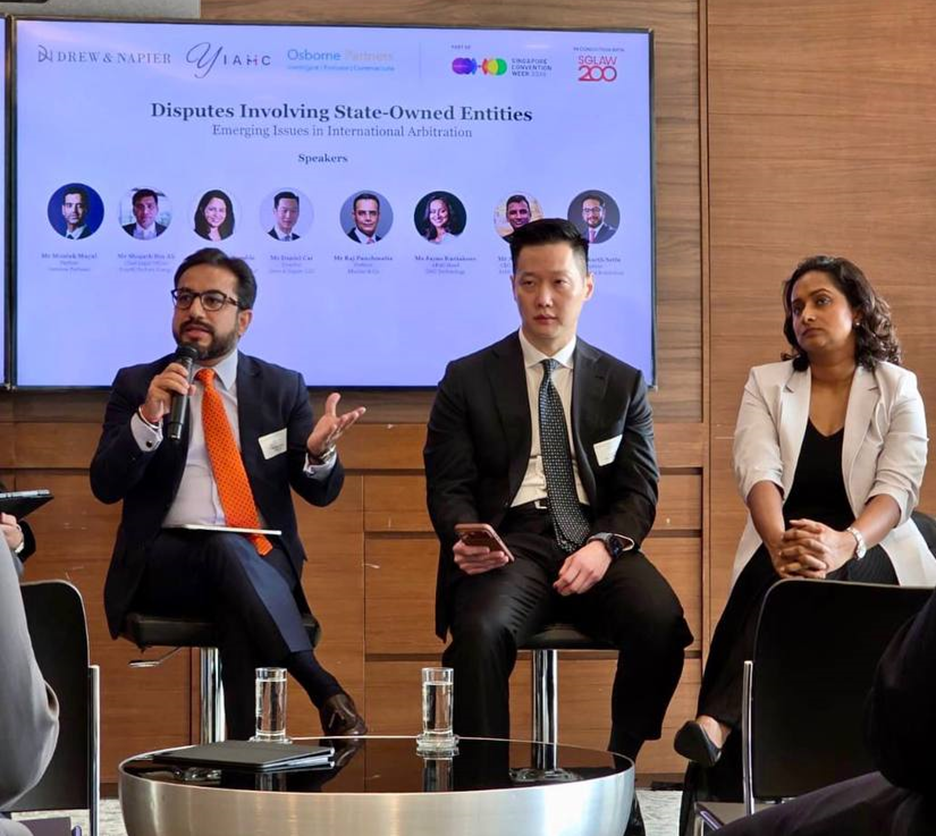
As part of Singapore Convention Week 2026, the Young International Arbitration and Mediation Centre hosted a panel titled “Disputes Involving State-Owned Entities: Emerging Issues in International Arbitration”. The session examined the legal and commercial challenges that can arise when private investors and businesses contract with States and state-owned entities (SOEs), including questions of risk allocation, dispute-resolution clauses, sovereign conduct, treaty protection, evidence, damages and enforcement.
A.J. Jawad, CEO and Registrar, International Arbitration and Mediation Centre (IAMC), Hyderabad, delivered the opening remarks. The discussion was moderated by Montek Mayal, Partner and Practice Head — Asia & Middle East, Osborne Partners.
The panel comprised:
-
Daniel Cai, Director, Dispute Resolution, Drew & Napier
-
Jayne Kuriakose, Head of Disputes and Litigation (Asia), DXC Technology
-
Purnima Kambalay, Senior Partner, Fox Mandal & Associates LLP
-
Raj Panchmatia, Partner, Khaitan & Co
-
Shujath Bin Ali, Chief Legal Officer, Fourth Partner Energy
-
Sidharth Sethi, Partner, JSA
The discussion was structured around the changing landscape of disputes involving States and SOEs, the risks that need to be considered at the contracting stage, and the challenges that arise once a dispute reaches arbitration or litigation.
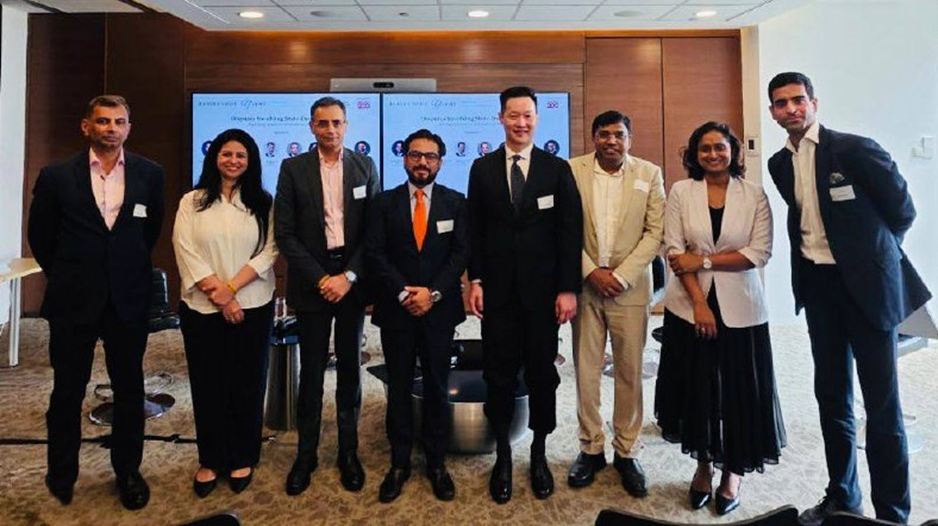
[In Picture Left to Right: A.J. Jawad, Purnima Kambalay, Raj Panchmatia, Sidharth Sethi, Daniel Cai, Shujath Bin Ali, Jayne Kuriakose and Montek Mayal]
Geopolitical changes are reshaping disputes involving States and SOEs
Opening the discussion, Jawad noted that the growing participation of SOEs in cross-border investment and commercial activity had made questions concerning the identity of the relevant State entity, allocation of responsibilities and eventual enforcement increasingly important.
Montek Mayal set the context by referring to increased government intervention in commercial activity, including developments involving supply chains, trade tariffs and energy markets. He said the panel would examine the commercial life cycle of disputes involving States and SOEs, beginning with the broader landscape before moving to risk allocation and the consequences when those risks materialise.
Purnima Kambalay observed that the strategic context in which States and SOEs operate had changed considerably. She pointed to the growing importance of natural resources and the strategic significance of particular jurisdictions. In her view, government policy and geopolitical considerations are increasingly relevant to how SOEs interact with one another and with private investors.
She contrasted this with what she described as the more regulatory and commercially driven environment of several years ago. According to Purnima Kambalay, investors now face greater uncertainty where commercial arrangements are affected by broader strategic or governmental considerations.
Multiple government touchpoints can create commercial and regulatory risk
Shujath Bin Ali discussed the practical experience of businesses dealing with SOEs and government agencies. He noted that a transaction may involve several government bodies even after a commercial agreement has been signed. These can include entities responsible for approvals, financing and other regulatory requirements.
He also referred to the effect of regulatory changes, trade sanctions and localisation measures on businesses whose initial investment decisions were based on a particular regulatory or commercial environment. A change in policy affecting, for example, the source of equipment could alter the assumptions underlying the investment and financing arrangements.
Jayne Kuriakose approached the issue from the perspective of a multinational enterprise. She explained that resilience had become increasingly important for large technology businesses following the pandemic and successive geopolitical disruptions. She identified data sovereignty and cybersecurity as two areas that had materially affected how technology businesses structure their operations and allocate capital.
She also noted that increasing restrictions on where data may be stored can require companies serving public-sector customers to maintain infrastructure within particular jurisdictions. This can increase costs and affect earlier investment decisions.
Dispute-resolution clauses should be considered before a dispute arises
The panel then turned to dispute-resolution provisions in contracts with States and SOEs.
Jayne Kuriakose said that, historically, dispute-resolution clauses had not always received the same level of attention during commercial negotiations. Experience with disputes under earlier contracts had changed that approach. She said her organisation now considers more carefully whether arbitration or litigation provides the more appropriate mechanism in a particular jurisdiction.
Among the considerations she identified were the availability of appellate review, the time and cost of proceedings and whether the process offered the desired level of fairness and transparency when the counterparty is a State or SOE.
Raj Panchmatia similarly cautioned against treating dispute resolution as an issue that can be addressed only once a transaction has gone wrong. He said businesses negotiating long-term contracts should consider what happens if the arrangement changes several years later.
He referred to provisions dealing with change in law, force majeure, termination, compensation and pricing adjustments as matters that may become important over the life of a long-term agreement.
Raj Panchmatia also noted the importance of considering the nature of the underlying commercial bargain where the counterparty is a government entity.
Not every risk can be allocated contractually
Shujath Bin Ali proposed a distinction between risks that can be allocated, those that can be mitigated, and those that may ultimately have to be accepted and priced. He explained that some regulatory or geopolitical risks cannot simply be transferred through contract. Businesses may instead need to engage with government authorities, assess probability and impact, and account for the risk in their commercial decisions.
The discussion also highlighted the practical limits of bargaining power in contracts with SOEs. Montek Mayal observed that businesses may sometimes receive contractual documents with limited scope for negotiation.
Purnima Kambalay said that, in India, dispute-resolution provisions in government and SOE contracts can sometimes take the form of standard clauses that do not adequately reflect the complexity of modern disputes. She referred to clauses combining mediation, arbitration and court proceedings, and stressed the need to pay closer attention to the drafting of the dispute-resolution mechanism.
Jawad added that questions concerning the use of mediation and arbitration in disputes involving public sector entities had also arisen at the policy level. He argued that the focus should be on how arbitration is managed rather than simply excluding it as a mechanism for resolving high-value disputes.
State capacity and power asymmetry complicate disputes
Sidharth Sethi examined the legal consequences of the power asymmetry that can arise when a private party contracts with a State or SOE.
He noted that the contractual counterparty may represent only one part of a wider governmental structure. Conduct affecting the transaction may originate with another ministry, regulator or public-sector undertaking. The resulting question is one of attributability: identifying which entity took the relevant decision, in what capacity, and what legal relationship connects that conduct to the State or SOE.
Sidharth Sethi also identified fragmentation of remedies and forums as a related difficulty. A contract may provide for arbitration, while conduct by another governmental entity may give rise to domestic or treaty-based avenues. A dispute arising from one sequence of events may therefore involve multiple respondents, causes of action and proceedings.
Commercial and sovereign capacities must be distinguished
Daniel Cai discussed the distinction between a State acting in a commercial capacity and acting through sovereign or regulatory powers.
He explained that a State may enter into a commercial contract and subsequently exercise regulatory powers that alter the conditions under which the transaction operates. This creates an important question concerning the legal remedies available to the affected party.
Daniel Cai also discussed the Singapore position, noting that Singapore courts apply the restrictive theory of State immunity and distinguish commercial acts from sovereign acts. He said businesses therefore need to consider the possibility of a State acting in different capacities when structuring their transactions.
Treaty protection as a second layer of protection
The panel then considered the role of investment treaties for foreign investors.
Daniel Cai described treaty protection as a potential second layer of protection, particularly where the underlying contract does not provide an adequate dispute-resolution mechanism or where harm results from regulatory action by a State entity other than the contractual counterparty. At the same time, he cautioned that treaty protection should not be treated as a substitute for careful contractual drafting.
Sidharth Sethi discussed the evolution of India’s investment treaty policy. He referred to India’s termination of a number of bilateral investment treaties following adverse awards in the mid-2010s and the adoption of the 2016 Model Bilateral Investment Treaty1 (BIT). He also discussed more recent treaty developments, including the India-UAE BIT2, in the context of the changing scope of investor-State dispute settlement.
Sidharth Sethi’s assessment was that India’s treaty policy was being recalibrated while retaining greater regulatory space. He also pointed to differences among newer investment agreements in the extent to which they provide for investor-State arbitration.
Montek Mayal noted that treaty arbitrations can involve substantial costs and observed that restrictions on third-party funding in certain jurisdictions could have implications for less-capitalised investors.
Arbitration may not always be the first strategic step
The panel also considered whether commencing arbitration immediately is always the best approach when the counterparty is a State or SOE.
Raj Panchmatia stressed that the answer depends on the client’s underlying business relationship. Where a company is heavily dependent on a particular SOE, immediately commencing proceedings may have commercial consequences beyond the dispute itself. He suggested that, where appropriate, parties may first explore whether the relevant government departments can resolve the issue or use existing contractual mechanisms.
The discussion therefore placed emphasis on dispute management, rather than treating arbitration as the automatic first response.
Evidence can become a major challenge in State-related disputes
Raj Panchmatia then examined evidentiary issues. He observed that parties may have access to the formal decisions and correspondence of State authorities without necessarily having access to the internal deliberations that led to those decisions.
He therefore stressed the importance of maintaining correspondence and creating a contemporaneous record of interactions with government departments. Where proceedings subsequently arise, such records can assist in establishing the sequence of events and the parties’ respective positions.
Jayne Kuriakose discussed document preservation from the corporate perspective. She explained that mature legal teams may employ legal-hold processes to preserve emails and other records, particularly where project personnel change before a dispute has been resolved.
She also identified challenges in explaining the way large multinational corporations account for revenue, margins and profits when loss-of-profit or loss-of-chance claims arise. In her view, differences between corporate accounting practices and the way those figures are understood in arbitration can create difficulties for counsel, experts and tribunals.
Liability is only the beginning of the damages analysis
Daniel Cai observed that establishing a breach does not resolve the question of damages. He identified three principal issues: valuation date, causation and methodology.
In an expropriation dispute, for example, the choice between the date of the State’s intervention and the date of the award can affect the resulting valuation. He also stressed the need to establish that the claimed loss resulted from the relevant conduct of the State or SOE rather than from wider market conditions.
Montek Mayal similarly emphasised the importance of addressing valuation questions at an early stage. He referred to the interaction between State conduct, country-risk assumptions and damages calculations and noted that these issues can become particularly significant in volatile markets.
The position of States as claimants also deserves attention
Sidharth Sethi noted that the analysis should not be confined to disputes in which the private investor is the claimant. He distinguished between investor-State arbitration and ordinary commercial arbitration involving an SOE.
In a contractual arbitration, an SOE may itself be pursuing a claim against a private company. He noted that such cases can raise their own enforcement concerns, particularly where the private counterparty has limited assets or becomes insolvent. He also referred to counterclaims in investor-State proceedings, subject to the applicable treaty or contract and the relevant connection with the investment.
Enforcement remains a practical concern
The final part of the session addressed enforcement of awards against SOEs.
Responding to an audience question, Raj Panchmatia said that enforcement strategy can differ when the award debtor is a State-owned entity. Among the issues requiring consideration, he identified whether the entity participated in the relevant commercial contract and arbitration, and whether the circumstances permit an argument based on State immunity to be maintained.
Jayne Kuriakose highlighted the significance of court procedures requiring deposits in certain circumstances when an award is challenged. From an in-house perspective, she described this as a feature of Indian arbitration that can have practical advantages for an award creditor, while also recognising the corresponding financial burden on a party challenging the award.
From dispute resolution to dispute prevention
In the concluding round, the panellists were asked to identify issues that should receive greater attention in the coming years.
Sidharth Sethi pointed to a possible shift towards dispute avoidance, prevention and management, with mediation potentially playing a larger role.
Raj Panchmatia emphasised the importance of enabling government officials to resolve disputes where appropriate and suggested greater availability of information about the dispute history of SOEs so that potential contracting parties can make more informed decisions.
Purnima Kambalay highlighted the need for greater stability in commercial contracts and referred to the importance of investor education and the availability of information when disputes arise.
The discussion therefore closed on a broader question than the conduct of arbitration itself: how commercial parties, governments and dispute-resolution professionals can identify and manage risks before they develop into formal disputes. The panel’s discussion ranged from contract drafting and State capacity to treaty protection, evidence, valuation and enforcement, reflecting the multiple legal and commercial dimensions of disputes involving States and SOEs.
1. In 2016 India launched 2016 Indian Model BIT to be used as a template for future BITs.
2. A Bilateral Investment Treaty BIT signed on 13th February, 2024 at Abu Dhabi, United Arab Emirates (UAE) between the Indian Government and the Government of UAE, w.e.f. 31st August, 2024.