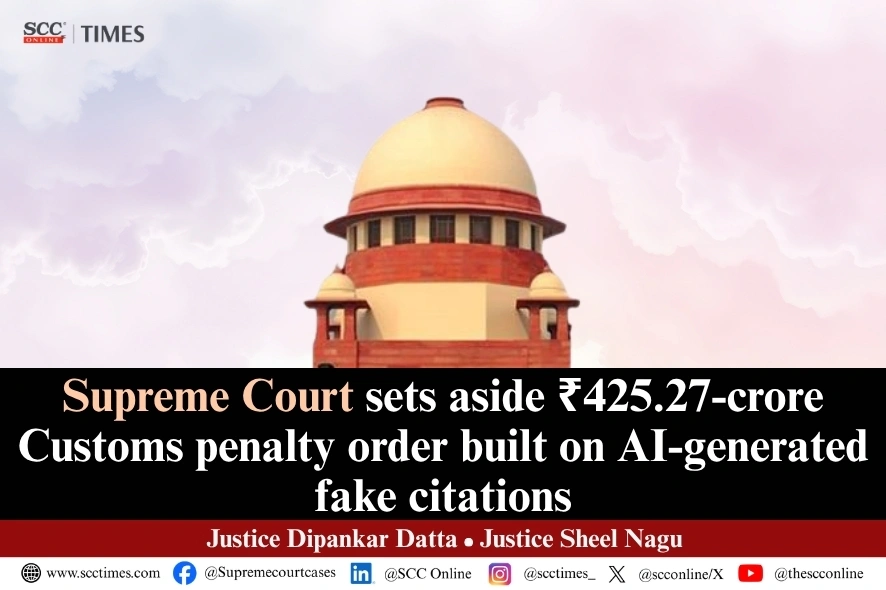
Supreme Court: In a case concerning imposition of penalty under Section 114, Customs Act, 1962 for misdeclaration of natural diamonds as lab-grown diamonds, a Division Bench of Dipankar Datta* and Sheel Nagu, JJ., held that reliance upon non-existent case laws, fake citations and AI-hallucinated ratios proved fatal to the sustainability of the order-in-original. The Court observed that while use of artificial intelligence (AI) as an assistive tool to speed up the decision-making process could not be denied, “assistance can never be substituted for adjudication” and entrusting AI with “the pilot’s seat” would be “both imprudent and dangerous”. Finding that the respondent had relied upon dubious material in the Order-in-Original dated 8 October 2025 imposing a penalty of ₹425,27,99,100 on the appellant, the Court set aside the impugned order of the Gujarat High Court dated 20 January 2026 as well as the Order-in-Original. The proceedings were revived for fresh adjudication by an officer of the same rank other than the officer who had passed the original order. The civil appeal was accordingly allowed.
Background
The present appeal arose out of an Order-in-Original dated 8 October 2025 passed by the Additional Commissioner of Customs, Surat, imposing a penalty of ₹425,27,99,100 on the appellant under Section 114, Customs Act, 1962, for misdeclaring a consignment of natural diamonds as lab-grown diamonds to pay a lower tariff. The challenge to the said penalty before the Gujarat High Court failed, as the appeal was dismissed vide order dated 20 January 2026. The said order of the High Court was impugned before the Court.
Analysis
The Court held that entering into the merits of the challenge was unnecessary, since the appellant contended that several judgments and articles cited by the respondent in the Order-in-Original dated 8 October 2025 had been generated using artificial intelligence.
Upon individually verifying the judgments and articles, the Court found that the respondent had relied upon case laws which were either non-existent or had fake citations. Further investigation also revealed that some of the case laws relied upon, though they did exist, did not lay down the ratio deduced therefrom and appeared to be a hallucination of AI.
The Court referred to Pooja Ramesh Singh v. Jammu & Kashmir Bank Ltd., 2026 SCC OnLine SC 1258, which dealt with the use of AI in judgments and wherein the Court had observed that, “It is necessary for courts to adopt a zero-tolerance mode for producing, citing or using artificial intelligence-generated precedents without verification. It is a misconduct on the part of an advocate to cite such judgments without verification. Equally, it is a serious lapse if a judge relies on such a fake or hallucinated artificial intelligence-generated material as precedents in support of the determination. We have no hesitation in declaring that such a decision is no decision in the eyes of the law, irrespective of whether such material had a direct or indirect bearing on the decision-making. Such decisions are to be set aside even if an iota of fake or hallucinated material enters the decision-making process, as it would violate the sanctity of adjudication.” It further noted that the Court had recently released the draft Regulations for use of Artificial Intelligence in Courts, 2026, inviting comments and suggestions.
The Court observed that use of AI as an assistive tool to speed up the decision-making process could not be denied. However, it sounded a note of caution:
“Assistance can never be substituted for adjudication. AI may well serve as training wheels but entrusting it with the pilot’s seat would be both imprudent and dangerous.”
Decision
The Court held that the use of AI in the present case, resulting in reliance being placed on material which was dubious, proved fatal to the sustainability of the order imposing penalty.
Consequently, the impugned order of the Gujarat High Court confirming the penalty was set aside along with the Order-in-Original dated 8 October 2025. The proceedings against the appellant were revived for being decided afresh by an officer of the same rank other than the officer who had passed the original order.
The civil appeal was allowed and pending applications, if any, were disposed of. The Court left it to the wisdom of the appointing authority to initiate such action against the author of the Order-in-Original dated 8 October 2025 as may be warranted in the circumstances, in accordance with law.
Also Read: SC on AI Hallucinated Judgments and Fake Citations | SCC Times
[Vijay Ghanshyam Gadiya v. Union of India, 2026 SCC OnLine SC 1741, decided on 2-9-2026]
*Judgement authored by: Justice Dipankar Datta