Following a series of significant institutional initiatives, the Gujarat High Court Arbitration Centre (Domestic & International) (GHAC) is set to convene GHAC Arbitration Week 2026, a landmark three-day programme bringing together the judiciary, Bar, business and industry, law firms, and arbitrators to deliberate on the future of institutional arbitration in Gujarat.
Scheduled from 4 September to 6 September 2026 at the GIFT City Club, Gandhinagar, the programme will be preceded by a distinguished Opening Ceremony on 3 September 2026.
A significant milestone: GHAC’s institutional arbitration conference and foundation stone laying
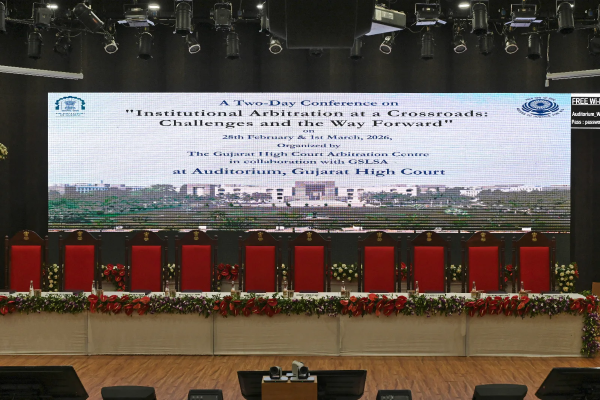
The Arbitration Week comes at an important stage in GHAC’s institutional journey. Earlier this year, GHAC in collaboration with the Gujarat State Legal Services Authority (GSLSA) and under the aegis of the High Court of Gujarat, organised a two-day programme on 28 February and 1 March 2026 at the Gujarat High Court Auditorium, Sola, Ahmedabad.
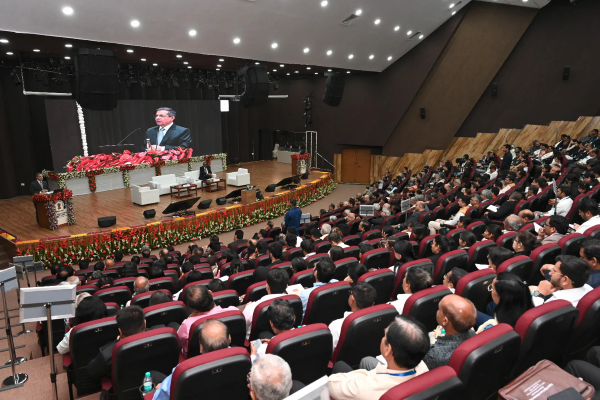
The programme marked the foundation stone laying of its new state-of-the-art building at the Gujarat High Court Auditorium, Sola, Ahmedabad, alongside a conference on “Institutional Arbitration at a Crossroads: Challenges & the Way Forward”, the release of its newsletter and the launch of its redesigned website.
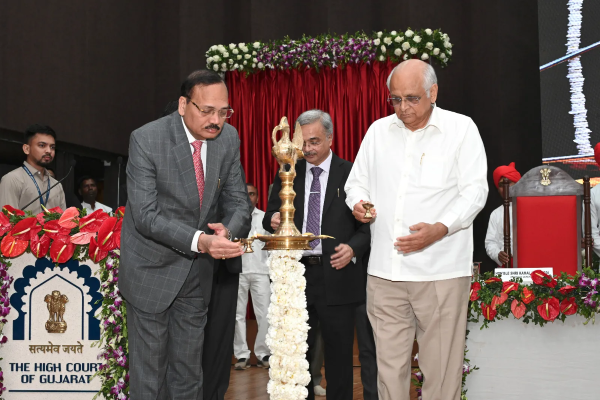
The Foundation Stone Laying Ceremony was inaugurated by Justice Surya Kant, Chief Justice of India, and Shri Bhupendrabhai Patel, Chief Minister of Gujarat.
Foundation Laying of Arbitration Centre at Gujarat High Court — Watch Here
Conference — Day 1 — Watch Here
Conference — Day 2 — Watch Here
A distinguished gathering
The programme was attended by several distinguished members of the judiciary and government, including:
-
Justice Aravind Kumar, Judge, Supreme Court of India
-
Justice N. V. Anjaria, Judge, Supreme Court of India
-
Justice Vipul M. Pancholi, Judge, Supreme Court of India
-
Shri Harsh Sanghavi, Deputy Chief Minister, State of Gujarat
-
Justice Sunita Agarwal, Patron-in-Chief, GHAC & GSLSA and Chief Justice, High Court of Gujarat
-
Justice A. Y. Kogje, Judge, High Court of Gujarat, President, GHAC & Executive Chairman, GSLSA
-
Justice A. S. Supehia, Judge, High Court of Gujarat and Chairperson, Gujarat Legal Services Committee
-
Shri Kaushik Vekariya, Minister of State for Law & Justice, State of Gujarat
The significance of these developments extends beyond the establishment of new infrastructure. Together, they reflect GHAC’s efforts to strengthen its institutional identity, expand its engagement with the arbitration community, and create a stronger foundation for the future of institutional dispute resolution in Gujarat.
GHAC Arbitration Week 2026 now seeks to carry this momentum forward, from strengthening institutional foundations to fostering a more connected and collaborative arbitration ecosystem.
From institutional foundations to a shared vision
The theme of GHAC Arbitration Week 2026, “Building Gujarat’s Institutional Arbitration Ecosystem,” reflects a broader vision for the future of dispute resolution in the State.
Gujarat’s expanding commercial, industrial, and infrastructure landscape has created a growing need for dispute-resolution mechanisms that are efficient, predictable, credible, and responsive to the requirements of modern commerce.
Institutional arbitration can play a critical role in meeting this need by providing structured processes, professional administration, and greater certainty for parties.
Against this backdrop, Arbitration Week is envisioned as more than a conventional legal conference. It seeks to create a space where different perspectives can come together, allowing the arbitration community to examine not only the challenges before institutional arbitration but also the opportunities for its growth.
Three Days. Three Stakeholders. One Vision.
GHAC Arbitration Week 2026 is designed as a meeting point for the diverse stakeholders who shape the practice and future of arbitration. The programme seeks to foster meaningful engagement among the key participants of the arbitration ecosystem and provide a platform for diverse perspectives on the evolving landscape of institutional arbitration.
The Arbitration Week will facilitate conversations among advocates and arbitration practitioners, businesses and in-house legal teams, law firms and industry representatives, and arbitrators creating space for perspectives from across the dispute-resolution landscape.
By connecting these perspectives, GHAC aims to encourage a more cohesive approach to institutional arbitration, one where institutions, practitioners and users can collectively contribute to building a stronger and more responsive arbitration ecosystem in Gujarat.
The objective is to move beyond theoretical discussions and explore the practical steps required to make institutional arbitration more accessible, effective, and trusted.
Building on GHAC’s institutional journey
GHAC Arbitration Week 2026 follows a year of important institutional developments for the Gujarat High Court Arbitration Centre.
The foundation stone laying ceremony for GHAC’s new state-of-the-art building, held earlier this year, represented an investment in the physical infrastructure required to support the Centre’s expanding role.
The accompanying conference on “Institutional Arbitration at a Crossroads: Challenges & the Way Forward” brought the challenges facing institutional arbitration into focus.
The release of GHAC’s newsletter and launch of its redesigned website further strengthened the Centre’s efforts towards knowledge dissemination, digital accessibility and engagement with the wider arbitration community.
Arbitration Week carries this momentum forward by shifting the focus towards broader professional engagement and sustained dialogue among the stakeholders who influence the future of arbitration.
The larger vision
A successful institutional arbitration ecosystem depends on more than the existence of arbitral institutions. It requires the confidence and participation of the wider community, including courts, counsel, businesses, arbitrators, institutions, and policymakers.
For Gujarat, this assumes particular significance given the State’s prominent position in commerce, industry, infrastructure, and international business. A robust institutional arbitration framework can contribute to greater commercial confidence by offering parties an efficient, credible and professionally administered avenue for resolving disputes.
GHAC Arbitration Week therefore seeks to advance a shared vision of arbitration that is efficient, fair, transparent, accessible, and cost-effective.
Looking ahead
GHAC Arbitration Week 2026 represents the next step in an institutional journey that has already seen significant developments, from the creation of dedicated infrastructure to strengthening the Centre’s digital and knowledge platforms.
As leading voices from the judiciary, legal profession, business community and international arbitration fraternity converge in Gandhinagar, the Arbitration Week offers an opportunity to ask not simply where institutional arbitration stands today, but where it needs to go next.
Over three days, the programme will seek to transform dialogue into greater understanding, collaboration and institutional confidence, contributing towards the larger vision of building Gujarat into a strong and credible hub for domestic and international institutional arbitration.