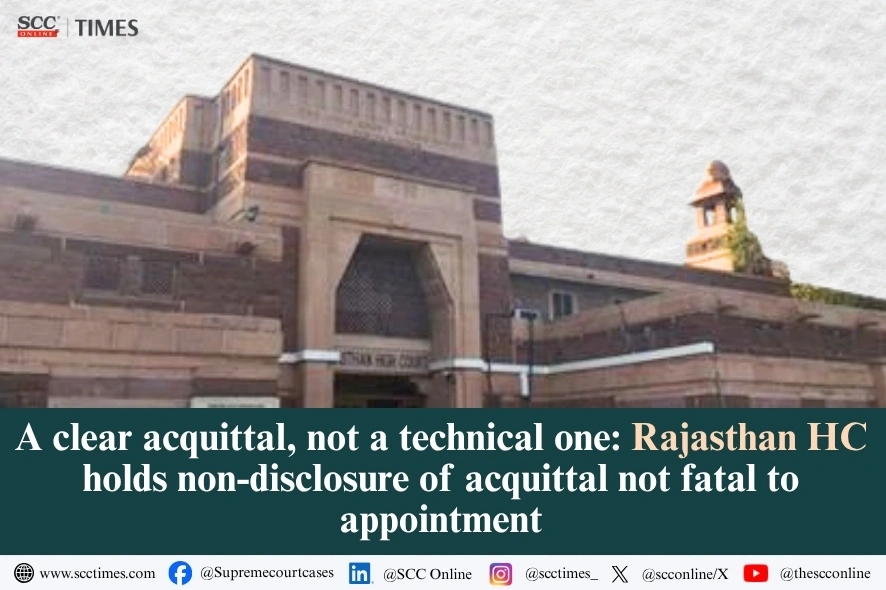
Rajasthan High Court: In a civil writ petition, filed against the order passed by Central Administrative Tribunal (CAT), affirming the rejection of the candidature of petitioner for the post of Travelling Ticket Examiner (TTE) on the sole ground of non-disclosure of prior criminal proceedings, a Division Bench of Anuroop Singhi* and Munnuri Laxman, JJ., set aside the order passed by CAT holding that the rejection of candidature of the petitioner by the respondents was bad in law as no criminal proceedings were pending against the petitioner and he was acquitted prior to the commencement of the recruitment process, especially when the acquittal of the petitioner was neither on technical grounds nor on account of reasonable doubt but a clear acquittal. The Court held that the order was contrary to law propounded in Avtar Singh case, therefore, directed the respondents to grant appointment to the petitioner with notional benefits.
Background
The respondents conducted a recruitment process for the post of TTE. Upon qualifying the examination, the petitioner was selected and was allotted Bikaner Division. While document verification and submission of attestation form before joining, where particulars related to any criminal case, arrest or prosecution were required to be disclosed, the petitioner did not disclose that in the year 2002, a criminal case was registered against the petitioner for offences under Sections 419, 420, 467, 468 and 471, Penal Code, 1860, where he was acquitted by the competent court in 2009, prior to the date of issuance of advertisement for recruitment in the year 2010.
The petitioner was not called for medical examination on the ground of non-disclosure of facts pertaining to the criminal case. His representation was rejected which stated that he was under a bona fide impression that as he was acquitted in the sole criminal case registered against him in 2009, prior to the issuance of advertisement and his participation in the written examination, it had no significance and only under this presumption the said disclosure was not made, thus rejecting his candidature in 2015 on the sole ground of non-disclosure of criminal case in the attestation form.
The petitioner challenged the rejection of candidature before CAT where the order of rejection was affirmed. Hence, challenging the same, this petition was filed.
Analysis and Decision
The Court took note of the fact that when the petitioner filled the application form in 2010, there was no criminal case pending against him. The attestation form required the petitioner to furnish specific information with respect to prior criminal proceedings which the petitioner denied. It was an admitted fact that on the date of filling of the attestation form, not only no such criminal proceedings were pending against the petitioner but he was even acquitted way back in the year 2009, so a mechanical rejection of the candidature of the petitioner, solely on the ground of non-disclosure of prior criminal proceedings, would be contrary to the law propounded by the Supreme Court in Avtar Singh v. Union of India, (2016) 8 SCC 471.
The Court observed that the respondents failed to apply their mind and the principles enunciated in the Avtar Singh case while rejecting the candidature of the petitioner solely on the ground of non-disclosure of information regarding criminal case.
The Court took note of the case of State of U.P. v. Dinesh Kumar, 2026 SCC OnLine SC 52, cited by respondents, where it was held that once a candidate withholds an information, such suppression would make him ineligible for appointment in public service where honesty and transparency are indispensable attributes and justify a far stricter view by the authorities. The Court distinguished the case on facts stating that in the said case, the investigation in the criminal case was pending at the time of filing of the affidavit and thus, the facts are distinguishable from the case in hand as here the petitioner was already acquitted 6 years prior to the filling of the attestation form. Therefore, the case is not applicable to the present case.
The Court also relied on Ravindra Kumar v. State of U.P., (2024) 5 SCC 264, where the Supreme Court held that non-disclosure of an acquitted criminal case is not a hard-and-fast bar to employment and that “broad-brushing every non-disclosure as a disqualification” would be unjust, each case must be assessed on its own facts and circumstances.
Applying the principles of Avtar Singh case, the Court held that the rejection of candidature of the petitioner by the respondents was bad in law, specially when the acquittal of the petitioner was neither on technical grounds nor on account of reasonable doubt but a clear acquittal, which the respondents neglected.
The Court observed that the impugned order did not record any finding with respect to the non-applicability of the principles laid down in Avtar Singh case. Moreover, the petitioner pursued his case immediately after his rejection by the respondents, thus, the petitioner cannot be denied relief on the ground of delay or subsequent events, as it is more than settled that pendency of proceedings cannot adversely prejudice the entitlement of the petitioner.
Therefore, the Court set aside the impugned order passed by CAT and directed the respondents to grant appointment to the petitioner on the post of TTE with notional benefits, by creating supernumerary post if the post was already filled.
The Court clarified that while the petitioner is entitled to notional benefits including seniority, he will not be entitled to arrears of salary for the period during which he did not serve.
[Ajmer Singh v. Union of India, 2026 SCC OnLine Raj 5074, decided on 30-7-2026]
Judgment authored by: Justice Anuroop Singhi
Advocates who appeared in this case:
For Petitioner: Shreyash Ramdev
For Respondents: Vaibhav Bhansali, BP Bohra