


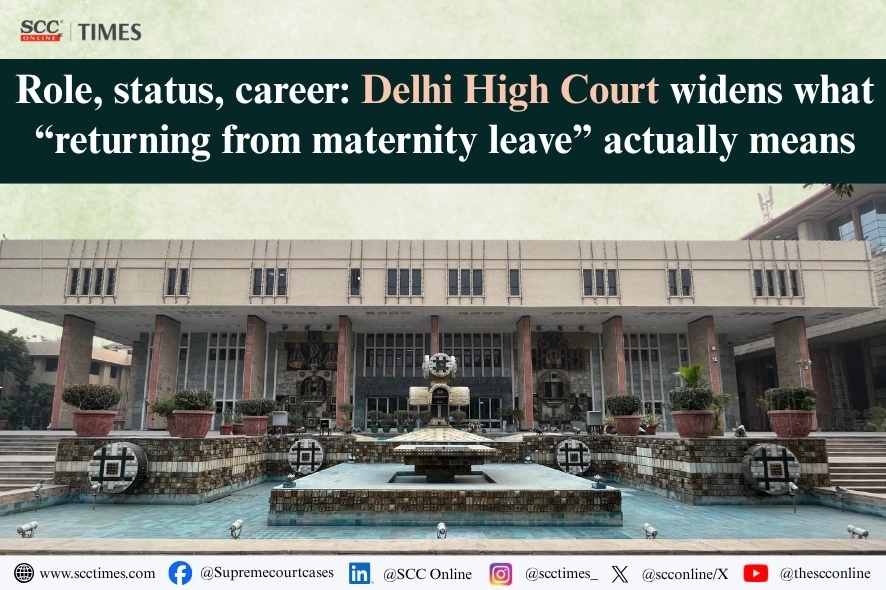
Delhi High Court: In a significant ruling on maternity protection in private employment, a Single Judge Bench of Sachin Datta, J. declared that the prohibition under Section 12(1), Maternity Benefit Act, 1961 and Section 68(1), Code on Social Security, 2020 against varying a woman’s conditions of service to her disadvantage during her statutorily protected absence is not limited to termination of employment or reduction in salary/designation. It extends to the substantive incidents of employment, including the nature of duties, grade, functional status, reporting hierarchy, supervisory responsibilities, and opportunities for appraisal and promotion.
The Court held that a woman returning from maternity leave is ordinarily entitled to restoration to the post held immediately before such leave. Where that post is no longer available for bona fide and demonstrable organisational reasons, she must be placed in a position as nearly equivalent as possible in terms of pay, grade, status, role, responsibilities, managerial authority and prospects of advancement.
In such circumstances, the employer must, before the employee resumes duty, communicate the reasons for the non-availability of her previous post and the particulars of the alternative position, including its grade, remuneration, reporting relationship and duties. Any objection raised by the employee must be duly considered and addressed through a reasoned communication.
The Court clarified that a woman may herself seek adjustments to her duties, hours, place or pattern of work, or an alternative role, having regard to her post-maternity circumstances. Such an arrangement shall not amount to consent to any diminution of her service conditions or waiver of statutory protection, nor shall it be held against her in appraisal, increments or promotion. She may seek restoration to her previous or equivalent position once the circumstances necessitating the adjustment cease.
The Court directed Respondent 2 to pay the petitioner ₹10 lakh as compensation and ₹1.50 lakh as costs within 8 weeks, failing which the amounts would carry 9 per cent per annum interest until realisation.
The Court further directed the Union Government to exercise its powers under Sections 149, 150 and 154, Code on Social Security, 2020 to frame rules, schemes or directions for effective implementation of maternity protections, including pregnancy-related accommodation, protection of role and status upon return from maternity leave, lactation support, crèche disclosure and functionality, grievance timelines, protection against retaliation, and designation of competent authorities for complaints and interim relief. The exercise was directed to be completed within 6 months.
Background
The petitioner, a Chartered Accountant with approximately 14 years of professional experience, was appointed as Manager—Accounting by Respondent 2 at a monthly salary of ₹2.60 lakh. After informing her employer of her pregnancy in May 2023, she was transferred to another team and subsequently proceeded on maternity leave in December 2023. Upon returning to work in July 2024, she was informed that her earlier position was no longer available and was assigned to the Treasury Department.
The petitioner alleged that the new assignment was substantially inferior to her previous managerial role, as it deprived her of supervisory responsibilities and managerial exposure. She further alleged that while her male counterparts were promoted, she was not restored to her earlier position. She also raised a grievance regarding the employer’s failure to provide a functional crèche facility.
The employer denied any demotion or discrimination, maintaining that the petitioner’s designation, salary, seniority, and managerial level remained unchanged. It contended that the reassignment was necessitated by organisational restructuring following a corporate acquisition and that the Treasury responsibilities assigned to her were commensurate with her experience and managerial level. The employer also challenged the maintainability of the writ petition, contending that the dispute arose from a private contract of service and that an alternative statutory remedy was available.
Analysis and Decision
Rejecting the objection to maintainability, the Court held that although Respondent 2 was a private commercial entity and ordinary incidents of a contractual employment relationship ordinarily fall outside Article 226 jurisdiction, the present petition sought enforcement of statutory obligations under Section 12, Maternity Benefit Act, 1961, which operate independently of and notwithstanding the terms of the employment contract by virtue of Section 27, Maternity Benefit Act, 1961. The Court held that a writ petition is maintainable against a private employer for enforcement of such statutory obligations. It further held that the availability of an alternative remedy was not an absolute bar, particularly where the petition raised issues implicating fundamental rights under Articles 14, 15 and 21 and where the statutory implementation mechanism under the Code on Social Security, 2020 had not yet been fully framed.
Interpreting Section 12(1), Maternity Benefit Act purposively, the Court held that the expression “vary to her disadvantage any of the conditions of her service” is of wide import and is not confined to dismissal, discharge or reduction in wages. It encompasses adverse changes in the substantive incidents of employment, including diminution of managerial or supervisory authority, reassignment to an inferior role, withdrawal of significant responsibilities, denial of promotional opportunities and impairment of professional growth. The Court cautioned that an employer cannot achieve indirectly what the statute prohibits directly by retaining an employee’s salary and designation while substantially diminishing the responsibilities, authority, status or career prospects attached to her position. Such formal or cosmetic compliance, the Court held, would defeat the object of the Maternity Benefit Act, which is a beneficial social welfare legislation intended to protect the dignity of motherhood, economic security and continued participation of women in the workforce.
The Court further located maternity protection within the constitutional guarantees of equality, non-discrimination, dignity, reproductive autonomy and humane conditions of work under Articles 14, 15, 21 and 42. It held that adverse employment treatment arising from pregnancy or maternity constitutes sex-based discrimination and that employment practices which penalise a woman for exercising her maternity rights, or effectively compel her to choose between motherhood and professional advancement, implicate Article 21.
Drawing upon K. Umadevi v. State of T.N., (2025) 8 SCC 263, Hamsaanandini Nanduri v. Union of India, 2026 SCC OnLine SC 402, MCD v. Female Workers (Muster Roll), (2000) 3 SCC 224 and other precedents, the Court emphasised that maternity protection is not merely a statutory benefit but forms part of the Constitutional commitment to dignity, equality, social justice and reproductive autonomy.
The Court also relied upon international standards, particularly Convention on the Elimination of All Forms of Discrimination Against Women (CEDAW) and the ILO Maternity Protection Convention, 2000, to reinforce the interpretation of domestic law. It noted that CEDAW requires maternity leave without loss of former employment, seniority or social allowances, while the ILO Convention recognises a woman’s right to return to the same or an equivalent position at the same rate of pay. Referring also to the statutory frameworks in the United States, Australia and the United Kingdom, the Court observed that modern maternity jurisprudence increasingly recognises continuity of role, status, responsibilities, seniority and career progression as integral components of maternity protection. In the Court’s view, although Indian legislation does not expressly codify a right to reinstatement to the same or an equivalent position after maternity leave, the constitutional and statutory framework, read purposively, substantially supports such protection.
On the facts, the Court found the employer’s explanation materially inconsistent. The employer’s own records indicated that the petitioner’s earlier position had been given to another employee during her maternity leave and that, shortly before her return, management was seeking to identify “something” or “anything” that could be assigned to her. The Court noted that no contemporaneous consideration appeared to have been given to securing a role commensurate with her qualifications, experience and seniority; she was neither consulted before her earlier position was filled nor given a reasoned written explanation regarding the change. The Court, while refraining from conclusively determining whether the Treasury role was objectively equivalent to her previous role, holding that such an evidentiary enquiry was not appropriate in writ proceedings, nevertheless found that the admitted facts demonstrated unfair treatment. It observed that the petitioner had effectively been treated as “spare capacity”, to be placed wherever work could be found for her.
The Court additionally found that Respondent 2 was in contravention of Section 11-A, Maternity Benefit Act, 1961, which requires establishments having 50 or more employees to provide a crèche facility. The employer’s own pleadings indicated that although a facility existed, it was not functional when required by the petitioner. The Court held that a non-functional crèche does not satisfy the statutory obligation.
Holding that maternity protection is not exhausted upon grant of maternity leave and payment of benefits, the Court declared that a woman returning from maternity leave is ordinarily entitled to restoration to the position held immediately before such leave. Where that position is genuinely unavailable for bona fide and demonstrable organisational reasons, she must be placed in a position as nearly equivalent as possible in terms of pay, grade, status, role, responsibilities, managerial authority and prospects of advancement. The employer must intimate the reasons for the non-availability of the earlier post and the particulars of the alternative position before the employee resumes duty, and any objection raised by her must be considered and answered through a reasoned communication.
The Court further clarified that a woman may herself seek adjustments in duties, hours, place or pattern of work or an alternative role owing to post-maternity circumstances, but such accommodation cannot be treated as consent to diminution of service conditions or be held against her in appraisal or promotion.
Recognising the absence of a comprehensive statutory framework governing post-maternity reintegration, the Court directed the Union of India to exercise its powers under Sections 149, 150 and 154, Code on Social Security, 2020 and, after appropriate consultation, frame rules or schemes or issue directions dealing with pregnancy-related accommodation, protection of role and status upon return from maternity leave, lactation support, crèche functionality, grievance timelines, protection against retaliation and designation of competent authorities. The exercise was directed to be completed within 6 months.
The Court also identified guiding principles including prior consultation before significant changes during maternity leave, protection against disadvantageous variation of service conditions, protection of appraisal and promotion, and safeguards against retaliation.
As to relief, although the petitioner’s prayers for reinstatement and appointment of an expert committee had become infructuous after she voluntarily resigned and joined Snap Inc. as an Accounting Manager, the Court held that a wrong had nevertheless been committed and that an appropriate remedy was required. The petitioner had originally sought ₹50 lakh in her writ petition for mental and emotional harassment, though her legal notice had earlier claimed ₹1.5 lakh. Exercising its power under Article 226 to mould relief, the Court ultimately awarded the petitioner ₹10 lakh as compensation for the indignity, loss of professional standing, anxiety, diminution of professional standing and eventual relinquishment of employment suffered by her, along with ₹1.50 lakh towards costs. The amounts were directed to be paid within 8 weeks, failing which they would carry interest at 9 per cent per annum from the date of judgment until realisation.
The petition was accordingly disposed of.
[Rakhi Bisht v. Union of India, 2026 SCC OnLine Del 6715, decided on 31-8-2026]
Advocates who appeared in this case:
For the Petitioner: Ms. Parul Singh, Advocate, along with Mr. Kunal Kher and Ms. Harshita Jain, Advocates.
For the Respondents: Mr. Ashish Dixit, CGSC, along with Mr. Umar Hashmi, Mr. Gautam Yadav and Ms. Iqra Sheikh, Advocates, for Respondent No. 1.
Ms. Mumtaz Bhalla and Ms. Prapti Allagh, Advocates, for Respondent No. 2.
Amicus Curiae: Mr. Sanjeev Mahajan, Advocate (Amicus Curiae), along with Ms. Simran Rao, Advocate.





