


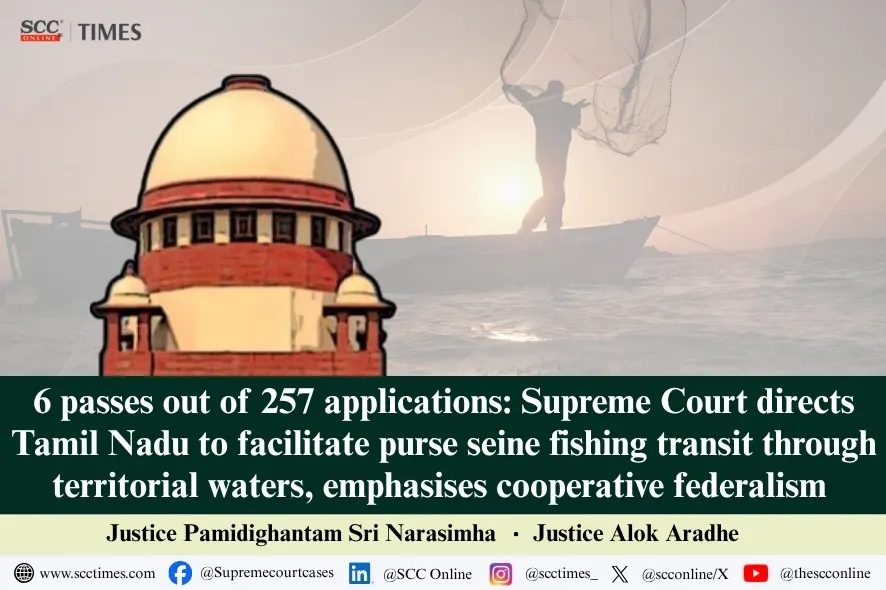
Supreme Court: In a case concerning the right of fishermen using purse seine nets to access the exclusive economic zone (EEZ) beyond Tamil Nadu’s territorial waters, a Division Bench of Pamidighantam Sri Narasimha and Alok Aradhe, JJ., held that the Union and State regulatory regimes operate in distinct and autonomous spheres, with the Union competent to regulate fisheries beyond territorial waters and the State competent to regulate fisheries within territorial waters. Emphasising “cooperative federalism”, the Court held that there was no conflict between the Sustainable Harnessing of Fisheries in the Exclusive Economic Zone Rules, 2025 and the Tamil Nadu Marine Fishing Regulation Rules, 2020. Noting that delay in processing access pass applications virtually amounted to an “unwritten ban”, the Court directed the State to ensure timely clearance of applications and frame necessary regulations designating a channel for transit of fishing vessels through its territorial waters to the EEZ for purse seine fishing.
Background
The issue before the Court was concerning the right of fishermen using purse seine nets to access the EEZ beyond the territorial waters of the State of Tamil Nadu. In 1983, the State of Tamil Nadu enacted the Tamil Nadu Marine Fishing Regulation Act, 1983 under List II Entry 21 of Schedule VII to the Constitution. Section 3(k) defined “specified area” as the sea along the coastline of the State, but not beyond its territorial waters; Section 5 empowered the State Government to regulate, restrict or prohibit fishing activities in such specified area, while Section 7 required fishing vessels to obtain a licence to fish therein. In exercise of these powers, the State Government issued GO Ms. No. 40 dated 25 March 2000, prohibiting fishing with purse seine nets within the territorial waters for conservation of juvenile fishing stock, which was subsequently sought to be enforced through the Tamil Nadu Marine Fishing Regulation Rules, 2020.
The grievance of the fishermen was that the State was invoking the 2020 Rules to prevent them from even carrying purse seine nets on their vessels while proceeding beyond 12 nautical miles to undertake fishing in the EEZ, which, according to them, fell outside the regulatory domain of the State. The State, per contra, contended that carrying purse seine nets on a fishing vessel itself constituted a violation under Rule 17(7), as the vessels could use such nets within the territorial waters while proceeding towards the EEZ, thereby making enforcement of the prohibition difficult. The ban under the 2000 GO had earlier been upheld by the Madras High Court by judgment dated 20 April 2021. During the pendency of the special leave petition challenging the said judgment, the applicants approached the Supreme Court under Article 32 seeking permission to undertake fishing with purse seine nets beyond the territorial waters of Tamil Nadu.
Analysis
The Court noted that, pursuant to its order dated 24 August 2022, an Expert Committee was constituted to examine the impact of purse seine nets on fish population in the EEZ, address the grievances of stakeholders and facilitate a national consensus. The Committee’s interim report found that purse seine nets did not cause any major environmental harm to fishing stocks, though effective regulation was necessary. Its final report recommended, inter alia, special annual permits for vessels intending to transit through Tamil Nadu’s territorial waters to fish in the EEZ, spatial, temporal and technical regulations, implementation of a Vessel Monitoring System (VMS), mandatory catch reporting and a centralised National Permit System. Taking note of these recommendations, the Union Government notified the Sustainable Harnessing of Fisheries in the Exclusive Economic Zone Rules, 2025 (EEZ Rules, 2025), providing for an “access pass” for fishing in the EEZ and prescribing a regulatory framework for sustainable fishing.
The Court held that there are 2 distinct legal regimes operating in 2 regulatory provinces — the EEZ Rules, 2025 governing fishing activities in the EEZ and the Tamil Nadu Marine Fishing Regulation Rules, 2020 governing fishing activities within the territorial waters. There is no conflict between the 2 regimes, as the power to regulate fisheries beyond territorial waters falls under Entry 57, List I and lies within the legislative and executive competence of the Union, whereas regulation of fisheries in territorial waters falls under Entry 21, List II and within the competence of the State. The powers of the Union and the State are co-equal and autonomous within their respective legislative spheres. Emphasising the principle of cooperative federalism, the Court observed that both administrations are duty bearers to implement the respective regulations and ensure easy access and efficient clearance of applications to pursue the fundamental right under Article 19(1)(g), subject to reasonable regulations.
On the practical aspect, the Court found the status of applications for access passes as on 3 August 2026 “rather disturbing”. Out of 257 applications, 226 were pending verification by the State of Tamil Nadu and only 6 access passes had been issued. This figure was noted to be the lowest recorded among all coastal states. The Court held that non-processing of applications in time virtually amounted to imposing an unwritten ban, which was impermissible in law, and accordingly directed the State to ensure effective, efficient and timely clearance of applications.
Also Read: Sustainable Harnessing of Fisheries in the Exclusive Economic Zone Rules, 2025 | SCC Times
Decision
Consequently, the Court disposed of the IA by directing that:
-
The rights and liabilities of the parties would be governed by the relevant laws, the EEZ Rules, 2025 and the Tamil Nadu Marine Fishing Regulation Rules, 2020.
-
The State Government to frame necessary rules/regulations designating a specified channel under Rule 15(5) and (6), 2020 Rules for transit of vessels through its territorial waters to the EEZ for fishing using purse seine nets, taking into account the final recommendations of the Expert Committee.
[Fisherman Care v. Union of India, 2026 SCC OnLine SC 1749, decided on 2-9-2026]





