


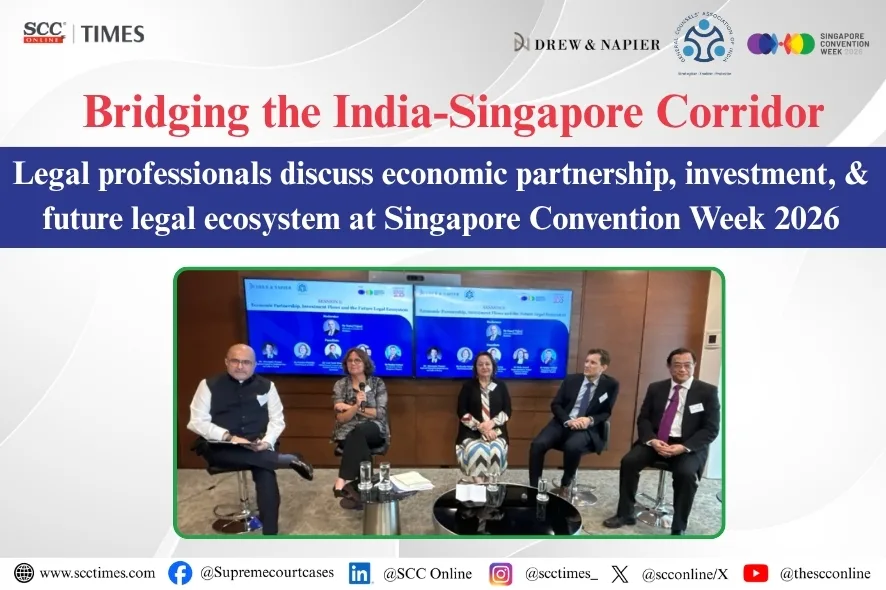
On the occasion of the Singapore Convention Week 2026, the General Counsels’ Association of India (GCAI) and Drew & Napier LLC organised a partner event titled “India-Singapore Legal Bridge— Enabling Growth, Investment and Effective Dispute Resolution in a Changing Global Economy” on 28 August, 2026.
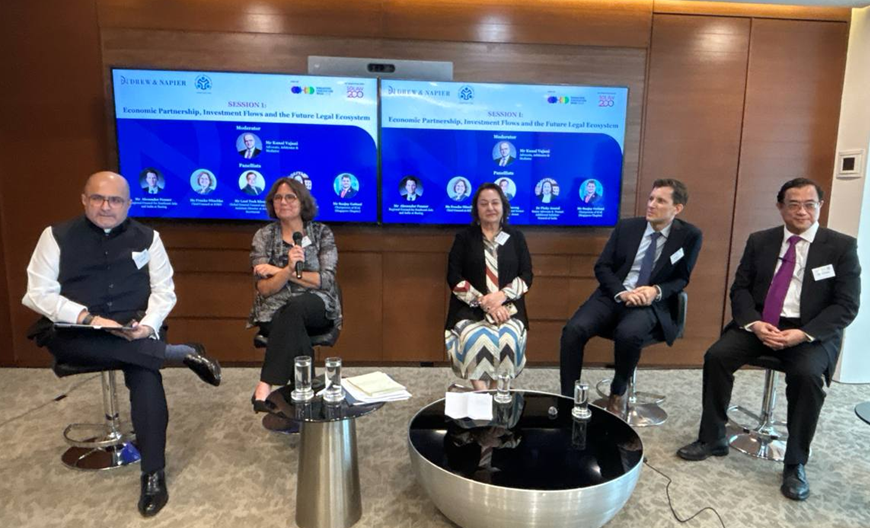
The session began with a keynote address by Mr. Looi Teck Keong, Global General Counsel and Former Assistant Director, ASEAN Secretariat, and was followed by a panel discussion titled “Economic Partnership, Investment Flows and the Future Legal Ecosystem” on the theme “Building the Next Generation India—Singapore Growth Corridor”. The panel underscored that the future of the partnership hinges on robust legal frameworks, regulatory interoperability, and the strategic use of dispute resolution mechanisms.
Moderated by Mr. Kunal Vajani, Advocate, Arbitrator & Mediator, the panel consisted of esteemed professionals namely, Dr. Pinky Anand, Former ASG of India, and Senior Advocate, Supreme Court of India; Mr. Looi Teck Keong, Global General Counsel and Former Assistant Director, ASEAN Secretariat; Mr. Alexander Fenner, Regional Counsel for Southeast Asia and India, Boeing; Ms. Frauke Nitschke, Chief Counsel, International Centre for Settlement of Investment Disputes.
Keynote Address
From Treaty to Transaction- Building the India-Singapore Corridor: Mr. Looi Teck Keong
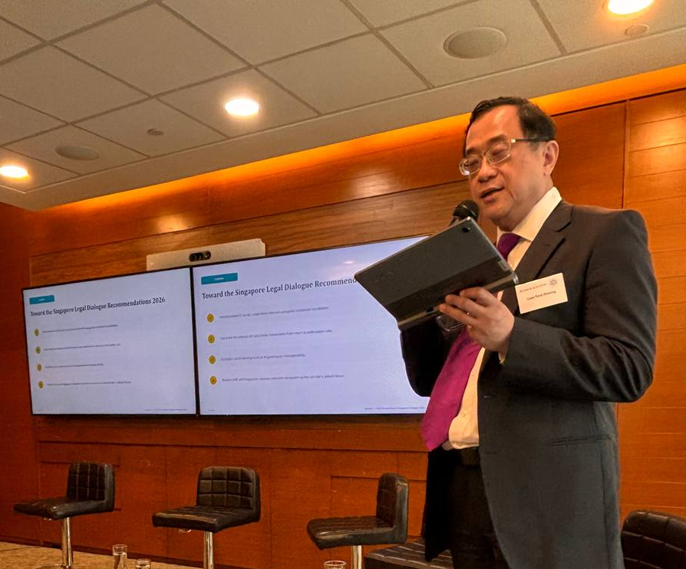
In his opening address, Mr. Looi Teck Keong underlined the reasons for the conference, such as the trade and investment agenda at hand, the institutional momentum caused by the recent India-Singapore Ministerial Roundtable, emerging areas of AI, Environmental, Social, and Governance (ESG), digital economies, etc.
Reflecting on India-Singapore decades-long ties, he highlighted that, “Singapore is India’s largest trade and investment partner within ASEAN and for Indian companies, it functions less as a destination and more as a platform, the base from which to reach all 10 ASEAN member states.” He added that it had been 20 years since the signing of the India-Singapore Comprehensive Economic Cooperation Agreement (CECA) in 2005 and the relationship between the two countries was still being built.
Thereafter, he provided five areas for the panel to focus on, which are as follows:
- Viksit Bharat 2047: He argued that India’s vision to become a developed economy by 2047 demands capital, technology, and trusted partners. This creates real opportunity for Singapore businesses as investors and institutional partners. “A vision of that scale cannot be financed or built on an ad hoc one-off transaction; it needs the institutional plumbing.”
- CECA and future economic cooperation: He stated that after the enforcement of the agreement, India-Singapore financial relationship had greatly improved as tariffs eliminated 81% of Singapore’s exports to India, Singapore became India’s number one source of foreign direct investment (FDI) with cumulative stock exceeding US $160 billion, and bilateral trade approximately grew five-fold. On this basis, he argued that the next areas of focus for the two countries should be deeper services and professional mobility, aviation and aerospace supply chains, financial services and risk transfer, tax certainty as the double taxation avoidance agreement post-2016 framework, and investment protection and dispute resolution infrastructure.
- Infrastructure, energy transition, logistics and digital economy: Underscoring the conversations around green and digital shipping corridors, he stated that knowledge sharing on small modular reactor technology and the wider clean energy transition, as well as the digital economy agenda, were discussed at the recent Ministerial Roundtable, which represented genuine investment opportunities on both sides.
- Singapore as a gateway for ASEAN investment: He argued that the gateway was bidirectional, wherein Singapore’s role was to be the platform through which capital, expertise and trust flow between ASEAN and India. Thus, for ASEAN businesses, India is no longer simply a large, distant market to be approached cautiously. It is a fast-scaling manufacturing and digital economy that increasingly needs the kind of trusted intermediary Singapore’s legal and financial infrastructure provides.
-
Multilateral doors for India: He stated that the Regional Comprehensive Economic Partnership (RCEP), which India left in 2019, and the Comprehensive and Progressive Agreement for Trans-Pacific Partnership (CPTPP), to which India had yet to apply, were two key multilateral pathways for India. Herein, he argued that Singapore could provide anchored legal and transactional infrastructure.
Mr. Keong emphasised that the important theme was “treaty to transaction”, i.e., signing an agreement is a beginning, not an outcome. A treaty getting signed is the political commitment; thereafter, implementing rules have to be written, and standards, licensing regimes, fine print regulators have to be enforced, which frequently differ from what was in the treaty itself. Thus, when disputes arise in cross-border commercial relationships, they must be resolvable predictably. In this regard, he highlighted that India signed the Singapore Convention on Mediation (SMC) in 2019 but had still not ratified it.
He added that three things determine closure of the gap between treaty signing and movement of capital: regulatory certainty and genuine ease of doing business, Intellectual Property Rights protection, and competition law that gives small and medium-sized businesses a fair outcome.
Reminiscing about his experience in the ASEAN Secretariat, Mr. Keong talked about how he secured the ministerial mandate that moved ASEAN’s competition rules from voluntary guidelines to the binding ASEAN Framework Agreement on Competition, which required almost a year of lobbying. This shift from guidance to binding law was what was required between India-Singapore cooperation, and this is the stage they are at.
Thereafter, he delved into the outcomes of the recent Ministerial Roundtable, which resulted in three instruments:
- A Food Safety MOU between India’s FSSAI and the Singapore Food Agency: Opens the door to Indian export of mangoes, lychees, cherries, plums, and, after Singapore’s approval, of Indian poultry export establishments.
- Maritime Heritage MOU: Signals investment in the relationships of power and cultural infrastructure, not just commercial architecture.
-
Telecom and Broadcasting Letter of Intent signed between India’s Telecom Regulatory Authority (TRAI) and Singapore’s Infocom Media Development Authority (IMDA)
Other than these three instruments, the countries agreed on several topics such as building on the 2024 Semiconductor Ecosystem Partnership, India’s UPI partnership with PayNow, space cooperation between Singapore Space Agency and India’s IN-SPACe, capital markets links between SGX and India’s National Stock Exchange, and cybersecurity.
Mr. Keong also spoke about the recent India-Singapore Business Roundtable, which discussed ease of doing business in India for Singapore firms, capital market flows, cooperation in AI, India accessing Singapore as a gateway to international markets, and more.
Noting these developments, he stated that though countries may create valuable political architecture like MOUs, these themselves were not transactions. General counsels must deliver contracts that survive scrutiny across two regulatory regimes, sensible risk allocation between parties with very different risk appetites, and a real route to resolve disputes.
Reflecting on his many years of legal practice across this region, he opined that the cooperation required regulatory predictability, enforceable intellectual property rights, contract and competition law, and efficient neutral dispute resolution. Institutions like the Singapore International Arbitration Centre were one of the most underused assets in this entire corridor.
He opined that three emerging areas will define the India-Singapore Corridor:
- AI Governance: He recommended that India, Singapore, and ASEAN should converge early on regarding interoperable standards, shared definitions, shared risk classifications, as none of their frameworks has yet hardened into final form, rather than reconcile fragmented ones later, which is far more expensive and slow.
- ESG and Clean Energy: This area would include making green and digital shipping corridors, sharing knowledge on small modular reactors, and standardised ESG taxonomies to unlock cross-border green capital.
-
Digital Economy: This would likely include the UPI-PayNow linkage and Project Nexus targeting 2027, which would connect India’s payment rails to five ASEAN countries. “Payment infrastructure doesn’t make headlines the way an MOU signing does, but it may be the most mature piece of treaty-to-transaction work that this corridor has produced so far.”
Lastly, Mr. Keong gave a few recommendations for the India-Singapore relationship:
- Institutionalise general counsel-to-general counsel cooperation channels and expand connections between the two legal communities.
- Fast-track instruments like the Telecom Letter of Intent to a possible binding cooperation following the precedent ASEAN set with the ASEAN Framework Agreement on Competition.
- Establish a joint working track specifically on AI governance interoperability before fragmentation sets in.
-
Position SIAC and Singapore Dispute Resolution ecosystem more broadly as this corridor’s default forum by deliberate design.
Panel Discussion: Economic Partnership, Investment Flows and the Future Legal Ecosystem
At the outset, Mr. Kunal Vajani introduced the panellists and briefly explained the scope of the discussion.
What is ICSID and what services does it offer: Ms. Frauke Nitschke
Ms. Frauke Nitschke began by explaining that the International Centre for Settlement of Investment Disputes (ICSID) is not an arbitration institution. It is an arm of the World Bank Group established precisely to provide an investment climate and support the flow of foreign capital for economic growth and shared prosperity. Furthermore, ICSID partners with the International Bank for Reconstruction and Development (IBRD) and the International Finance Corporation (IFC) to offer longer-term dispute management and dispute prevention capacity building as well.
She stated that though ICSID is known for its dispute resolution service, it was a crucial moment to use the lessons learned from ICSID cases and reduce the number of future disputes for the economic benefit of States and investors.
Regarding which disputes come under ICSID jurisdiction, Ms. Nitschke stated that ICSID deals with investor-State/State entity disputes, even without a treaty or contractual provisions or membership with ICSID to use ICSID dispute settlement. Without membership, dispute resolution under ICSID requires consent, which is derived from contractual provisions that can be drafted using ICSID’s Model Clause on Contractual Arbitration.
“ICSID is not only available for contracting states, but we look forward to welcoming India at one point to the ICSID family.”
Remarking that ICSID was best known for its arbitration services, including administration of UNCITRAL proceedings, she mentioned that ICSID also has an ICSID Additional Facility which can be used for arbitration and conciliation where one or neither of the parties is an ICSID Member State or a national of an ICSID Member State.
Emphasising mediation, she remarked that mediation was growing as a means of amicable dispute settlement in investor-state relationships. She added that to opt for ICSID mediation, parties did not require a treaty; they could have a contractual provision or an ad-hoc agreement. ICSID has over 50 investor-state mediations, most of which were based on a post-dispute, ad-hoc agreement or on a contractual provision. ICSID is available for mediations without any nationality requirement too, so a dispute could be mediated between a domestically incorporated entity and the State in which the investment is located.
She explained that the ICSID Administrative Council authorised mediation for these situations to support investor-state relations for the retention of the investment. She remarked, “Nobody is actually in a business relationship interested in arbitration, neither the investor nor the State. So once arbitration is commenced, usually the relationship is at that point where the investor has already cancelled or withdrawn the investment.”
Lastly, Ms. Nitschke stated that ICSID mediation could be used while the business relationship is ongoing wherever negotiation is required, before arbitration begins, alongside arbitration, or after an arbitration award has been rendered.
Answering a follow-up question of how ICSID was trying to promote mediation before arbitration by Mr. Vajani, she explained that while the issue was heavily discussed during the drafting of ICSID Mediation Rules, 2022, the parties in their contractual relationships or in their treaties can decide how to combine mediation and arbitration. She added that since 30% of the arbitrations at ICSID settle, ICSID, in its correspondence with the parties, reminds them of the mediation availability alongside an arbitration once an arbitration has been filed. In the Procedural Order 1 Draft that sets out the basic framework of the arbitration customised to the case, ICSID also includes a mediation provision to provide that option to states who were not ready to negotiate before commencement of the arbitration but felt differently thereafter.
Building in multi-tier dispute clauses in the contract: Mr. Alexander Fenner
Responding to a question on how global corporations view multi-tiered dispute resolution clauses, particularly in light of ICSID’s mediation framework, Mr. Alexander Fenner advocated for building in a mandatory or default mediation step at the contracting stage. He observed that mediation is generally not expensive, especially when a dispute has progressed to the point where counsel is engaged, and arbitration documents are being drafted. At that stage, the materials required for mediation can be assembled relatively easily, and the process itself is typically short.
He identified a significant psychological barrier that often prevents parties from mediating. He explained that when parties are in a dispute and uncertain about each other’s willingness to enter settlement discussions, merely proposing mediation can be perceived as a sign of weakness by the opposing party. If mediation is not built into the contractual framework for dispute resolution, parties may end up mediating less than they should. This can lead to stalemates where neither party wants to signal a desire to talk, even though discussions would be beneficial. He expressed appreciation when parties adopt such provisions at the outset.
Bottlenecks in the India-Singapore Corridor: Dr. Pinky Anand
Dr. Pinky Anand began by acknowledging the significant progress already made in the India-Singapore partnership. She noted that India and Singapore are already the largest partners considering the FDI statistics and the UPI payment system partnership. She observed that consumer usage is the greatest source of investment and development.
Turning to legal services, she proposed the creation of a joint protocol between the two countries instead of a Mutual Legal Assistance Treaty, covering merit, logistics and substance, and utilising the resources of both countries to develop another tier of systems.
On the logistical side, she gave the example of a Singapore-seated arbitration where witnesses are located in India. Under a joint protocol, the witness could be examined in India through a local commissioner, facilitating the process. Regarding enforcement, Dr. Anand emphasised that the biggest issue in commercial arbitration was its enforcement, and a joint protocol addressing enforcement would be beneficial.
She cited the successful precedent of the Singapore International Mediation Centre (SIMC) entering into a joint protocol with the Shenzhen Court, whereby SIMC mediation awards/decrees are implemented as consent decrees of the Shenzhen Court. She suggested that similar features could be introduced into the India-Singapore systems.
Furthermore, Dr. Anand highlighted the growing institutional presence, noting that the Singapore International Arbitration Centre (SIAC) has opened offices in Gujarat, Mumbai, and, recently, in Delhi. This facilitates the exchange of information and services between the two countries. She observed that it is time to recognise that service industries, including professional services and consumer-related disputes, need to be addressed at the commercial level through interstate discourse.
On the aspect of services, she added that commercial courts were another resource for commercial disputes. She acknowledged the leadership of Chief Justice Sundaresh Menon, who has been instrumental in developing the Singapore International Commercial Court (SICC), and expressed hope that similar initiatives could be introduced in India.
Synergies between India and Singapore: Mr. Alexander Fenner
When asked about the synergies attracting global companies to both jurisdictions, Mr. Fenner highlighted the fundamental importance of the rule of law. He explained that for a global company considering investment, the primary concern is the likelihood that rights will be determined according to legal principles. This had two components: a philosophical or political commitment, meaning whether the system is set up to operate that way, and a practical one, concerning how quickly, efficiently, and cost-effectively it operates.
Mr. Fenner praised both Singapore and India for their solid commitment to legal principles, robust legal systems, and the confidence that when questions of rights arise, they are determined through a legal process. This is a key factor in assessing legal risk when entering a market.
Regarding the practical implementation of this commitment, he opined that Singapore’s role as a dispute resolution forum is very important. While acknowledging that there is potential for doing more arbitration in India in the future, he noted that at present, there was a strong position to capture synergies from Singapore’s dispute resolution capabilities in agreements between India and third-party states. He concluded that for multinationals looking to expand in Asia, both Singapore and India are attractive markets with useful commonalities, such as their political commitment to the rule of law, and complementary features, like Singapore’s unique dispute resolution ability, which can be leveraged to make investments in India more predictable and effective.
Extending the economic partnership and navigating AI Governance: Mr. Looi Teck Keong
Mr. Keong emphasised the need for concrete cooperation activities to extend and expand the economic partnership between the Asian region and India. He observed that while politicians sign broad-level cooperation agreements with significant publicity, once sectoral cooperation activities are identified, businesses need to come together to specify exactly what those activities entail. For example, in AI governance, it is crucial to understand developments in the region and in Singapore, and to ensure that regulatory compliance aspects are addressed through discussion.
Furthermore, he added that global counsels must develop frameworks within their respective businesses to navigate the fragmented nature of legislative and governance aspects of AI. This requires the development of institutional frameworks, which can only be achieved through collaboration with institutions like the Global Council for Responsible AI and other similar bodies in various countries. The challenge lies in navigating multiple institutions across borders to avoid compliance costs that could outweigh business profitability. Thus, lawyers were responsible for such collaboration and analysis.
ICSID’s AI Policy: Ms. Frauke Nitschke
Responding to a question on AI’s role in investor-state disputes, Ms. Nitschke shared that ICSID has not yet adopted an AI policy. ICSID typically observes developments at the domestic level, and parties bring AI protocols, like disclosure requirements, into their cases as they see fit. Furthermore, there is no decision-making by AI at ICSID, and Tribunals have disclosure protocols relating to summarising documents or identifying specific provisions. Thus, the overall approach remains human-natured.
AI in Decision-Making: Dr. Pinky Anand
When asked about AI’s role in arbitral decision-making, Dr. Anand answered firmly in the negative. She agreed with the earlier observation that AI is a useful tool for documentation and other tasks, but she did not believe that decision-making or lawyering could be effectively handled by AI. She shared a light-hearted anecdote about her first attempt to use AI for a bilateral investment treaty issue involving geopolitical complications, to which the AI responded that the matter was too complicated.
AI and Confidentiality in the US: Mr. Alexander Fenner
Addressing the use of artificial intelligence in arbitration, Mr. Fenner raised concerns about privilege and confidentiality. He described this as an evolving field in the United States, with significant concern that the use of AI products could have implications for privilege or confidentiality in various jurisdictions, and these implications are not yet fully clear or developed. From a party’s perspective, he stressed the importance of ensuring that anything the tribunal does not undermine confidentiality. This is why, in the arbitration context, disclosure from the panel regarding AI usage is so important.
AI intervention and adjudication in small disputes: Mr. Looi Teck Keong
Mr. Keong offered a different perspective on AI’s potential in high-volume disputes. Drawing on his experience at the ASEAN Secretariat, he observed that there is some degree of automation applicable to the huge number of commoditised disputes. He opined that it was simply not possible for governments to have standalone dispute resolution centres to address each of these disputes. He cited Alibaba’s automated dispute resolution system as an example, noting that the company handles thousands of disputes involving small industries and businesses.
On the possibility of AI sitting as judges, he noted that since data at the appellate stage is recorded and limited in scope, AI could potentially deal with this data and produce acceptable outcomes, subject to a human-in-the-loop mechanism.
In conclusion, the panel underscored that while the political will for a deeper India-Singapore partnership is strong, success will depend on the legal ecosystem’s ability to translate commitments into trusted, enforceable outcomes. The discussion on joint protocols, the role of Singapore as a dispute resolution forum, and the cautious adoption of AI highlighted the path forward for deeper cooperation between the two nations.





