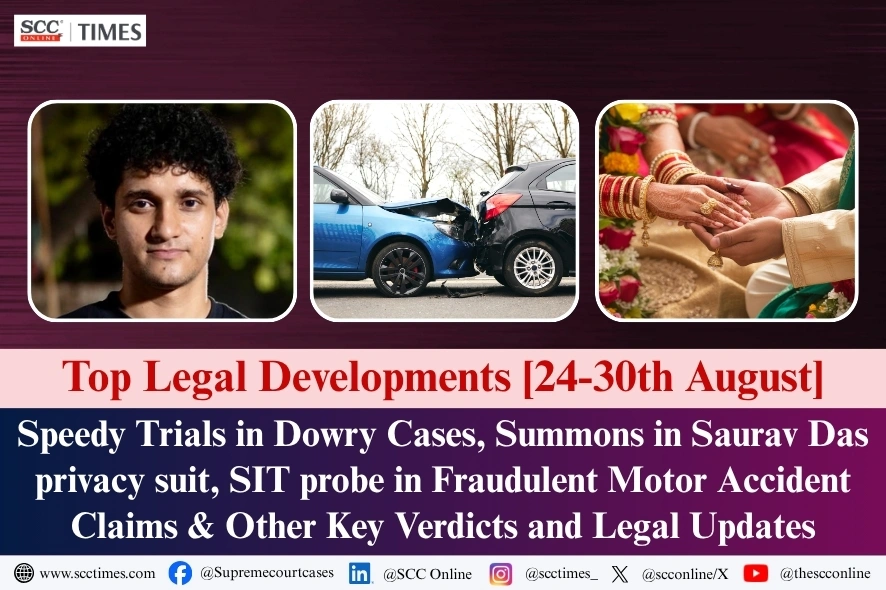
This roundup of weekly legal developments in India covers the most significant Supreme Court and High Court rulings, including Speedy Trials in dowry and cruelty cases, cancellation of Bail in the Satara murder case, Consumer Fora pecuniary jurisdiction, maintenance liability of fathers despite the mother’s earnings, a Pan-India SIT probe into fraudulent motor accident claims, the Polluter-Pays Principle, AI and the welfare of Gen Z, Alpha and Beta, Yamuna pollution, habeas corpus and the right to protest, protection of sex workers, live-in relationship rights, the dignity of Mental Health Centres, constitution of the National Nursing and Midwifery Commission, voluntary retirement and locus poenitentiae under pension rules, Janhvi Kapoor’s Personality Rights, and withdrawal of SpiceJet insolvency proceedings with costs.
TOP STORIES OF THE WEEK
Frame charges in 60-90 days, no unnecessary adjournments: SC gives directions for effective Speedy Trials in Dowry & Cruelty cases
In State of U.P. v. Ajmal Beg1, the Division Bench while taking note of affidavits and data filed by several High Courts, States and Union Territories in pursuance of orders passed by the Court in State of U.P. v. Ajmal Beg, 2025 SCC OnLine SC 2801, passed another set of important directions addressing the systemic delay and ineffective implementation attending prosecutions under Sections 304-B, Section 498-A, Penal Code, 1860 (IPC) and the
Delhi HC Order in Saurav Das Case: What the Court said on Summons, Amendment of Plaint and Injunction Plea
In Saurav Das v. The Pamphlet2, while hearing a case concerning a prayer for interim injunction, a Single Judge Bench permitted Saurav Das to amend the memo of parties as well as the plaint for substituting the name of Defendant 4 from “Information TV Private Limited” to “Good Morning India Private Limited”, stated to be the entity publishing the newspaper The Sunday Guardian. The Court directed the amended memo of parties and plaint to be filed within one week and ordered issuance of summons in the suit. Read more about Saurav Das case HERE
SUPREME COURT HIGHLIGHTS OF THE WEEK
Bail| Supreme Court cancels bail of accused in pre-planned Satara murder case; holds repeated threats and carrying petrol prima facie indicate common intention
In Yash Mahesh Gaikwad v. State of Maharashtra, 2026 SCC OnLine SC 1696, while hearing a case concerning grant and cancellation of bail in a murder case arising out of an alleged pre-planned attack in which the deceased-complainant was set ablaze, a Division Bench held that the circumstances of the case, including the repeated threats extended by the accused persons, their arrival together at the crime scene in a four-wheeler carrying petrol, and the subsequent act of pouring inflammable fluid over the deceased and setting him ablaze, prima facie indicated that the accused persons were acting in concert and in furtherance of a common intention. Read more about Satara murder case HERE
Also Read: Del HC grants bail in Jungpura doctor murder case | SCC Times
Consumer Forum| SC seeks Centre’s response on how Consumer Fora’s Pecuniary Jurisdiction is decided in view of identified anomalies
In Avon Elastomers (India) v. Bajaj Allianz General Insurance Co. Ltd., 2026 SCC OnLine SC 1669 , while hearing a special leave petition raising a substantial question as to whether jurisdiction of the consumer fora would depend on the value of the goods or services paid as consideration or will depend on the amount of compensation claimed, the Division Bench found it appropriate to first obtain the Union of India’s response to the formulated anomalies, including disputes involving fixed deposits, savings accounts, subsidised medical services, defects in fixtures and fittings, and defective components of high-value vehicles and therefore, directed the Union of India to file an appropriate affidavit within 6 weeks responding to the same. The Court directed to address the reduction of the National Commission’s pecuniary jurisdiction from ₹10 crore to ₹2 crore. Read more HERE
Maintenance| Mother’s earnings cannot halve Father’s liability to maintain children
In Sujata Kumari v. Rahul Kumar, 2026 SCC OnLine SC 1675 while examining whether the fact that the mother was gainfully employed could, by itself, justify reducing the father’s contribution towards the interim maintenance of their minor daughters, the Division Bench held that “wife earns is not, by itself, a reason to halve the father’s liability” as the obligation to maintain the children is shared by both parents, it “cannot be divided by arithmetic alone”. Accordingly, the Court restored the Family Court’s award of ₹30,000 per month to each daughter, emphasising their needs, the father’s earning capacity, and the mother’s substantial contribution towards their daily care and upbringing. Read more about effect of mother’s earning on father’s liability to maintain children HERE
Also Read: SC: maintenance waiver under matrimonial settlement bars its revival under DV proceeding | SCC Times
Motor Accident Claims| SC orders Pan-India SIT probe into fraudulent motor accident claims, warns insurers against “pick and choose approach” for reporting claims
In Oriental Insurance Co. Ltd. v. Tuni Pati3, proceeding initially concerned with a narrow question, whether the vehicle stated to have caused a motor accident was in fact the vehicle involved in the accident, however, subsequently revealed a much wider concern, i.e., allegations of fraudulent motor accident claims being lodged in a recurring and organised pattern, including instances where the same vehicle was shown as having been involved in multiple accidents. Describing the suspected fraud as being of “enormous proportion” and expanding the proceedings to examine mechanisms for detecting and investigating such claims pan India, the Division Bench directed all the States to constitute a special dedicated SIT at the State level for dealing with suspected fraudulent insurance claims and issued fresh directions. Read more about SC order on Pan-India SIT probe into fraudulent motor accident claims HERE
Environment Law| Polluter-pays principle applies only where damage is attributable to the polluter
In Vyakti Vikas Kendra India v. Manoj Misra, 2026 SCC OnLine SC 1694, an appeal challenging the National Green Tribunal’s (NGT) order dated 7 December 2017 in Manoj Misra v. DDA, 2017 SCC OnLine NGT 966, wherein the appellant, the organiser of the 2016 World Culture Festival, “Vyakti Vikas Kendra, India” or as per NGT “Art of Living International Centre”, was held liable for environmental damage allegedly caused to the Yamuna floodplain, the Division Bench found that the floodplain was already in a damaged condition before the site was handed over to the appellant and that the evidence relied on by the NGT did not establish that the appellant caused additional damage. Read more about what SC said on NGT’s liability assessment against “Art of Living International Centre” HERE
MAJOR HIGH COURT RULINGS THIS WEEK
Artificial Intelligence| Rajasthan High Court takes suo motu cognizance of welfare of Gen Z, Alpha & Beta
In Re: “In the matter of Welfare and Future of Generation Gen-Z, Gen-Alpha and Gen-Beta, taking suo motu cognizance of the issues affecting the welfare and future of “Generation Z”, “Generation Alpha” and “Generation Beta”, a Single Judge Bench of Anoop Kumar Dhand, J., examined several concerns relating to education, technology, paper leaks, screen time, nutrition, health, safety and school infrastructure and emphasised the need to modernise the education system by integrating artificial intelligence (AI), digital learning and other emerging technologies while preserving foundational skills such as reading, writing, independent thinking and reasoning. Read more HERE
Environment Law| Delhi HC calls for immediate measures to address Yamuna pollution, waterlogging, sewage treatment and redevelopment of industrial areas
In Court on Its Own Motion v. Union of India4, a matter concerning waterlogging, untreated sewage, inadequate drainage infrastructure and pollution of the Yamuna, a Division Bench directed multiple authorities to take coordinated and time-bound measures to address deficiencies in drainage, sewage treatment and the redevelopment of non-conforming industrial areas. Read more about Yamuna pollution, waterlogging, sewage treatment and redevelopment of industrial areas HERE
Habeas Corpus |Free to move, not free to break the law: Delhi HC on Karni Sena President’s habeas corpus case
In Raj Shekhawat v. State (NCT of Delhi)5, a habeas corpus petition filed by petitioner, president of Kshatriya Karni Sena/Akhand Karni Party, seeking his production on the assertion that he was being illegally detained at the residence of a friend, the Division Bench while accepting the Delhi Police’s statement that the petitioner had not been detained, held that he was free to move around, while directing that any protest he wished to participate should be in accordance with law. Read more Karni Sena President’s habeas corpus case HERE
Immoral Traffic (Prevention) Act| Sex workers entitled to equal protection
In XYZ v. State of Chhattisgarh6, a petition under Section 482, Criminal Procedure Code, 1973 (CrPC) seeking quashing of FIR and consequential criminal proceedings for offences punishable under Sections 3, 4, 5 and 7, Immoral Traffic (Prevention) Act, 1956 (Immoral Traffic Act), the Division Bench held that the material placed on record did not disclose any specific allegation demonstrating that the petitioner was engaged in any independent act which would constitute the ingredients of the offences alleged against her, apart from the allegation regarding her status as a sex worker. The Court held that continuation of the criminal proceedings would amount to an abuse of the process of law and quashed the FIR, consequential charge-sheet and criminal proceedings insofar as they related to the petitioner. Read more about protection to sex workers under Immoral Traffic (Prevention) Act HERE
Live -in Relationship| No one can interfere with consenting adults’ choice to live together, much less threaten their life or liberty
In Uma Bharti v. State (NCT of Delhi), 2026 SCC OnLine Del 6423, a petition filed under Article 226 of the Constitution of India read with Section 528, Nagarik Suraksha Sanhita, 2023 (BNSS), seeking direction to be issued to Respondent 1 to provide protection to petitioner’s lives and liberty against Respondents 3 and 4, a Single Judge Bench reaffirmed that the choice of a partner and the decision to reside together are protected by Articles 19 and 21 of the Constitution, and that “nobody, be it their parents/relatives/ friends, have a right and/ or authority to cause any hinderance and/ or interfere with their choice thereof, much less threaten their life and/ or liberty”. Accordingly, the Court directed the police authorities to provide the petitioners all necessary assistance in accordance with law. Read more about consenting adult’s autonomy to live together HERE
Mental Health| Not “Centres of Physical Health,” so why “Mental Health Centres”
In The High Court Legal Services Committee v. State of Kerala7, a matter concerning the proposed reconsideration of the nomenclature of Mental Health Centres, with a view to addressing the stigma associated with mental healthcare institutions and promoting the dignity, welfare and social inclusion of vulnerable patients, a Division Bench emphasised that the nomenclature of institutions providing mental healthcare should not perpetuate stigma against vulnerable patients. The Court observed that the issue should not be approached as an adversarial dispute, but from the perspective of patient welfare, dignity, and community welfare. The Court directed the Government to examine the suggestion for reconsidering the existing designation of “Mental Health Centres” and to inform the Court of its decision. Read more about renaming of Mental Halth Centres HERE
National Nursing and Midwifery Commission| Delhi HC directs Centre to decide on constitution of National Nursing and Midwifery Commission within 2 months
In a case concerning the non-constitution of the National Nursing and Midwifery Commission (NNMC) despite the coming into force of the National Nursing and Midwifery Commission Act, 2023, a Single Judge Bench directed that the writ petition be treated as a representation on behalf of the petitioner. The Court directed the respondents to consider and decide the representation within a period of 2 months from the date of the order and communicate the decision to the petitioner. The Court further granted liberty to the petitioner to approach the Court by way of a fresh writ petition in case of any further grievance. Read more about National Nursing and Midwifery Commission HERE
Pension benefits| “Locus Poenitentiae” under Rule 48-A of CCS (Pension) Rules, 1972 ends on effective date of retirement
In Gana Pati Biswas v. Union of India8, while hearing an application was filed under Article 226 by an ex-Head Constable (petitioner), calling into question the legal efficacy and sanctity of the order dated 31 January 2010 passed by the Commandant, 37th Battalion, Border Security Force (BSF), accepting his application for voluntary retirement with effect from 31 July 2010, as well as challenging the subsequent administrative communication dated 15 November 2011, whereby his belated representation seeking reinstatement into service was rejected, and he accordingly prayed for issuance of a writ in the nature of certiorari quashing both communications, coupled with a mandamus directing the respondent authorities to reinstate him into service with all consequential benefits, continuity of service and back wages. Uday Kumar, J., dismissed the writ petition being devoid of merits and directed the respondent authorities to refund the deposited sum of ₹26,45,692.00, along with any interest accrued thereon from the fixed deposit held in the nationalised bank, to the writ petitioner within 4 weeks from the date of communication of this order. Read more about “Locus Poenitentiae” under Rule 48-A of CCS (Pension) Rules, 1972 HERE
Personality Rights| Delhi High Court declines blanket injunction against 6884 URLs; directs takedown of 552 URLs in Janhvi Kapoor personality rights case
In Janhvi Kapoor v. Ashok Kumar/John Doe9, while hearing a case concerning the alleged misuse of Janhvi Kapoor’s personality rights through several URLs, social media accounts and other digital material, a Single Judge Bench declined to grant a blanket injunction against all 6884 URLs forming subject-matter of the proceedings. The Court held that the claims and prayers were over-broad and directed Janhvi Kapoor to segregate the impugned URLs into 3 categories, namely, ex facie pornographic and sexually vulgar content, content directly monetising Janhvi Kapoor’s personality rights, and content indirectly promoting sale of merchandise and services by using Janhvi Kapoor’s name and likeness. Read more about Janhvi Kapoor personality rights case HERE
TRIBUNAL UPDATES OF THE WEEK
NCLT Allows Withdrawal of unadmitted company petition against SpiceJet but declines to record settlement; Imposes ₹15 Lakh costs
In Aviator ML 29641, Ltd. v. SpiceJet Ltd.10, new IA/3976/2026 was filed by Aviator ML 29641 Ltd. (operational creditor) under Rule 11 read with Rule 11(2) of the National Company Law Tribunal Rules, 2016 (‘NCLT Rules, 2016’), seeking liberty to withdraw C.P. IB-674/ND/2024 (company petition) filed under Section 9 of the Insolvency and Bankruptcy Code, 2016 (IBC) against SpiceJet Limited (corporate debtor). The Bench permitted withdrawal of the company petition under Rule 8 of the Insolvency and Bankruptcy (Application to Adjudicating Authority) Rules, 2016 (2016 Rules). However, it declined to take the parties settlement agreement on record, as the request for withdrawal had been made at a belated stage of the proceeding. It directed payment of costs of Rs. 15,00,000/-, shared equally between the parties, as a condition for the withdrawal to take effect. Read more HERE
THIS WEEK’S KEY LEGISLATIVE UPDATE
-
Tribunals Reforms Act, 2026 takes effect from 25 August 2026 | SCC Times
-
Centre Corrects EPF Inspection Charge Rate from 0.35% to 0.18% | SCC Times
OTHER DEVELOPMENTS OF THIS WEEK
LAW MADE EASY
OP.ED.
-
What is the Meaning of “Undertaking” and “Substantially the Whole Undertaking” under the Companies Act? by Makarand Joshi
-
The Conscience of the Court: Suspicious Circumstances, Testamentary Intent, and Proof of Wills by Sanjukta Majumdar
-
“Better Abolish This Institution”: Why Homebuyers Have Come to Believe RERA Works for Promoters by V.P. Singh
-
Legal Effect of Omission of Section 213, Succession Act, 1925 by the Repealing and Amending Act, 2025 by N.V. Vasudevan, Sriram Venkatavaradan and Saai Sudharsan Sathiyamoorthy
Also Read:
-
Justice Anil R. Dave to lead NFSU’s IDDRC as it goes Operational| SCC Times
-
Pinky Anand leads workshop on forensic evidence SOPs for sexual assault cases | SCC Times
-
SC’s SAMADHAN SAMAROH 2026: 1,712 cases resolved | SCC Times
-
GHAC Arbitration Week 2026 | Building Gujarat’s Arbitration Ecosystem | SCC Times
-
Top Weekly Legal Developments India: 17-23 August 2026 | SCC Times
-
CJI Surya Kant takes note of concerns raised by Justice Sandeep Mehta | SCC Times
-
Del HC permits LL.M. student with attendance shortfall to continue | SCC Times
1. Misc. Application Nos. 2689-90 of 2025
2. CS(OS) 753 of 2026
3. SLP (C) No. 5582 of 2023 with Civil Appeal No. 6865 of 2026
4. W.P.(C) 7594/2018 & W.P.(C) 9617/2022
5. W.P.(CRL) 2617 of 2026
6. CRMP No. 1613 of 2023
7. IA 25/2026 in WP(C) No. 16603 of 2026
8. WPA 1701 of 2012
9. CS(COMM) 868 of 2026
10. IB-674/ND/2024, New IA/3976/2026