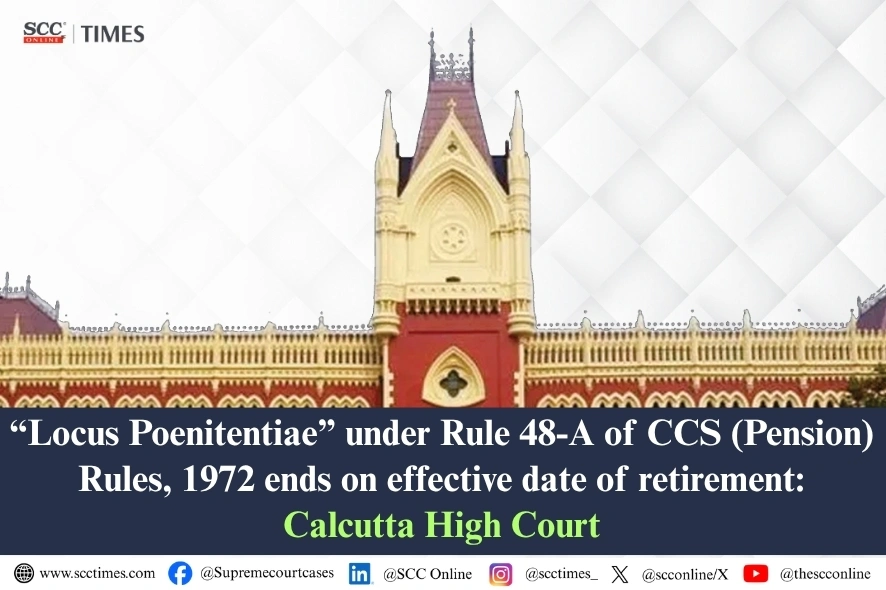
Calcutta High Court: An application was filed under Article 226 by an ex-Head Constable (petitioner), calling into question the legal efficacy and sanctity of the order dated 31 January 2010 passed by the Commandant, 37th Battalion, Border Security Force (BSF), accepting his application for voluntary retirement with effect from 31 July 2010, as well as challenging the subsequent administrative communication dated 15 November 2011, whereby his belated representation seeking reinstatement into service was rejected, and he accordingly prayed for issuance of a writ in the nature of certiorari quashing both communications, coupled with a mandamus directing the respondent authorities to reinstate him into service with all consequential benefits, continuity of service and back wages. Uday Kumar, J., dismissed the writ petition being devoid of merits and directed the respondent authorities to refund the deposited sum of ₹26,45,692.00, along with any interest accrued thereon from the fixed deposit held in the nationalised bank, to the writ petitioner within 4 weeks from the date of communication of this order.
Facts
The petitioner was enrolled as a Constable in the BSF, posted to the 46th Battalion, BSF, in 1988. In 2006, he was transferred to the 37th Battalion, BSF, and was later promoted to the rank of Head Constable in 2002 and had completed 22 years, 10 months and 26 days of service without any adverse or red ink entry in his service record. On 2 March 2009, owing to deteriorating health, he applied for a medical transfer. Between 25 March 2009 and 25 April 2009, he was assigned as Mess Commander of his Company, E-Coy, responsible for managing the dietary arrangements of approximately 115 BSF personnel. During this period, he allegedly detected irregularities in the recording of the ration consumed by Assistant Commandant J.K. Nangal, who, according to the petitioner, was consuming full meals while being recorded as having taken “Half Meal” or “NIL” in the Mess Registration Book.
The petitioner protested by recording “Full Diet” against the officer’s name on 8 April 2009, 9 April 2009 and 10 April 2009, following which, on 11 April 2009, he was removed from his duties as Mess Commander and temporarily transferred. Although the Deputy Inspector General (DIG) subsequently directed his transfer to a neutral environment, the Commandant allegedly failed to implement the direction. Thereafter, the petitioner alleged that his medical examination and leave applications were delayed and that, despite medical advice for light duties, he was required to undertake 12-hour border patrols. On 25 September 2009, while posted at Border Outpost Ranaghat, he sought leave to attend to his hospitalised daughter and allegedly faced verbal intimidation from J.K. Nangal. He subsequently lodged a criminal complaint at Bagda Police Station, while his wife approached the District Magistrate seeking protection. The authorities thereafter issued warnings and, on 23 December 2009, conducted a summary disciplinary trial under Section 19(a), BSF Act, 1968, imposing a penalty of 14 days’ pay.
The petitioner alleged that, on the evening of 23 December 2009, Commandant Umed Singh summoned him to his office and compelled him to choose between submitting a pension application and leaving service peacefully or facing a court-martial and dismissal without pension on false criminal charges. On 24 December 2009, he was again summoned to the officer’s chamber and, allegedly under fear, psychological coercion and unequal bargaining power, signed a pre-typed application seeking voluntary retirement. On 31 January 2010, the Commandant accepted the application under Rule 48-A, Central Civil Services (CCS) (Pension) Rules, 1972 [CCS (Pension) Rules, 1972] with his release fixed for 31 July 2010.
The petitioner thereafter made several representations alleging that his signature had been obtained under duress, including representations dated 15 March 2010 to the DIG, 10 May 2010 to the Inspector General, South Bengal Frontier Headquarters, 20 July 2011 by way of a demand for justice notice, and 17 October 2011 to the Director General, BSF. He also approached the Chief Minister of West Bengal, whose representation was rejected on 15 November 2011 as baseless and devoid of merit. Significantly, in response to his representation dated 15 March 2010, the DIG, by communication dated 13 April 2010, informed the petitioner that he could withdraw his voluntary retirement notice before it became effective. The petitioner, however, asserted that this communication was never served upon him either by registered post or by hand, thereby depriving him of the opportunity to withdraw his voluntary retirement request before its effective date.
Issues under consideration
1. Whether an order of voluntary retirement passed by a competent authority on an application submitted by a service personnel can be assailed under Article 226 on the ground of alleged coercion and duress, when such disputed questions of fact lack contemporaneous corroborative proof and stand directly contradicted by official records and subsequent conduct?
2. Whether the petitioner exercised an enforceable right of locus poenitentiae to withdraw his voluntary retirement notice under Rule 48-A, CCS (Pension) Rules, and whether the alleged non-service of the DIG’s communication dated 13 April 2010 vitiated his separation?
3. What is the true legal effect of the petitioner’s post-application conduct, specifically the submission of pension clearance forms, requests for educational certificates, continuous acceptance of monthly pension, and the subsequent deposit of ₹26,45,692.00 pursuant to interim judicial orders?
Analysis and Held
On the issue of coercion, duress, and scope of judicial review, the Court noted that just 12 days after the alleged threat, the petitioner willingly appeared before the Commandant during a formal institutional interview alongside 5 other retiring personnel. The BSF Interview Register records no whisper of coercion; rather, it documents that he cited domestic responsibilities and the welfare of his aging mother. Furthermore, he actively compiled and submitted his pension clearance papers, without lodging any protest or caveat with higher authorities and he submitted a handwritten application for the return of his original educational marksheets to prepare for a civilian career upon his impending retirement on 31 July 2010. Thus, the allegations of duress are nothing more than a convenient, afterthought camouflage crafted to undo a career choice once civilian realities set in.
The Court further noted that it is a well-established principle of constitutional law that disputed questions of fact, such as whether a verbal threat was uttered inside a closed office at 1900 hours on a winter evening, cannot be conveniently resolved in a summary writ proceeding under Article 226 in the absence of contemporaneous corroborative proof. When the official records, signed registers, and proactive conduct of the petitioner overwhelmingly point toward a voluntary submission of a retirement notice under Rule 48-A, CCS (Pension) Rules; a writ court cannot indulge in conjectural assumptions to tear down an administrative action. Thus, the voluntary retirement application submitted by the petitioner was a conscious, voluntary act unvitiated by any legally actionable coercion or duress, and the challenge mounted against it on this score is wholly unsustainable.
On the issue of “locus poenitentiae” and Rule 48-A, CCS (Pension) Rules, the Court noted that Rule 48-A, CCS (Pension) Rules permits a government servant who has completed the requisite qualifying service to seek voluntary retirement by giving 3 months’ notice in writing to the appointing authority. At the same time, Rule 48-A(4) stipulates that such notice cannot be withdrawn except with the specific approval of the appointing authority and that the request for withdrawal must be made before the intended date of retirement. The Court, relying upon Balram Gupta v. Union of India, 1987 (Supp) SCC 228, J.N. Srivastava v. Union of India, (1998) 9 SCC 559, Power Finance Corpn. Ltd. v. Pramod Kumar Bhatia, (1997) 4 SCC 280 and Shambhu Murari Sinha v. Project & Development India Ltd., (2000) 5 SCC 621, held that the doctrine of “locus poenitentiae” permits an employee to withdraw a voluntary retirement notice before it becomes effective, so long as the employer-employee relationship continues. However, such right must actually be exercised before the effective date of retirement; once the effective date arrives and the jural relationship stands severed, the right to unilateral withdrawal comes to an end.
The Court further held that the petitioner never exercised this right within the permissible period. His representations dated 15 March 2010 and 10 May 2010, as well as the subsequent communications, raised grievances concerning the alleged ration irregularities and sought an inquiry against the Commanding Officer, but did not contain any request for withdrawal of his voluntary retirement notice. The petitioner’s contention that he was deprived of the opportunity to withdraw his notice because the DIG’s communication dated 13 April 2010 was not served upon him was rejected in view of the official Dak Challan dated 16 April 2010 evidencing its dispatch and service at the unit barracks. More importantly, even assuming that the communication had been delayed, the statutory right under Rule 48-A(4) was an affirmative right to be exercised by the petitioner himself. His subsequent conduct, including submission of pension papers on 23 April 2010 and seeking return of his educational certificates on 25 April 2010 for pursuing civilian employment, demonstrated that he had no intention of withdrawing his retirement notice. Accordingly, the Court held that the petitioner neither exercised an enforceable right of withdrawal before 31 July 2010 nor established any administrative failure vitiating his separation from service, and that the window of locus poenitentiae closed upon his retirement and severance of the jural relationship.
On the issue of post-application conduct and effect of interim deposit, the Court held that equity aids the vigilant and those who approach the Court with clean hands, and that the petitioner’s conduct after retirement disentitled him from seeking reinstatement. Following his retirement on 31 July 2010, he left the BSF camp and continued to receive a monthly pension of ₹6705 for over a year without formally seeking withdrawal of his voluntary retirement. The Court rejected his reliance on the subsequent deposit of ₹26,45,692 into the government treasury pursuant to an interim order dated 13 November 2019, observing that such deposit was merely compliance with a conditional judicial direction and could not retrospectively revive the severed employer-employee relationship. Thus, the petitioner’s submission of pension papers, acceptance of pension and subsequent deposit of retiral dues were held to disentitle him from claiming the equitable relief of reinstatement.
Accordingly, the Court answered all 3 questions against the petitioner, holding that the challenge to his voluntary retirement on the ground of coercion was unsupported by contemporaneous evidence and contradicted by his subsequent conduct; that he failed to exercise his statutory right of withdrawal under Rule 48-A(4), CCS (Pension) Rules before the effective date of 31 July 2010, rendering the reliance on Balram Gupta and Shambhu Murari Sinha misplaced; and that his subsequent acceptance of monthly pension and processing of retiral benefits estopped him from seeking reinstatement, with the deposit of ₹26,45,692 pursuant to the interim order dated 13 November 2019 being merely procedural compliance and incapable of curing his failure to seek timely withdrawal.
[Gana Pati Biswas v. Union of India, 2026 SCC OnLine Cal 12010, decided on 18-8-2026]
Advocates who appeared in this case:
For the Petitioner: Mr. Rajdatta Chattopadhyay, Ms. Risha Das, Mr. Somnath Guha and Mr. Kunal Ghosh
For the UOI: Mr. Pramod Kumar Drolia