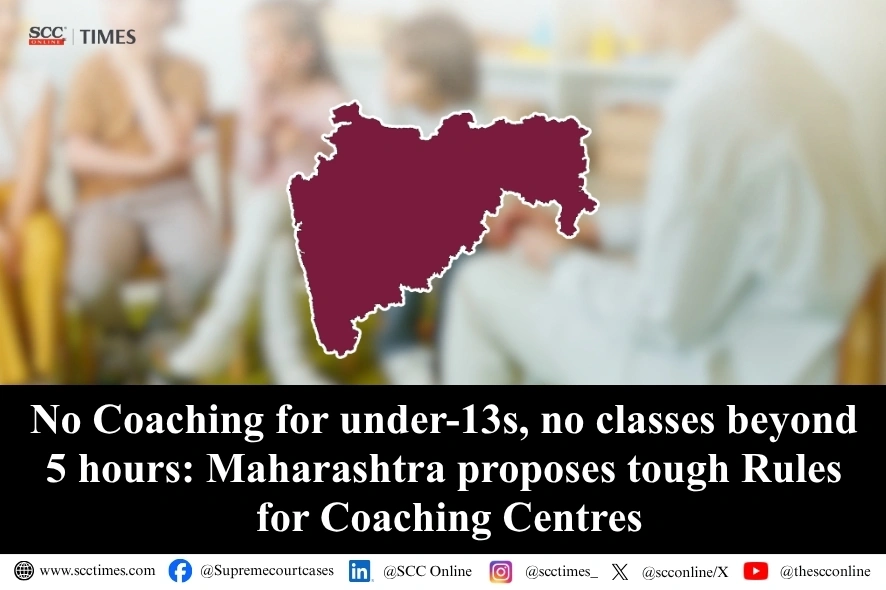
On 20 August 2026, Maharashtra’s School Education and Sports Department published the draft Maharashtra Private Coaching Centers (Registration and Regulation) Act, 2026, inviting suggestions and objections from stakeholders before finalisation of the proposed law.
The draft Act seeks to establish a regulatory framework for private coaching centres across the State, with a focus on the quality of education, student mental wellbeing, infrastructure and safety standards, fee regulation and grievance redressal mechanisms.
Suggestions and objections on the draft legislation may be submitted in writing on or before 4 September 2026, by 6:00 PM, to:
-
Commissioner (Education), Maharashtra State, Central Building, Dr. Annie Besant Road, Pune — 411001 (Email: educom-mah@mah.gov.in)
or
-
Director of Education (Secondary and Higher Secondary), Maharashtra State, Dr. Annie Besant Road, Pune — 411001 (Email: doesecondary1@gmail.com).
The proposed legislation would mandate registration of coaching centres, regulate fees, prescribe infrastructure and safety standards, require counselling systems for students, establish grievance redressal mechanisms and provide for inspection, inquiry and penalties for violations.
Key Points of the draft Maharashtra Private Coaching Centers (Registration and Regulation) Act, 2026:
-
The draft Maharashtra Private Coaching Centers (Registration and Regulation) Act, 2026 proposes a comprehensive regulatory framework comprising 18 sections across 6 chapters covering registration, regulation, student protection, grievance redressal, enforcement and penalties for private coaching centres in Maharashtra.
-
The proposed law will apply to coaching centres providing academic coaching, tuition, instruction or guidance to more than 25 students for consideration. Sports, dance, theatre, painting, yoga and other non-academic creative activities are excluded from its scope.
-
Registration and renewal of registration will be mandatory for all private coaching centres, and existing ones must obtain registration within six months of the Act coming into force.
-
Every branch of a coaching centre will be treated as a separate coaching centre and must obtain separate registration. Registration will remain valid for three years, and renewal must be initiated at least three months before expiry.
-
The State Government will develop an online portal through which all applications for registration and renewal must be submitted.
-
Coaching centres will be required to publish and regularly update key information on their official websites, including details of tutors and their qualifications, courses offered, duration and fee structure, coaching hours, facilities and infrastructure, refund policies, admission capacity, etc.
-
Coaching centres will not be permitted to:
-
Enrol students below 13 years of age.
-
Employ tutors with qualifications below graduation.
-
Hire persons against whom any cognizable offence has been registered under Indian Penal Code or Bhartiya Nyay Sahita.
-
Make misleading promises regarding marks, rankings or success.
-
Publish misleading advertisements.
-
-
Every coaching centre must establish a counselling system as prescribed under the Act and publish detailed information on tutors, courses, fees, facilities, refund policies and intake capacity on its website.
-
Coaching centres must obtain and maintain all permissions required under applicable laws and local authority regulations.
-
Private coaching centres will be prohibited from discriminating against any student, tutor or non-teaching staff on grounds of religion, race, caste, sex, place of birth or physical disability, and will be required to provide equal educational opportunities to Divyang students.
-
Coaching centres will be prohibited from operating within the premises of recognised schools or colleges and from entering into any form of integration arrangement with recognised schools, commonly referred to as the “dummy school” model.
-
Teachers working in recognised schools or junior colleges cannot be employed by private coaching centres.
-
The draft Bill proposes fee regulation measures, including:
-
Mandatory fee receipts.
-
No charges beyond declared course fees.
-
No fee increase during the course period.
-
Course fees must include study material, notes and internal examinations.
-
-
Students leaving a course midway after paying the full fee will be entitled to a pro-rata refund of tuition fees and, where applicable, hostel and mess charges within ten days.
-
Proposed infrastructure standards include:
-
No coaching centre will be permitted to operate in basement premises.
-
Mandatory parking facilities for students and staff.
-
Minimum one square metre area per student.
-
Fire and building safety certification.
-
CCTV coverage with one month of footage retention.
-
Safe drinking water and first-aid facilities.
-
Separate toilets for boys and girls.
-
Divyang-friendly facilities.
-
-
Coaching centres must ensure that their buildings and surrounding premises are Divyang-friendly and comply with the Rights of Persons with Disabilities Act, 2016.
-
These centres must provide a weekly off for students and tutors, cannot hold tests immediately after a weekly off, and cannot conduct classes for more than five hours a day. Classes should neither begin too early in the morning nor continue too late in the evening.
-
Coaching centres must conduct counselling and awareness programmes relating to mental wellbeing, life skills, fitness, stress management, substance abuse, career options and responsible parenting.
-
Students and parents must be informed about the difficulty level of examinations, the effort required for preparation and the fact that admission to a coaching centre does not guarantee success in competitive examinations.
-
Coaching centres must conduct aptitude assessments and provide realistic feedback to students and parents regarding academic capabilities and career pathways.
-
Results of internal assessment tests cannot be publicly disclosed and must be used solely for academic improvement and counselling purposes.
-
Batch segregation based on academic performance will not be permitted. Batches must be formed according to the order of admission and cannot be changed during the course.
-
Digital records must be maintained relating to enrolment, academic progress, aptitude and learning abilities and preserve such records for at least ten years.
-
Coaching centres shifting to a new location during the validity of registration must update the government registration portal and obtain a revised registration certificate within one week.
-
A grievance redressal mechanism must be established within one month of the Act coming into force and published on the coaching centre’s website and notice board.
-
Complaints involving POCSO, workplace sexual harassment or offences under criminal law must be acted upon within 24 hours, and relevant information including CCTV footage must be provided to authorities.
-
Inquiry officers and appellate authorities may call for records, books of accounts, digital records, CCTV footage and written explanations during investigations.
-
Authorities may enter coaching centre premises, conduct inspections, searches and seizures, and take custody of documents, electronic records, CCTV footage or other evidence relevant to an inquiry.
-
Inquiry officers and appellate authorities will have powers similar to those of a civil court, including summoning witnesses, receiving evidence and requisitioning records.
-
Any suspected offence under the Bharatiya Nyaya Sanhita (BNS) occurring within a coaching centre must be reported immediately to the local police station.
-
The Bill proposes the following penalties for violations:
-
Minor violations: Fine of ₹1 lakh to ₹5 lakh.
-
Repeated minor violations: Fine up to ₹10 lakh.
-
Major violations: Fine of ₹10 lakh to ₹50 lakh.
-
-
Authorities may suspend registration, cancel registration, order closure of coaching centres and, in certain cases, recommend de-recognition of schools involved in violations.
[Draft Maharashtra Private Coaching Centers (Registration and Regulation) Act, 2026, dated 20-8-2026]