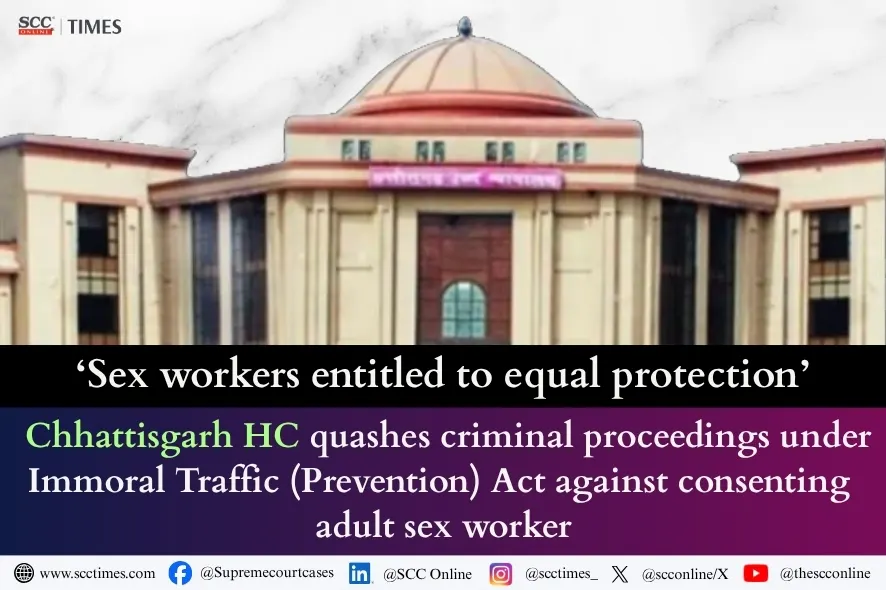
Chhattisgarh High Court: In a petition under Section 482, Criminal Procedure Code, 1973 (CrPC) seeking quashing of FIR and consequential criminal proceedings for offences punishable under Sections 3, 4, 5 and 7, Immoral Traffic (Prevention) Act, 1956 (Immoral Traffic Act), the Division Bench of Ramesh Sinha*, CJ., and Ravindra Kumar Agrawal, J., held that the material placed on record did not disclose any specific allegation demonstrating that the petitioner was engaged in any independent act which would constitute the ingredients of the offences alleged against her, apart from the allegation regarding her status as a sex worker. The Court held that continuation of the criminal proceedings would amount to an abuse of the process of law and quashed the FIR, consequential charge-sheet and criminal proceedings insofar as they related to the petitioner.
Background
The dispute arose from a petition under Section 482 CrPC seeking quashing of an FIR registered at Police Station Telibandha, Raipur and the consequential criminal proceedings for offences punishable under Sections 3, 4, 5 and 7, Immoral Traffic Act. The petitioner submitted that she was neither present nor residing at the hotel at the time of the alleged raid and that she was subsequently called to the police station and falsely implicated in the case.
Though she was arrested and later released on bail, the police subsequently filed the charge-sheet against her and other accused persons.
However, the State opposed the petition and submitted that the FIR was registered pursuant to information received by the police regarding the alleged commission of offences under Sections 3, 4, 5 and 7, Immoral Traffic Act and that, after investigation, the charge-sheet had been filed. It was submitted that the allegations were supported by the material collected during investigation and that the disputed questions regarding the petitioner’s presence at the place of occurrence and the evidentiary value of the material could be adjudicated only during trial. It was therefore submitted that no exceptional circumstance was made out warranting interference at that stage.
Analysis
The Court noted that the petitioner was a major woman who had been charge-sheeted for the offences punishable under Sections 3, 4, 5 and 7, Immoral Traffic Act. The Court further noted that the specific case of the petitioner was that she was neither residing at nor present in the hotel at the time of the alleged raid and that she had been falsely implicated by the police.
The Court referred to the Supreme Court judgment in Budhadev Karmaskar v. State of W.B., (2022) 20 SCC 220, wherein it held that sex workers are entitled to equal protection of the law and that criminal law must apply equally in all cases, on the basis of age and consent. It was further emphasised in the Budhadev Karmaskar, that when it is clear that the sex worker is an adult and is participating with consent, the police must refrain from interfering or taking any criminal action and that whenever there is a raid on any brothel, since voluntary sex work is not illegal and only running the brothel is unlawful, the sex workers concerned should not be arrested or penalised or harassed or victimised.
The Court observed that, while exercising powers under Article
The Supreme Court had further directed that whenever there is a raid on any brothel, since voluntary sex work is not illegal and only running the brothel is unlawful, the sex workers concerned should not be arrested, penalised, harassed or victimised. The Court also noted that the Budhadev Karmaskar judgment continued to be recognised by the Supreme Court, including in its subsequent judgment in Prajwala v. Union of India, 2026 SCC OnLine SC 1053, wherein it was reiterated that voluntary sex workers are not to be harassed or victimised during raids on brothels.
The Court observed that the allegations against the petitioner, even as projected by the prosecution, were essentially that she was a sex worker and was found in connection with the alleged activities at the hotel. The petitioner had specifically disputed her presence at the place of occurrence and had asserted that she was not staying in or present at the hotel at the relevant time.
More importantly, the Court observed that the material placed on record did not disclose any specific allegation demonstrating that the petitioner was engaged in any independent act which would constitute the ingredients of the offences alleged against her, apart from the allegation regarding her status as a sex worker. The Court emphasised that the directions issued by the Supreme Court in Budhadev Karmaskar were required to be kept in view while examining the legality of continuation of criminal proceedings against an adult woman merely on account of her alleged involvement as a sex worker.
The Court also noted that, while considering the prayer for interim relief on 25 July 2023, the Court had already examined the allegations against the petitioner in the light of the Budhadev Karmaskar judgment and recorded a finding that a strong case was made out for staying the further proceedings. Since thereafter no material had been brought on record to demonstrate any substantial change in the factual or legal position so as to warrant a different conclusion, the Court held that the interim order deserved to be given final effect.
The Court further observed that continuation of the criminal proceedings against the petitioner, in the facts of the present case, would serve no useful purpose and would amount to subjecting an adult woman to the very harassment and victimisation against which the Supreme Court had issued specific directions.
The Court, having regard to the totality of the facts and circumstances of the case, the allegations levelled against the petitioner, the material collected during investigation, the fact that the petitioner had specifically disputed her presence at the alleged place of occurrence, and more particularly the binding directions issued by the Supreme Court in Budhadev Karmaskar, was of the considered opinion that continuation of the criminal proceedings against the petitioner would amount to an abuse of the process of law. The Court therefore held that the case of the petitioner warranted interference in exercise of the inherent jurisdiction of the Court.
Decision
The Court accordingly allowed the petition and quashed the FIR for offences punishable under Sections 3, 4, 5 and 7, Immoral Traffic Act, the consequential charge-sheet and the criminal case pending before the Judicial Magistrate First Class, Raipur, insofar as it related to the petitioner, were hereby quashed.
The Court further directed that the interim order dated 25 July 2023 would stand merged with the present final order.
[XYZ v. State of Chhattisgarh, 2026 SCC OnLine Chh 16356, decided on 13-8-2026]
*Judgment authored by: Chief Justice Ramesh Sinha
Advocates who appeared in this case :
For the Petitioner: Raza Ali, Advocate
For the Respondent: Anusha Naik, Dy. Govt. Advocate