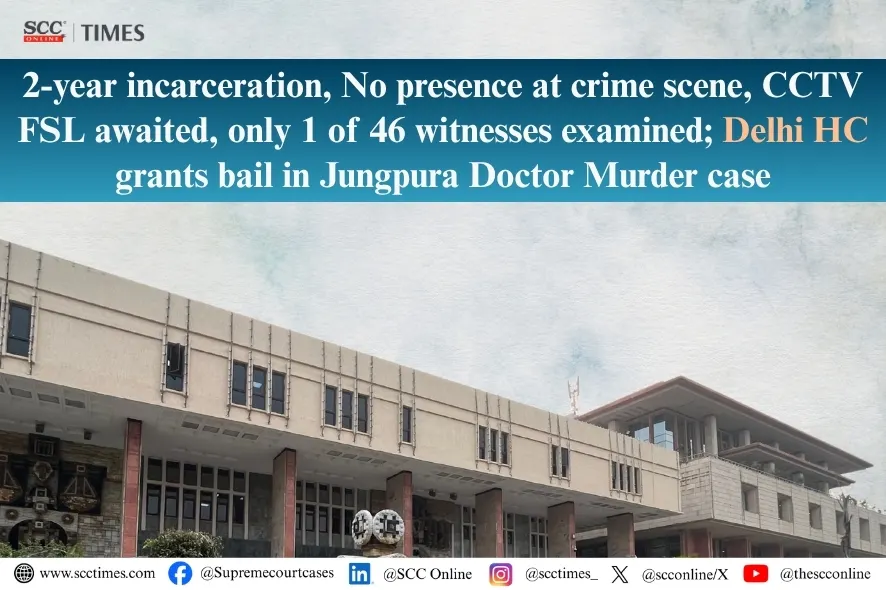
Delhi High Court: In the bail applications filed by the applicants, the accused in chilling murder of Dr Yogesh Chander Paul in Jangpura, the Single Bench of Purushaindra Kumar Kaurav, J., while considering their prolonged incarceration, the stage of the trial, the nature of the evidence and their fundamental right to life and personal liberty under Article 21 of the Constitution, granted them regular bail.
Background
On 10 May 2024, the police received information concerning the death of Dr Yogesh Chander Paul. Upon reaching his residence at C-14, Jangpura Extension, Delhi, the police found him dead in suspicious circumstances. His both hands were tied, and a visible injury was noticed on the back of his head. Jewellery and cash were also allegedly missing from the house.
An FIR was registered and investigation was conducted, culminating in the filing of the charge-sheet. Applicant 1 was implicated for offences under Sections 302, 396, 412, 120-B and 34, Penal Code, 1860 (IPC) and Applicant 2 was implicated under Sections 394, 302, 397, 412, 120-B and 34 IPC.
The prosecution alleged that Applicant 1 had conducted a recce on 5 May 2024 and thereafter remained in contact with the other accused persons. The prosecution relied upon CCTV footage and call detail records (CDRs) to establish his alleged involvement.
Applicant 1’s defence was that he was at Haridwar on the date of the incident, a fact which was also reflected in the prosecution’s own case. It was submitted that there was no recovery from him, that he was not present when the offence occurred, that he had no criminal antecedents and that he had already undergone a substantial period of incarceration.
Further, Applicant 2 had worked as a maid in the deceased’s family for about 25 years. The defence argued that this circumstance by itself could not justify her implication. It was submitted that there was no call detail record showing contact between Applicant 2 and the other accused persons. Her alleged connection was principally with co-accused. She maintained that she was unaware of any criminal intention on the part of the co-accused and had no criminal antecedents.
The State and the complainant’s counsel opposed bail on the ground that the CDRs, CCTV footage and surrounding circumstances established Applicant 1’s complicity. In Applicant 2’s case, it was alleged that co-accused used to visit her and that, at Applicant 2’s instance, information concerning the deceased’s family was passed to the other accused persons. Therefore, the prosecution characterised both applicants as participants in a larger conspiracy.
Analysis
The Court noted that Applicant 1 had undergone approx 2 years and 2 months of incarceration and Applicant 2 had undergone 2 years, 2 months and 17 days. Thus, both applicants have already suffered more than 2 years’ incarceration. Further, neither applicant had criminal antecedents.
The Court asserted that continued incarceration of the applicants had to be balanced against their fundamental right to life and personal liberty guaranteed under Article 21 of the Constitution.
The Court noted that both applicants were admittedly not present at the time of the incident on 10 May 2024. Although Appellant 1 was allegedly visible in CCTV footage dated 5 May 2024, the Forensic Science Laboratory (FSL) report concerning the CCTV footage was still awaited. The Court observed that, at that stage, the CDR analysis and disclosure statements made during investigation constituted the evidence against him. Appellant 2 was not shown to have been present at the time of the incident. The Court specifically noted that there were no CDRs connecting Appellant 2 with the other accused persons. Consequently, the Court treated the prosecution case against both applicants as one founded upon circumstantial evidence.
The Court relied on Sharad Birdhichand Sarda v. State of Maharashtra, (1984) 4 SCC 116, describing it as the locus classicus on appreciation of circumstantial evidence and discussed the 5 principles, or “Panchsheel” conditions, which must be fulfilled before guilt can be established on circumstantial evidence:
-
The circumstances from which the conclusion of guilt is drawn must be fully established.
-
The established facts must be consistent only with the hypothesis of the accused’s guilt and must not be explainable on another hypothesis.
-
The circumstances must be conclusive in nature and tendency.
-
They must exclude every possible hypothesis except the one sought to be proved.
-
There must be a chain of evidence so complete that no reasonable ground remains consistent with the innocence of the accused, and it must show that, in all human probability, the act was committed by the accused.
The Court reiterated that the object of bail is not to inflict punishment by way of pre-trial detention. In Dataram Singh v. State of U.P., (2018) 3 SCC 22, it was noted that the presumption of innocence continues in favour of the accused and that bail is the rule. The Court further relied on Union of India v. K.A. Najeeb, (2021) 3 SCC 713, wherein it was held that an undertrial cannot be subjected to indefinite incarceration pending trial. Where a timely conclusion of the trial is not possible and the accused has already undergone substantial incarceration, Constitutional Courts would ordinarily be required to enlarge the accused on bail.
The Court also noted that the prosecution had cited 46 witnesses, but only 1 prosecution witness had been examined. Therefore, the trial was not likely to conclude in the near future. Importantly, there was no material showing that the applicants themselves were responsible for the delay.
Decision
Having regard to the applicants’ incarceration of more than 2 years; the circumstantial nature of the prosecution case; the fact that neither applicant was present at the time of the incident; the absence of criminal antecedents; the incomplete nature of some of the material relied upon by the prosecution; the very early stage of the trial, with only 1 of 46 prosecution witnesses examined; and the constitutional protection of life and personal liberty under Article 21, the Court held that the applicants were entitled to regular bail.
Accordingly, the Court allowed the applications, and directed that the applicants be released on regular bail, subject to such terms and conditions as the concerned trial court might impose.
[Himanshu Joshi v. State (NCT of Delhi), 2026 SCC OnLine Del 6424, decided on 19-8-2026]
Advocates who appeared in this case:
For the Applicant: Mr Akshay Bhandari, Ms Megha Saroa, Mr Kushal Kumar, Mr Janak Raj Ambavat, Advocates.
For the Respondent: Mr. Shoaib Haider, APP for State with Insp. Pankaj, PS H.N. Din.
For the Complainant: Sambhav Jain and Mr. Pranav Raj Singh, Advocates