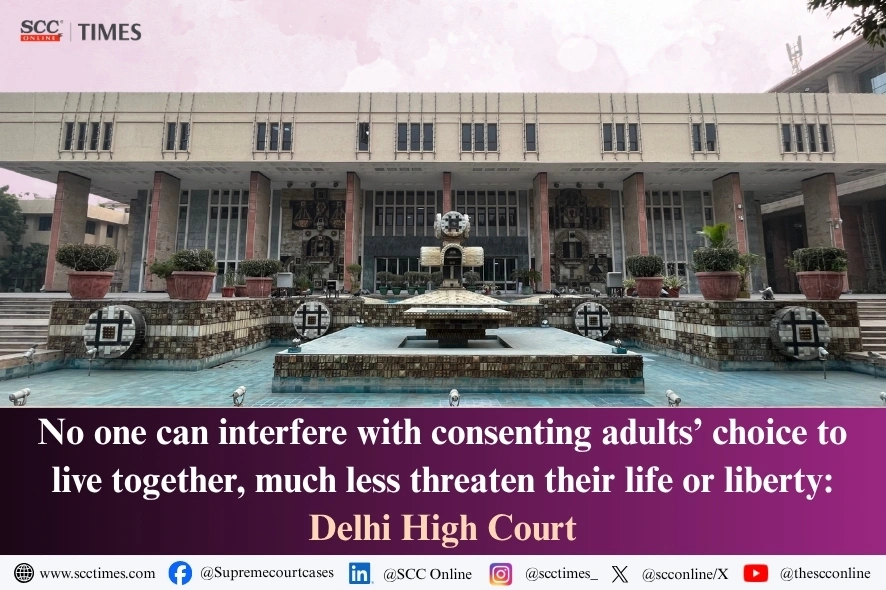
Delhi High Court: In a petition filed under Article 226 of the Constitution of India read with Section 528, Nagarik Suraksha Sanhita, 2023 (BNSS), seeking direction to be issued to Respondent 1 to provide protection to petitioner’s lives and liberty against Respondents 3 and 4, a Single Judge Bench of Saurabh Banerjee, J., reaffirmed that the choice of a partner and the decision to reside together are protected by Articles 19 and 21 of the Constitution, and that “nobody, be it their parents/relatives/ friends, have a right and/ or authority to cause any hinderance and/ or interfere with their choice thereof, much less threaten their life and/ or liberty”. Accordingly, the Court directed the police authorities to provide the petitioners all necessary assistance in accordance with law.
Also Read: Not Married, But Still Protected: Supreme Court Extends Section 498-A IPC to Live-In Relationships
Brief Facts
The petitioners were consenting adults born in 1993 and 1990 respectively. They had known each other since 2014 and had been residing together in a live-in relationship. They intended to marry each other on 1 August 2026.
The petitioners alleged that Respondent 3, the father of Petitioner 1, and Respondent 4, her brother, were unhappy with their relationship and were “constantly threatening the petitioners with violence”. Consequently, the petitioners apprehended grave harm to their lives and liberty.
The petitioners had approached the Station House Officer (SHO) concerned with a complaint on 6 August 2026, alleging a threat to their lives. According to them, no action had been taken on the complaint. Therefore, they approached the High Court contending that their fundamental right under Article 21 was in jeopardy and seeking protection of their lives and liberty.
Issue for Determination
Whether consenting adult partners living together in a live-in relationship are entitled to protection of their life and liberty against threats or interference from family members on account of their choice to live together?
Analysis
The Court noted that both petitioners were consenting adults. It held that they had the right to choose their respective partners and to reside with them in a live-in relationship “as per their individual choice/desire with no interference from anyone”.
The Court relied on Nandakumar v. State of Kerala, (2018) 16 SCC 602, wherein it was observed that, irrespective of whether the parties had entered into a marriage, majors possess an “unfettered right to reside with each other as they desire”, including in a live-in relationship. It was further stated that live-in relationships have received legal recognition, including through the Protection of Women from Domestic Violence Act, 2005.
The Court asserted that although the petitioners were not legally married, they were consenting adults and their relationship was “akin to marriage, though not legally”. The Court emphasised that marriage in India is recognised when it is between two consenting individuals, irrespective of “caste, creed, colour, religion and/or faith”. In this context, the Court held that Articles 19 and 21 guarantee the respective rights of such individuals to freedom, life and liberty. Relying upon Shafin Jahan v. Asokan K.M., (2018) 16 SCC 368, it observed that curtailment of these rights through societal morals and prejudices amounts to “deprivation of one’s very individualistic identity”.
The Court held that once the petitioners had “willingly, consensually and with utmost responsibility” chosen to enter into a live-in relationship, no one — including their parents, relatives or friends — had any right or authority to interfere with that choice, much less threaten their life or liberty.
Decision
The Court allowed the petition and directed that the petitioners could contact either the SHO, Police Station Vijay Vihar, or the Beat Constable concerned whenever the need arose. It directed the police authorities to provide the petitioners “all necessary assistance” in accordance with law.
The Court further directed that if the petitioners subsequently chose to reside within the jurisdiction of another police station, they were required to inform the SHO of that police station and provide the complete details, including their address, within three days of shifting. The SHO concerned and/or Beat Constable would thereafter extend the same protection to them.
[Uma Bharti v. State (NCT of Delhi), 2026 SCC OnLine Del 6423, decided on 13-8-2026]
Advocates who appeared in this case:
For the Petitioners: Mohd. Yusuf and Ms. Sulekha, Advs.
For the Respondents: Mr. Rahul Tyagi, ASC with Ms. Priya Rai, Mr. Shubham Goyal, Mr. Avinash Kumar Singh and Mr. Priyansh Raj Singh, Advs.
SI- Rajesh Kumar, PS: Vijay Vihar