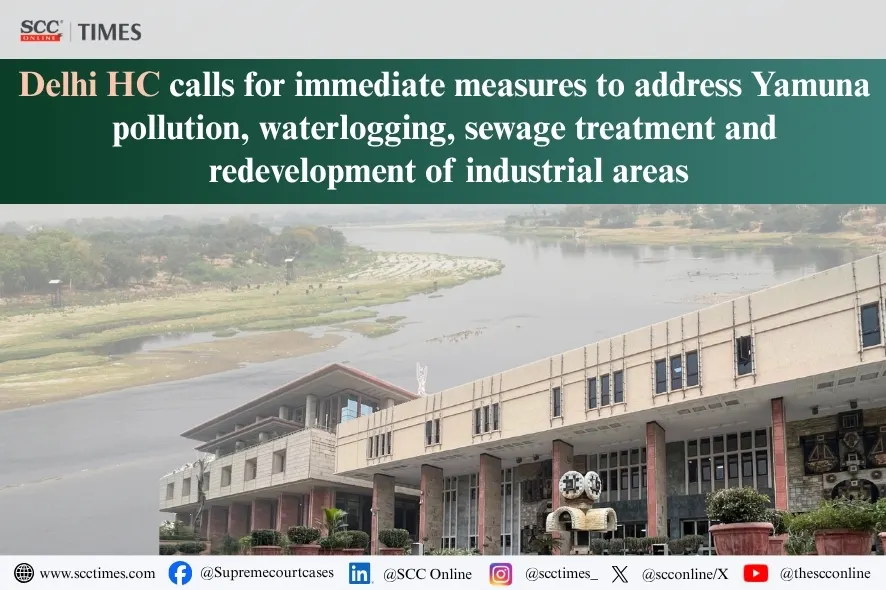
Delhi High Court: In a matter concerning waterlogging, untreated sewage, inadequate drainage infrastructure and pollution of the Yamuna, a Division Bench comprising Prathiba M. Singh* and Manmeet Pritam Singh Arora, JJ., directed multiple authorities to take coordinated and time-bound measures to address deficiencies in drainage, sewage treatment and the redevelopment of non-conforming industrial areas.
The proceedings involved the continuing monitoring of measures concerning the Abul Fazal Drain, Sewage Treatment Plants (STPs), Decentralised Sewage Treatment Plants (DSTPs), and redevelopment of non-conforming industrial areas. The Court considered status reports and submissions from the Municipal Corporation of Delhi (MCD), Delhi Jal Board (DJB), Delhi Development Authority (DDA), Delhi State Industrial and Infrastructure Development Corporation (DSIIDC), Government of NCT of Delhi (GNCTD), Uttar Pradesh Irrigation Department and National Mission for Clean Ganga (NMCG), among others.
Abul Fazal Drain
The Court expressed serious concern regarding the condition of the open Abul Fazal Drain, which runs alongside a road used by vehicles and pedestrians without adequate protection.
Pursuant to its earlier order dated 28 March 2026, the Court had directed the MCD to construct a separator wall between the drain and the road and to install reflectors and lights to make the drain visible to commuters.
The MCD informed the Court that the lights and reflectors had already been installed. However, construction of the separator wall had been delayed as the Uttar Pradesh Irrigation Department had not issued the requisite no-objection certificate (NOC).
Considering the safety risk posed by the unprotected drain, the Court directed the MCD to immediately construct the separator wall and cover the open drain with slabs, wherever required by law, without awaiting any further NOC.
The MCD was also directed to undertake continuous desilting and cleaning of the drain and its surrounding area.
With regard to the proposed extension of the Abul Fazal Drain, the Uttar Pradesh Irrigation Department informed the Court that sanction had been sought from the NMCG and that the Department intended to commence the work by 15 September 2026. The Court directed the NMCG to consider the application and communicate its decision at the earliest.
Upgradation and Expansion of STPs
The Court examined the status reports filed by the DJB regarding sewage treatment infrastructure in Delhi.
It noted that 28 existing STPs, having a combined capacity of 735 MGD, were operational and meeting the NGT-prescribed 10/10 parameters.
A further 9 STPs, with a combined capacity of 78.86 MGD, were under upgradation and were presently operating at the 30/50 standard. Their upgradation to the 10/10 standard was expected to be completed between December 2027 and May 2028.
The Court further noted that:
1. 29 DSTPs in the outer areas of Delhi, with a combined capacity of 170 MGD, were being taken up. Work had been awarded for 28 DSTPs, while 1 was at the tender stage.
2. 13 new DSTPs, having a proposed combined capacity of 328 MGD, were proposed at drain outfalls and catchment areas. Their Detailed Project Reports (DPRs) had been prepared and sent to the NMCG.
3. The DJB was undertaking a gap analysis concerning an additional 132 MGD of sewage treatment capacity.
The DJB informed the Court that the existing STP capacity stood at 814.26 MGD as on 24 August 2026 and that it intended to increase this to 1041.10 MGD by 31 December 2027, apart from the additional capacity proposed through the new DSTPs.
Untreated Sewage and Mixing of Treated Water
The Court noted the concern raised by the Local Commissioners that only part of Delhi’s sewage was being treated, while untreated sewage continued to flow into the Yamuna.
In this regard, the Court directed the Director General, NMCG, to examine the proposal for establishing 13 additional DSTPs having a combined capacity of 328 MGD.
The Court also identified a separate concern: treated water discharged from STPs was, in certain instances, entering drains carrying untreated sewage and consequently becoming mixed with untreated water.
The Court therefore directed that proper drainage arrangements for carrying treated water be accorded top priority for both existing STPs and proposed DSTPs. The DJB was directed to supervise this aspect and file an updated status report.
Redevelopment of Non-Conforming Industrial Areas
The Court considered the redevelopment of 25 non-conforming industrial areas in Delhi.
Plans prepared by various agencies had been submitted to DSIIDC, forwarded to the MCD and thereafter sent to the DDA for consideration of necessary relaxations under the Master Plan. The Court noted that the absence of a response from the DDA had resulted in a stalemate.
The Court emphasised that redevelopment of these areas was essential not only for providing proper infrastructure but also for eliminating waterlogging and preventing untreated sewage from entering the Yamuna.
“The redevelopment of these areas is absolutely essential to ensure that untreated sewage water does not flow into the Yamuna River and waterlogging is eliminated. This fact has to be appreciated by all the authorities.”
The Court directed the Additional Commissioner (Planning), DDA, to hold a meeting with all authorities concerned on 31 August 2026 and establish clear timelines for approval of the plans and consideration of necessary relaxations.
The Court further observed that the authorities should adopt a pragmatic approach, noting that several of these industrial clusters had existed for decades without adequate infrastructure. It held that imposing newly introduced requirements without considering the existing ground realities could make redevelopment impractical.
Samaypur Badli
The Court separately considered the redevelopment of the Samaypur Badli industrial area.
The Rural Area Manufacturers Association submitted that the existing layout plan had been prepared based on a 2001 layout and did not take into account subsequent changes introduced through the Master Plan and related notifications.
The Court directed the DDA, Ministry of Industries, GNCTD, MCD and DSIIDC to consider the relevant documents and demarcate the entire Samaypur Badli area so that a fresh redevelopment plan could be prepared.
A meeting was directed to be held on 2 September 2026 at 11.30 a.m., under the Chairmanship of the Secretary, Ministry of Industries, GNCTD. Thereafter, Square Design, the agency concerned with preparation of the plans, was directed to commence preparation of a fresh redevelopment plan within 3 months.
Phirni Road
The Court also considered the redevelopment of the Phirni Road area, where differences between 2 competing industrial associations had contributed to uncertainty regarding the redevelopment plans.
The Court permitted both associations to submit their comments to DSIIDC by 31 August 2026.
A meeting between the 2 associations, DSIIDC and the agency preparing the redevelopment plans was directed to be held on 26 August 2026 at 11.30 a.m. Following consideration of the comments, the agency concerned was directed to finalise the plans and submit them to the MCD by 30 September 2026.
CETPs and Pollution
The Court noted that issues concerning Common Effluent Treatment Plants (CETPs) and the interplay between water pollution and air pollution remained to be considered. These issues were deferred for consideration at the next hearing.
Directions
The Court directed the authorities concerned to file updated status reports and comply with the timelines stipulated in the order.
The matter has been listed for further hearing on 25 September 2026 at 4.00 p.m.
The Registry was directed to communicate the order to the Director General, NMCG, particularly in relation to the directions concerning the extension of the Abul Fazal Drain and the proposed 13 additional DSTPs.
[Court on Its Own Motion v. Union of India, 2026 SCC OnLine Del 6466, decided on 24-8-2026]
*Order by: Justice Prathiba M. Singh
Advocates who appeared in this case :
For the Petitioners: Zain Haider and Tanvir Ali, Advocates
For the Respondents: Ripudaman Bhardwaj, CGSC, with Kushagra Kansal and Amit Kumar Rana, Advocates,Rajesh Yadav, Senior Advocate, with V.P. Rana, Advocate,Subhash Chhand Budhiraja, Advocate, with Rajender Prasad Jain, Director, MSME,Prabhsahay Kaur, Standing Counsel; Deeksha L. Kakar, Panel Lawyer; Aditya Verma and Sana Parveen, Advocates, with Nakul, DD (Planning), DDA,Pratima N. Lakra, CGSC, with Shailendra Kumar Mishra, Advocate,Biraja Mahapatra and Abhay Singh, Advocates, with Dinesh Jindal, Law Officer, DPCC,Sanjeev Kumar Dubey, Senior Advocate, with Yamini Sharma, Shah Rukh Khan, Meghaa Wadera and Ghanender Singh, Advocates,Varsha Banerjee, Arjun Katyal and Mahipal Singh, Advocates,Deevanshu Sharma, Advocate,S.K. Goyal, Scientist G & Chair, CSIR-NEERI, Delhi Regional Centre,Kapil Midha, Advocate,Tushar Sannu, Rajbala and Payal Rajput, Advocates, V.K. Singh, AE; Manish Rajpa, AE; Astik Jha, AE, DJB; Rajeev Narang, Action Electrical, MCD; Gaurav Kumar, AE, ENM; Deepak Rohila, SC, ENM,Dhruv Rohatgi, Panel Counsel, with Chandrika Sachdeva and Dhruv Kumar, Advocate,Vivek Kumar Tandon,Hitesh Sharma, Plant Manager, Mayapuri CETP,Sudhir Kumar, Treasurer, Mayapuri CETP,Ashok Kumar, Nangloi CETP,Ravi Sood, Badli CETP,Sanjay Vig, Mangol Puri CETP,K.D. Sharma, Jhilmil CETP,R.N. Sharma, Naraina CETP,Suresh Kumar, Okhla CETP,Shashi Pratap Singh, Anamika Tyagi and Laqshyaa Saluja, Advocates, with Sulakshna Kholia, Coordinator